
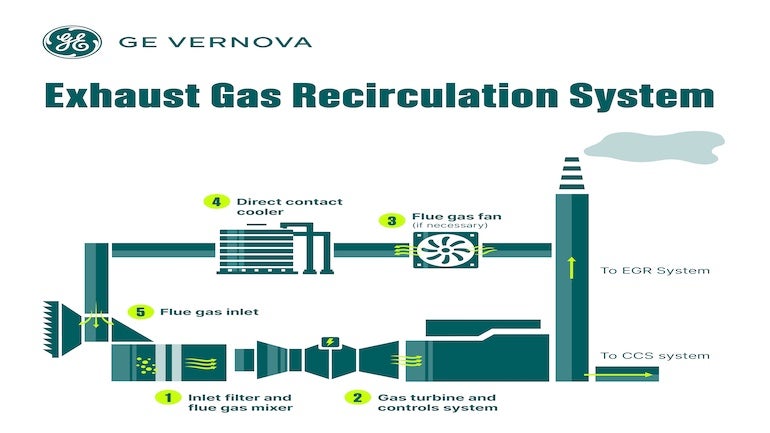
The technology will combine GE Vernova’s exhaust gas recirculation (EGR) system with Toshiba’s carbon capture solution, which utilises Toshiba’s proprietary solvent. This initiative is related to a recently created focus group involving Japan’s Ministry of Economy, Trade and Industry (METI) and GE Vernova.
The collaboration aims to improve the efficiency of CO2 separation and capture by integrating Toshiba’s and GE Vernova’s respective technologies in combined cycle power plants in Japan and elsewhere in Asia, where GE Vernova is supplying or will supply the gas turbines.
Toshiba and GE Vernova say they have jointly conducted comprehensive feasibility studies with utility companies operating combined cycle power plants across Japan. These studies, completed prior to the signing of the MoU, “confirmed the significant potential of the collaboration.”
METI’s Director-General for Energy and Environmental Policy, Shinichi Kihara said: “We welcome this initiative to achieve decarbonisation of power generation by utilising CCUS technology as there is a global urgency to simultaneously achieve stable energy supply, economic growth, and decarbonisation towards the global common goal of achieving net-zero.”
Takehiko Matsushita, Vice President of Toshiba’s Power Systems Division, said: “While thermal power plants offer a constant supply of electricity and are a primary power source, a growing global commitment to environmental sustainability has made cutting CO2 emissions from these facilities a crucial and immediate goal. We are delighted to sign this MoU, which will help us to contribute to the achievement of carbon neutrality while driving further business growth. Through our collaboration with GE Vernova, we aim to advance EGR and CO2 capture systems in Japan and other parts of Asia.”
Jeremee Wetherby, Carbon Solutions Leader at GE Vernova, said: “We are pleased to explore the benefits from our steam integration, exhaust gas recirculation system, and high gas turbine backpressure solutions with Toshiba’s extensive expertise in engineering and constructing of steam cycle systems. These steam systems are critical to the performance of GTCC power plants and will be important design considerations to maximise the performance of the capture systems, as well as reducing the decline in power output that occurs when CO2 capture systems are integrated.”
Toshiba’s capture system uses a plant’s own heat source to raise the temperature of the CO2 capture solvent, an approach that eliminates the need for additional boilers to generate steam, and that optimises and streamlines the system. “Comprehensive expertise” allows Toshiba to do this while minimising any decline in the plant’s net power output, the company asserts.
Integrating GTCC and CCS plants reduces capital costs and improves operational flexibility. GEVernova solutions — such as steam integration, exhaust gas recirculation, and high gas turbine backpressure — lower costs and “expand operational options”, the company says. For example, GE Vernova’s EGR system recirculates exhaust gases into the turbine inlet and alters exhaust gas composition, allowing the carbon capture absorber tower to be smaller, enhancing performance, reducing operating costs, and increasing carbon dioxide capture rates.
Meanwhile, GE Vernova and YTL PowerSeraya (YTLPS) are collaborating on a feasibility study aimed at lowering carbon dioxide emissions from YTL PowerSeraya’s H-class combined cycle power plant on Jurong Island, Singapore. The project is one of five feasibility exercises currently underway focused on applying CCS to CCGT to have received government funding via Singapore’s Energy Market Authority, the recipients being Keppel and PacificLight Power, as well as YTL. Results of the studies are expected in early 2026.
Generating companies YTL and Keppel are working on two projects each, one post combustion, the other pre combustion, while the PacificLight project is also post combustion.
The GE Vernova/YTL PowerSeraya study is focused on retrofitting an H-Class CCGT with post combustion technology capable of capturing at least 90% of the plant’s carbon dioxide emissions. GE Vernova says it is focusing the study on the seamless integration of the H-Class CCGT plant with post-combustion carbon capture technology. The scope will include: exhaust gas recirculation; steam integration; and controls integration.
In comparison to traditional bolt-on post-combustion carbon capture concepts, the proposed GE Vernova advanced system integration with EGR technology allows a gas power plant with post-combustion carbon capture to operate more efficiently and cost-effectively, reducing overall plant size and overall CAPEX and OPEX, whilst also boosting overall integrated plant performance.
“GE Vernova’s first-of-its-kind carbon capture assessment in Singapore proposes significant enhancements aimed at improving the proposed carbon capture process and reducing its impact on the power plants’ output, performance, and costs,” said Ramesh Singaram, President & CEO of GE Vernova’s Gas Power business in Asia Pacific region. GE Vernova technology is also being employed in the Net Zero Teesside project in the UK, expected, when it enters operation, to be the world’s first combined cycle power plant integrated with carbon capture plant at commercial scale.


