

The new report, published 3 October, “ahead of the legal deadline”, presents a detailed account of system conditions on 28 April leading up to the blackout, the sequence of events, and the restoration process. It supersedes an earlier report from the expert panel.
At 262 pages, the new document is described as the first major report of the expert panel and has been produced in line with EU regulations. But it is by no means the last word; its authors say it does not include analysis, consideration of root causes or suggestions as to how such blackouts might be avoided.
Work is already underway on preparation of the expert panel’s final report, which is expected to be released in Q1 2026. This will include a detailed root cause analysis and recommendations as to how to prevent similar events happening in the future.
The expert panel comments that in Portugal and France it has proved possible to collect the necessary data and transfer it in a timely manner to the panel, whereas in Spain significant difficulties arose in obtaining high quality data from “several DSOs and generating companies” and at the time of writing the report some of the information required from Spanish entities was still missing.
The expert panel notes that the morning hours of 28 April 2025 were characterised by increasing renewables generation, leading to decreasing prices on the day-ahead market and increasing exports from Spain, up to 5 GW in total. It was described as a typical spring day in south west Spain, with renewable infeed following usual patterns (as it had done on preceding days), with a high concentration of renewables in the south west of the country as of noon.
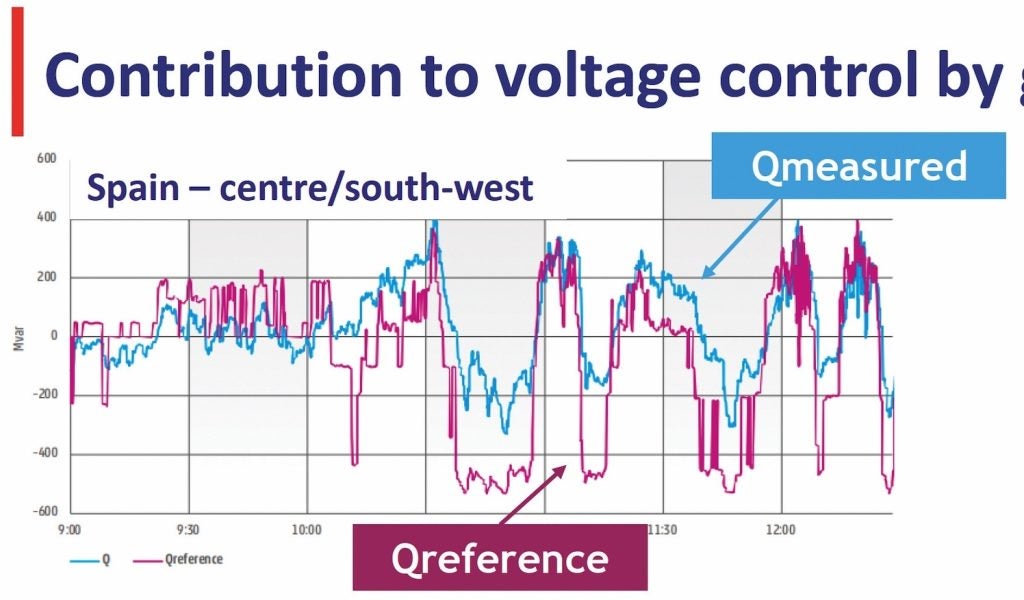
Example of difference between reactive power provided (Qmeasured)
and requested (Qreference) (central/south west Spain). (Source: ENTSO-E)
From around 09:00, the variability of the voltage in Spain started increasing, albeit without significant variations until shortly after 10:30, when the voltage in a part of the 400 kV transmission network briefly approached – but did not exceed – 435 kV.
Voltages in the 400 kV network remained below 435 kV during the period before the incident. No significant oscillations were detected until 12:03.
During the half hour preceding the blackout, two main periods of oscillations – power, voltage, and frequency swings – were observed in the Continental Europe Synchronous Area (CE SA), the first of which took place from 12:03 to 12:08. Analysis indicates that this oscillation had a local character primarily affecting Spanish and Portuguese power systems with a dominant frequency of 0.63 Hz. The second oscillation occurred between 12:19 and 12:22 as an inter-area oscillation, with a dominant frequency of 0.21 Hz, corresponding to the East-Centre-West continental mode. In order to damp these oscillations, the operators in the control rooms of the relevant TSOs took several mitigating measures, such as reducing the export from Spain to France, coupling of internal power lines in the South of Spain, and changing the operation mode of the HVDC link between France and Spain. While these measures mitigated the oscillations, they also led to an increase of voltage in the Iberian power system, the expert panel says.
At 12:32:00 – the starting point of the incident for the purposes of the expert panel report – the voltage of the 400 kV Iberian power grid was below 420 kV and no notable oscillations were being observed.
Several significant generation trips occurred from 12:32:00 onwards, the expert panel report says. Between 12:32:00.000 and 12:32:57.000, there was a loss of 208 MW identified as distributed wind and solar generators in northern and southern Spain, as well as an increase in net load in the distribution grids of approximately 317 MW, which might have been due to the disconnection of small embedded generators < 1 MW (mainly rooftop PV) or to an actual increase in load or to a combination of both. The reasons for these events are not known, the expert panel remarks.
From 12:32:57.000 until 12:33:18.020, major disconnection events occurred in the regions of Granada, Badajoz, Sevilla, Segovia, Huelva, and Cáceres, which resulted in an additional loss of generation of at least 2 GW (analysis of frequency deviation suggests a loss of some 2.2 GW).
This phase of major disconnection events started some milliseconds after 12:32:57 with the tripping of a generation transformer in the region of Granada due to the activation of over-voltage protection in the 220 kV side of a 400/220 kV transformer, which connects several generation facilities (photovoltaic, wind and concentrating solar power (CSP)) to the transmission grid. The transformer was injecting 355 MW into the grid and the voltage on the 400 kV grid was 417.9 kV at this time.
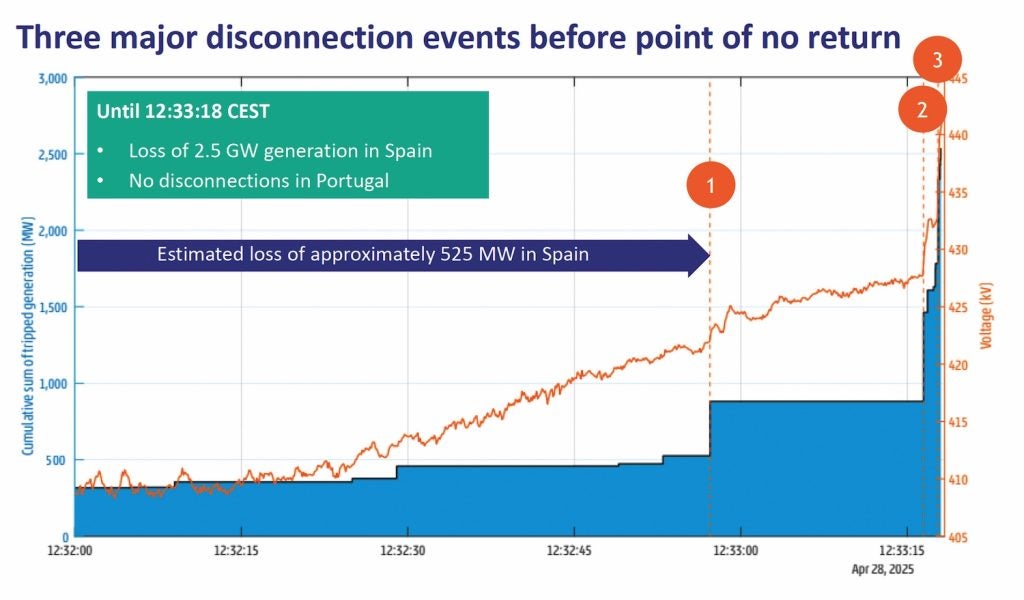
1: Milliseconds after 12:32:57 CEST, tripping of a generation transformer in the region of Granada, due to the activation of overvoltage protection. The transformer was injecting 355 MW into the grid at this time and voltage was 417.9 kV on the 400 kV transmission side. 2: Trips of PV and CSP facilities connected to two 400 kV transmission substations, in Badajoz, with a total interrupted injection of around 725 MW. 3: Several trips between 12:33:17 CEST and 12:33:18 CEST, which led to disconnection of wind and solar generation in Segovia, Huelva, Badajoz, Sevilla and Caceres, amounting to a total of around 930 MW (or more than 1100 MW on the basis of observed frequency variation). (Source: ENTSO-E)
The next event consisted of two sets of trips, resulting in an additional loss of around 725 MW of PV and CSP facilities connected to two 400 kV transmission substations in the area of Badajoz. In the first substation, an evacuation line tripped at 12:33:16.460. The voltage in the 400 kV grid at the time of this trip was 435.4 kV but this value, due to the way PMUs calculate and timestamp phasors, could already be influenced by the generation loss, the expert panel observes. In the second substation, the trip occurred at 12:33:16.820. The reasons for these two trips are not known.
After that, several trips occurred between 12:33:17 and 12:33:18.020, with disconnection of wind and solar generation in Segovia, Huelva, Badajoz, Sevilla and Caceres totalling around 930 MW (or perhaps more than 1100 MW, as suggested by frequency variation). Some of these trips occurred due to over-voltage protection, but the cause of most of these trips is not known, the expert panel says.
The voltage increased up to a level beyond 435 kV during this sequence of generation trips in Spain, amounting to more than 2.5 GW in total as of 12:33:18.020.
No generation trips were observed in Portugal and France within the 12:32:00 – 12:33:18 timeframe.
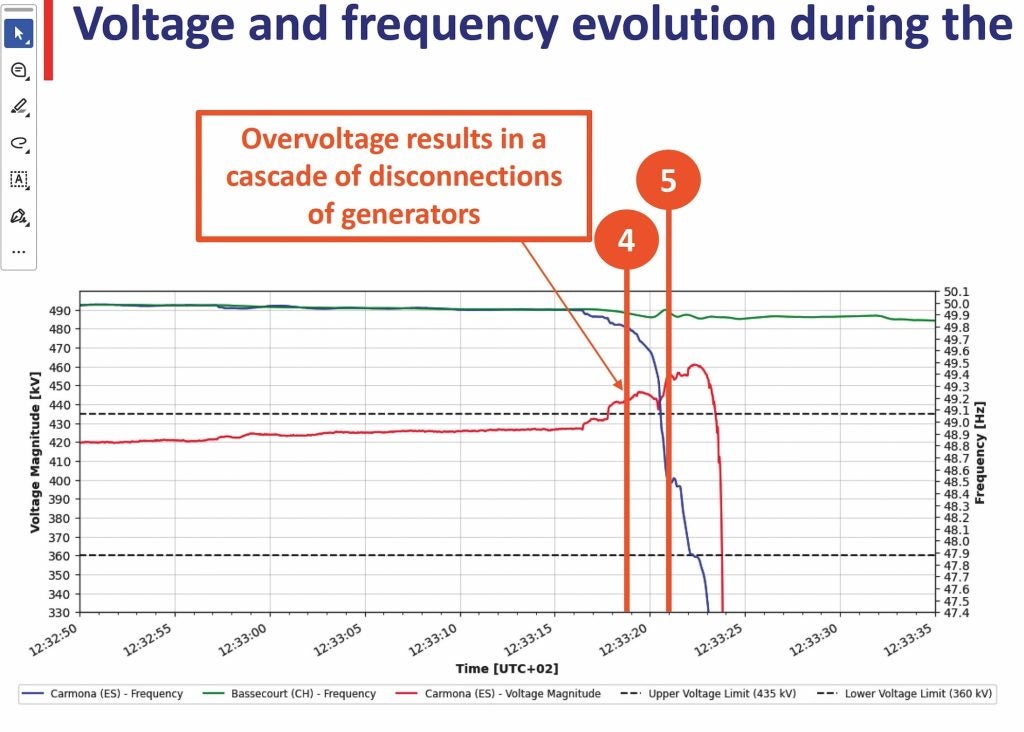
As some generation units were consuming reactive power with the effect of reducing the voltage, the disconnections of these units without adequate compensation of loss of reactive power by other resources in the system with the capability to inject/absorb reactive power meant that voltages in the system increased, not only in Spain but also in Portugal, the expert panel says, and the frequency decreased.
Between 12:33:18 and 12:33:21, voltage in the south of Spain sharply increased, and consequently also in Portugal. The over-voltage triggered a cascade of generation losses that caused the frequency of the Spanish and Portuguese power system to decline.
It is the first time that a cascading series of disconnections of generation components along with voltage increases has been part of the sequence of events leading to a blackout in the Continental Europe Synchronous Area.
At 12:33:19, the power systems of Spain and Portugal started losing synchronism with the rest of the European system.
Between 12:33:19 and 12:33:22, the automatic load shedding and system defence plans of Spain and Portugal – implemented in accordance with Commission Regulation 2017/2196 of 24 November 2017 establishing a network code on electricity emergency and restoration (NC ER) – were activated but unable to prevent the collapse of the Iberian power system.
At 12:33:20.473, the AC interconnection to Morocco tripped due to underfrequency. At 12:33:21.535, the AC overhead lines between France and Spain were disconnected by protection devices against a loss of synchronism. After this AC separation of the Iberian Peninsula, the power imbalance continued to increase, causing the frequency to further decline.
Finally, at 12:33:23.960, the electrical separation of the Iberian system was completed by the tripping of the HVDC lines that transmitted power from Spain to France and all system parameters of the Spanish and Portuguese electricity systems collapsed.
In comparison to the blackout in Spain and Portugal, France was only marginally affected by the incident. Besides a loss of approximately 7 MW of load, one nuclear power plant tripped due to the incident.
Among aspects of the blackout needing further investigation, the expert panel mentions the following: voltage management instruments available; assessment of grid users’ behaviour with respect to voltage control and disconnections; performance of the system defence plan and scope for improvement; and analysis of the local oscillations.


