Some of the IEA’s key findings:
Global hydrogen demand increased to almost 100 million tonnes in 2024, up 2% from 2023 and in line with overall energy demand growth. This rise was driven by greater use in sectors that have traditionally consumed hydrogen, like oil refining and industry. Demand from new applications accounted for less than 1% of the total and was almost entirely concentrated in biofuels production. The supply of hydrogen continued to be dominated by fossil fuels, using 290 billion cubic metres of natural gas and 90 million tonnes of coal equivalent in 2024. Low-emissions hydrogen production grew by 10% in 2024 and is on track to reach 1 Mt in 2025, but it still accounts for less than 1% of global production.
While the uptake of low-emissions hydrogen is not yet meeting the ambitions set in recent years – held back by high costs, uncertain demand and regulatory environments, and slow infrastructure development – there are still notable signs of growth. A recent wave of project delays and cancellations has reduced expectations for the deployment of low-emissions hydrogen this decade. However, in the early stages of adopting new technologies, there are often moments of strong progress as well as periods of sluggish development, and several indicators suggest that the sector continues to mature. For example, although final investment decisions (FIDs) continue to trail well behind announcements, more than 200 low-emissions hydrogen production projects have achieved positive FIDs since 2020, when there was only a handful of demonstration facilities in operation. Innovation is also moving at an impressive pace, with a record number of technologies across the hydrogen value chain showing significant progress over the past year.

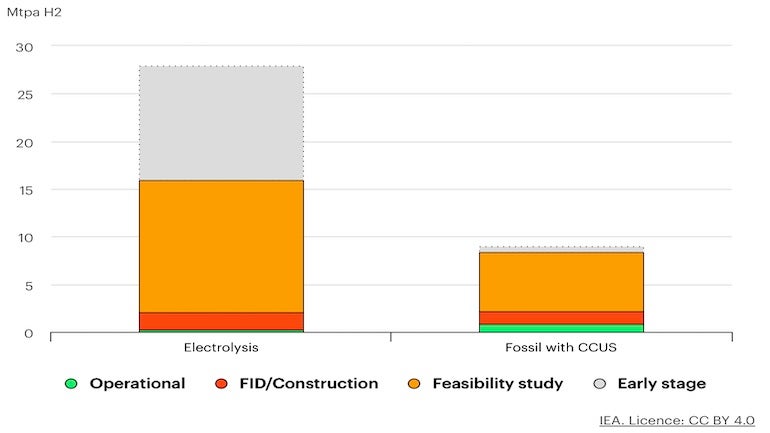
The pipeline of low-emissions production projects has shrunk, but a strong expansion by 2030 is still in sight. For the first time, potential low-emissions hydrogen production by 2030 based on announced projects has declined. Cancellations and delays mean that production that could be achieved by 2030 based on industry announcements now stands at 37 million tonnes per year, compared with 49 Mtpa when the 2024 IEA review was published a year ago. Potential production fell for both projects using electrolysis and those using fossil fuels with carbon capture utilisation and storage, although electrolysis projects were responsible for more than 80% of the total drop. These delays and cancellations included early-stage projects across Africa, the Americas, Europe and Australia. At the same time, the number of projects that have received a final investment decision grew by almost 20% since publication of the 2024 review and now represent 9% of the total project pipeline to 2030.
Despite the recalibration of industry plans, low-emissions hydrogen production is expected to grow strongly by 2030. Low-emissions hydrogen production from projects that are today operational or have reached FID is set to reach 4.2 Mtpa by 2030, a fivefold increase compared with 2024 production. While this is much lower than government and industry ambitions at the start of this decade, it represents growth from less than 1% of total hydrogen production today to around 4% in 2030. This low-emissions hydrogen growth to 2030 would resemble the fast expansions of other clean energy technologies seen in recent years, such as solar PV. Moreover, a new, comprehensive assessment of the prospects for announced projects for this year’s Review finds that an additional 6 Mt of low-emissions hydrogen production projects has strong potential to be operational by 2030 if effective policies to create demand and facilitate offtake are implemented.
The cost gap between low-emissions hydrogen and unabated-fossil-based production remains a key barrier for project development, but it is expected to narrow. The sharp decline in natural gas prices from levels observed in 2022-23 – and the increase in the cost of electrolysers due to inflation and slower-than-expected deployment of the technology – has led to a larger cost gap relative to production from unabated fossil fuels, meaning that support schemes remain necessary for longer. However, the gap is expected to narrow by 2030. Renewable hydrogen in China could become cost-competitive by the end of this decade due to low technology costs and cost of capital. In Europe, the gap is also set to shrink due to carbon dioxide prices and in areas with high renewable potential, and because natural gas prices for industrial users in the region are set to be more elevated than elsewhere. In regions where natural gas is cheaper, such as the United States and Middle East, the cost gap is set to remain larger, and CCUS is likely to be more competitive for producing low-emissions hydrogen in the near term.
China is the driving force in electrolyser deployment and manufacturing today, but overseas sales face barriers. Global installed capacity of water electrolysis reached 2 GW in 2024, and more than 1 GW of capacity had been added on top of that by July 2025. China now accounts for 65% of global installed capacity and capacity that has reached a final investment decision. China is also home to nearly 60% of global electrolyser manufacturing capacity.
Electrolyser manufacturers outside China face headwinds, raising concerns about the health of the industry. Strong momentum in the Chinese market contrasts with prospects for manufacturers elsewhere, which are experiencing sharp reductions in revenue and increased financial losses. For some, this has led to bankruptcies or acquisitions in what may signal a coming wave of consolidation. In China, the industry is not immune to such developments; its existing manufacturing capacity of 20 GW per year is significantly above current demand, which was around 2 GW in 2024. This may also lead to consolidation in due course.
Outside China, the cost of installing Chinese electrolysers is not significantly lower than installing those made by other producers when all factors are taken into account. The cost of making and installing an electrolyser outside China in 2024 was USD 2000 to USD 2600 per kW, compared with USD 600 to 1200 per kW for electrolysers manufactured and installed in China. However, the cost of equipment is just part of the total investment needed to install an electrolyser. More than half of the total corresponds to engineering, procurement, construction and contingency costs, which depend on the project location. When transport costs and tariffs are also considered, the cost of installing a Chinese electrolyser outside China is USD 1500 to USD 2400 per kW – narrowing the gap with non-Chinese competitors.
Barriers preventing the use of Chinese electrolysers outside China remain, but this may change soon. While installing electrolysers made in China can reduce upfront investment, they face efficiency and underperformance issues and need to be adapted to local standards. This can drive up operational costs, which can in turn make the overall production of hydrogen more expensive and diminish any investment cost advantages. This is currently limiting the global uptake of Chinese electrolysers, along with uncertainties related to maintenance and repairs over the lifetime of the plant. However, Chinese manufacturers are now addressing many of these barriers through innovation and exploring the expansion of manufacturing operations overseas.
Momentum for hydrogen offtake agreements slowed in 2024, with new deals concentrated in refining, chemicals and shipping. New offtake agreements signed in 2024 reached 1.7 Mtpa, compared with 2.4 Mtpa in 2023. However, some preliminary agreements signed in previous years were firmed, leading to investment in production projects. Existing uses of hydrogen in the refining and chemical sectors – and the use of hydrogen-based fuels in shipping and, to a smaller extent, aviation and power generation – account for almost all firm offtake agreements announced by the private sector to date and 80% of investment in committed production projects.
Policies to create demand are now being implemented, but at a slow pace. Europe leads the way on the adoption of sectoral quotas for hydrogen use in transport and industry, as set out in the EU Renewable Energy Directive (RED) and mandates for the aviation sector. India (with a focus on refining and fertilisers) and Japan and Korea (with a focus on power generation) have also started ambitious programmes.
Analysis of existing infrastructure and its proximity to low-emissions hydrogen production reveals early opportunities. Nearly 80 ports have well-developed expertise in managing chemical products, indicating a strong readiness to also handle hydrogen-based fuels. These ports, which are widely distributed across the globe, include some of the largest in the world, such as Rotterdam, Singapore and Ain Sokhna (Egypt). More than 30 of these ports could each access at least 100 ktpa of low-emissions hydrogen supply from announced projects within 400 km.
The pipeline for low-emissions hydrogen production in Southeast Asia shows considerable promise but needs to mature. Based on announced projects, low-emissions hydrogen production could reach 480 ktpa by 2030, highly concentrated in Indonesia and Malaysia. However, only 6% of announced production has reached a final investment decision, and 60% remains at very early stages of development. One notable exception is a 240 MW electrolyser project under construction in Viet Nam – one of few projects at this scale outside China to reach FID. Around 40% of the projects are geared for exports – mostly of ammonia, which is the target product of the large majority of the pipeline.
Existing industrial applications and shipping provide key opportunities for early adoption. The greatest opportunities to adopt low-emissions hydrogen in southeast Asia include ammonia production in Indonesia, Malaysia and Viet Nam and methanol production in Malaysia, to improve trade balances by reducing imports of natural gas and natural gas-based products; steel production in Indonesia and Viet Nam to meet growing regional demand; and maritime bunkering in Singapore to supply emerging demands in international shipping. The geographical concentration of existing applications, particularly in countries with large state-owned enterprises, provides a strong foundation for scaling up the sector. Near-term success will depend on accelerating the deployment of renewables to reduce production costs, implementing targeted policies for fuel-switching, and developing pilot projects that enable gradual progress towards commercialisation.