
The Openiano Gas Turbine (OGT) represents a fundamentally new approach to gas turbine design — one aimed at addressing the most persistent inefficiencies, emissions challenges, and supply-chain constraints facing the power generation sector today. Rather than incrementally refining legacy architectures, the Openiano Gas Turbine rethinks compression, combustion, energy storage and conversion into mechanical power.
The result is a gas turbine system capable of achieving up to 80% greater fuel efficiency, while simultaneously reducing emissions, simplifying materials requirements, and improving durability. The architecture is designed not only for high efficiency but also for manufacturability, scalability, and long-term operational resilience.
Eliminating the largest source of gas turbine efficiency loss
In conventional gas turbines, the integral compressor represents the single largest source of inefficiency. Typically, 50–70% of a turbine’s own power output is consumed internally to compress incoming air before combustion.
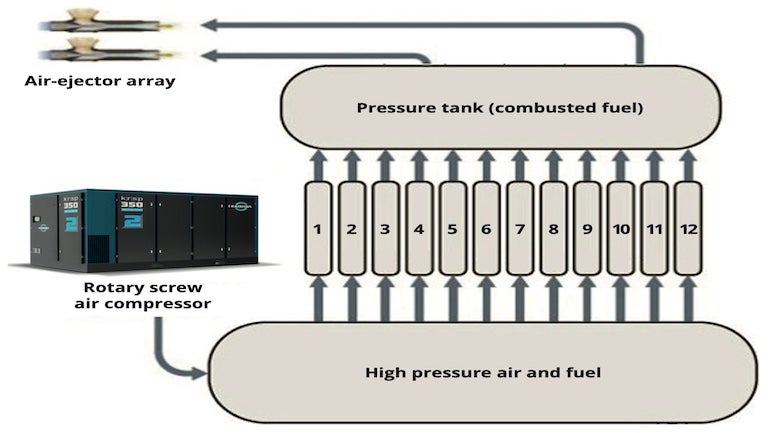
To illustrate the magnitude of this loss, consider a nominal 200 MW gas turbine. In theory, such a machine produces enough power to provide approximately 300–340 MW of generating capacity. However, 100–140 MW is immediately diverted to drive the compressor, leaving only a fraction available for external power generation. The OGT architecture eliminates this fundamental inefficiency by decoupling compression from the turbine core. Instead of an integral compressor, for a 200 MW OGT, compressed air is supplied by a commercial, industrial-grade, two-stage rotary screw compressor — for example, the 300 HP Kaishan KRSP2-300 shown in Figure 1 (or equivalent) — with a total electrical consumption of only ~220 kW.
Let that sink in:
- Conventional gas turbine compressor load: 100–140 MW
- OGT compressor power consumption: ~0.22 MW
The energy savings are not marginal—they are orders of magnitude. This architectural shift alone delivers a substantial portion of the OGT’s fuel-efficiency gains and fundamentally alters the energy balance of the gas-turbine system.
The major advantages of non-integral components
The Openiano Gas Turbine is deliberately engineered with non-integral, modular components — including an industrial-grade rotary screw compressor (as already mentioned), discrete combustion chambers, and a standalone turbine section. This architecture delivers exceptional robustness while dramatically simplifying servicing, maintenance, and long-term lifecycle management.
Unlike conventional gas turbines, where critical components are fully integrated and failures often require the replacement or factory return of the entire turbine, the OGT’s modular design allows individual components to be serviced, repaired, or replaced independently. What would constitute a major — and costly — outage for a traditional turbine is, in many cases, a straightforward and localised repair for the OGT.
The result is higher operational availability, reduced downtime, lower maintenance costs, and a fundamentally more resilient power generation system — engineered for real world reliability and rapid recovery.
Impulse turbine architecture using Pelton blades
Traditional gas turbines rely on airfoil-shaped blades that extract energy from expanding, high-temperature combustion gases. While this approach has been refined over decades, practical maximum efficiencies typically remain below 70%, with a significant share of input energy lost as waste heat. The OGT replaces this paradigm with an impulse-based turbine architecture using Pelton-style blades, long proven in high-efficiency hydropower applications. Pelton blades convert kinetic energy through direct impulse, rather than relying on pressure drop and thermal expansion.
Under appropriate operating conditions, Pelton-style impulse turbines can achieve efficiencies approaching 90%, enabling a far higher proportion of input energy to be converted into mechanical torque. By shifting from thermal expansion to impulse-driven energy transfer, the OGT substantially improves mechanical conversion efficiency while reducing thermal stress throughout the turbine.
Ultra-high-velocity water-jet energy conversion
At the core of the OGT turbine system is a novel air-ejector array that enables ultra-high-velocity water-jet energy conversion.
Each air-ejector operates by:
- using high-pressure combusted gas as the motive force;
- injecting high-pressure water from a dedicated reservoir;
- producing an ultra-high-velocity water jet at the outlet.
These water jets are precisely directed onto corresponding Pelton blades. Compared with directing hot gases alone onto airfoil blades, the OGT approach enables many-fold greater impulsive energy transfer. Energy that would otherwise be lost as exhaust heat is instead converted into usable mechanical power.
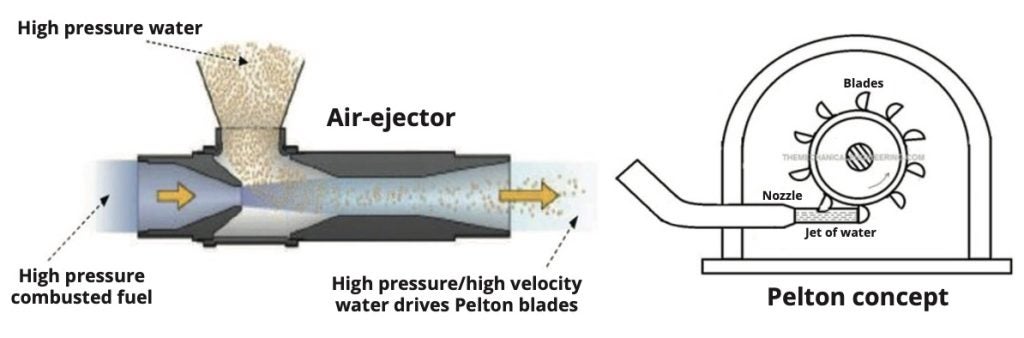
The result is a turbine system that extracts significantly more work from each
unit of fuel while operating at far lower component temperatures.
Inherent cooling and material simplicity
A frequently overlooked advantage of the OGT architecture is inherent thermal management. Because the turbine blades are driven by water jets, they are continuously cooled during operation. This eliminates the extreme turbine inlet temperatures — often exceeding 1400°C — that define conventional gas turbines.
As a result:
- OGT turbine blades do not require exotic, rare-earth-based superalloys;
- readily available industrial-grade alloys can be used;
- dependence on foreign-sourced critical materials is reduced or eliminated;
- blade life, durability, and maintenance intervals are significantly improved.
This material simplicity not only reduces cost but also enhances supply-chain resilience—an increasingly important consideration for utilities and governments alike.
Revolutionising gas turbine combustion
At the heart of the Openiano Gas Turbine lies the groundbreaking Openiano Combustion System, enabling unmatched performance and efficiency.
Thanks to this innovation, the OGT delivers up to 80% fuel savings, at least 50% reduction in carbon dioxide emissions, NOx levels below 2 ppm, and very low carbon monoxide output.
Unlike conventional gas turbines that rely on continuous and spontaneous combustion, the OCS employs a sequential combustion system across 12 combustion chambers. Air and fuel are injected and ignited 1.5 seconds apart in a controlled continuous cycle – resulting in significantly improved combustion efficiency.
Rather than using the traditional Brayton cycle to directly power the turbines, the Openiano Combustion System first channels the combusted air–fuel into a high-pressure storage tank. This intermediate step dramatically enhances fuel economy and reduces harmful emissions.
By maintaining combustion chamber temperatures at below 600°C, the OCS minimises NOx emissions and eliminates the need for exotic, heat-resistant metals in turbine blades. This low-temperature operation also makes the OGT uniquely suited to hybrid transportation, freight and shipping applications.
The Openiano Gas Turbine introduces an unprecedented 18-second combustion cycle, made possible by the proprietary Openiano Combustion System (OCS). Unlike conventional turbines, the OCS features 12 combustion chambers that ignite sequentially 1.5 seconds apart, creating a continuous and highly controlled cycle (12 x 1.5 seconds = 18 seconds).
Each combustion cycle is divided into three distinct 6-second phases:
Phase 1 – Intake (0-6 seconds): high pressure air and fuel are precisely admitted into the combustion chambers.
Phase 2 – Combustion (6-12 seconds): The air–fuel mixture is ignited, and the resulting high energy gases are directed into a pressure tank for optimised energy storage.
Phase 3 – Remnant recirculation (12-18 seconds): Residual combustion gases are purged from the combustion chambers and redirected to the secondary intake port of the main compressor. These remnants are mixed with fresh ambient air to prepare for the next intake phase.
This deliberate 18-second cycle ensures more complete combustion, significantly reducing carbon monoxide emissions and improving overall efficiency. By giving each chamber ample time for full combustion and gas evacuation/recycling, the OGT sets a new standard for clean and efficient gas turbine operation.
The benefits go beyond emissions and efficiency. Lesser combustion temperatures mean greater durability, longer intervals between overhauls, and easier maintenance. Frequent startups and shutdowns have no degrading effect on components, making the OGT ideal for a modern, flexible energy system – in tandem with battery energy storage systems.
Low temperatures, more complete combustion, improved performance
By design, the Openiano Combustion System maintains combustion temperatures below 600 °C — a stark contrast to traditional gas turbines. This low-temperature operation:
- minimises NOx formation;
- produces NOx levels below 2 ppm;
- results in as much as 50% less CO2 emissions;
- achieves very low CO emissions; and
- eliminates the need for heat-resistant exotic metals for turbine blades.
The combination of low emissions, high durability, and fuel flexibility positions the Openiano Gas Turbine for a wide range of applications, including stationary power generation, hybrid transportation, maritime propulsion, and freight systems, where efficiency, reliability, and lifecycle cost are critical.
A transformational impact on global climate change
The stakes could not be higher. If OGT technology were deployed to replace existing gas turbines worldwide — representing approximately 2.5 TW of installed capacity — the release of over 1 billion metric tons of CO2 could be prevented every year. That impact is comparable to eliminating all fossil-fuel-powered vehicles in the United States and Europe combined. This is not a marginal improvement. It is the kind of quantum leap required to keep global warming within the critical 1.5°C threshold.
Searching for strategic partners
As the Openiano Gas Turbine advances towards commercialisation following successful validation milestones, the next phase of development will require collaboration with experienced industry partners. Orentrix Inc is actively seeking strategic partners — including industrial firms, power generation visionaries, gas turbine OEMs, power generation integrators, and infrastructure developers — with the technical capability, manufacturing capacity, and commercialisation expertise necessary to bring the OGT from validated prototype to global deployment.
Importantly, the Openiano Gas Turbine is protected by a strong and expanding intellectual property position. The US patent has been formally allowed, with publication dated 23 October 2025. In addition, worldwide protection under the WIPO Patent Cooperation Treaty (PCT) has been filed across major industrial markets and is currently pending, with issuance anticipated in due course. This robust proprietary foundation secures the core architecture, combustion methodology, and system integration framework of the Openiano Gas Turbine, ensuring that strategic collaborators engage with a defensible and exclusive technology platform.
Such partnerships may include joint development programmes, licensing arrangements, co-manufacturing structures, or deployment-focused validation initiatives. The objective is to accelerate commercialisation while industrialising the technology to the highest standards of performance, reliability, and safety — under a framework that preserves intellectual property integrity and long-term value creation for partners. Organisations interested in exploring strategic partnerships, technical collaboration, or commercialisation pathways are invited to engage in further discussion.


