
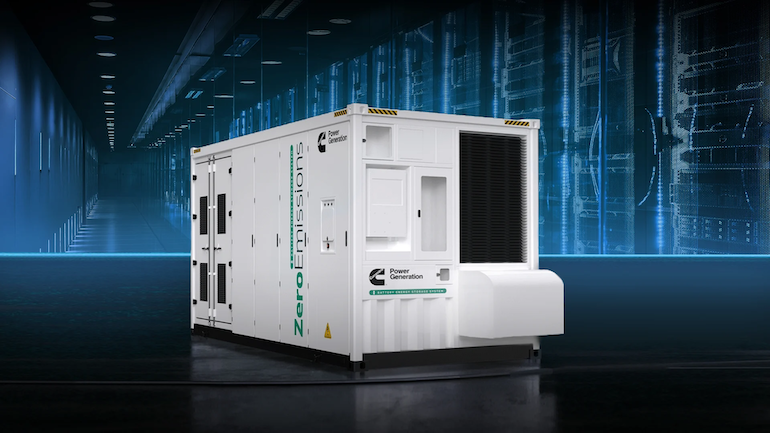
Cummins is set to supply its largest battery energy storage system to date for a US data centre, as operators look to manage the volatile electricity demand associated with artificial intelligence workloads.
The project will use Cummins’ battery storage technology to meet utility requirements for managing rapid load fluctuations, reducing oscillations and improving ride-through performance at the grid connection.
The company has not disclosed the data centre’s location, customer or the total size of the BESS deployment. Its system uses 5 MWh lithium iron phosphate battery blocks, liquid cooling and a flexible DC architecture that can work with different power conversion and energy management systems.
The announcement comes as large data centres place increasing demands on electricity networks. AI workloads can create rapid changes in power consumption, potentially creating challenges for grid operators and the infrastructure connecting individual campuses to the electricity system.
Battery storage can respond much faster than conventional generation, allowing it to absorb or release power as demand changes. In this application, the objective is therefore not simply to provide backup electricity, but to help control the data centre’s electrical profile.
“This project is an important achievement for Cummins,” said Jenny Bush, president of its Power Systems business. She added that BESS could support customers alongside “diesel standby and natural gas prime power” and integrated microgrid systems.
Cummins launched its BESS offering in May 2025. The company says the technology can also be used as a bridge while customers wait for permanent grid connections, potentially allowing data centre projects to begin operating sooner.
The system is designed to integrate with conventional generators as well as grid infrastructure, giving developers another way to manage limited connection capacity and peak demand.
For Cummins, the project represents a significant expansion beyond its established engine-based power generation business. The company is positioning battery storage as part of a broader power architecture for hyperscale and AI facilities, rather than as a standalone replacement for conventional generation.
Bush said BESS was becoming “a critical part of the modern data centre power strategy”, particularly for managing demand and improving resilience as AI-driven electricity consumption grows.


