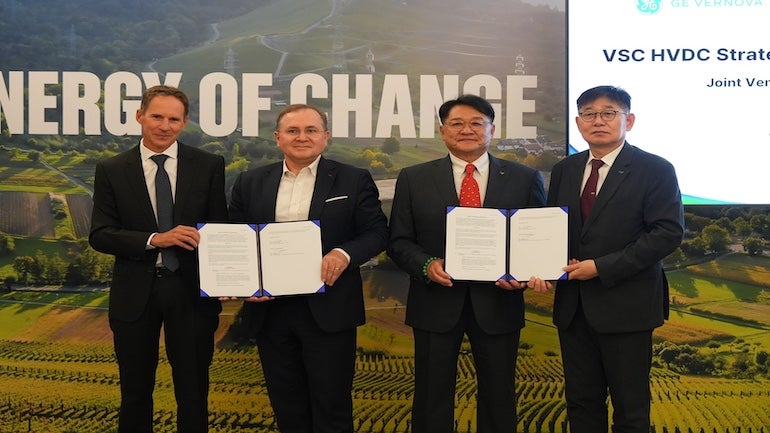
LS Electric and GE Vernova have agreed to establish a joint venture focused on voltage-source converter high-voltage direct current (VSC-HVDC) technology, targeting South Korea’s expanding transmission infrastructure and future international projects.
The agreement was signed in Paris on 25 August during CIGRE 2026, as South Korea prepares major grid investments to move renewable electricity from generation centres on the west coast and in the Honam region towards the Seoul metropolitan area.
The new company, Grid X Technology, will combine GE Vernova’s VSC-HVDC technology with LS Electric’s Korean manufacturing and project delivery capabilities. The partners intend to develop joint equipment offerings and execute HVDC projects in Korea before pursuing opportunities overseas.
The collaboration could be particularly relevant to the proposed West Coast Energy Highway, a government-backed transmission project designed to transport large volumes of renewable generation to areas of high electricity demand.
LS Electric already has experience supplying equipment for Korean HVDC projects, including the Bukdangjin–Godeok link and the East Coast–Seoul Metropolitan Area project. It operates an integrated HVDC manufacturing facility in Busan capable of designing, producing and testing key equipment such as converter transformers.
“This cooperation brings together world-class VSC-HVDC technology and LS ELECTRIC’s unique experience in executing HVDC projects in Korea,” said LS Electric chairman Koo Ja-kyun. He said the partnership would support the development of Korea’s “Energy Highway” and strengthen the country’s position in the global HVDC market.
GE Vernova Electrification CEO Philippe Piron said HVDC is increasingly important for transporting large quantities of electricity efficiently between generation and demand centres.
“By combining GE Vernova’s global HVDC technology and experience with LS ELECTRIC’s strong local manufacturing and execution capabilities,” Piron said, the companies could support the transmission infrastructure required for Korea’s future energy system.
The joint venture reflects a broader shift towards HVDC as grids accommodate larger renewable projects and increasingly concentrated power demand. For Korea, developing domestic capability in VSC technology could also reduce project and supply chain risks as transmission investment accelerates.


