
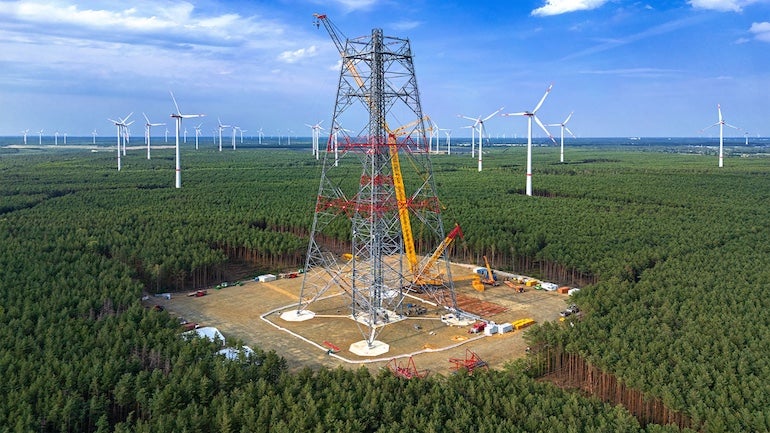
Construction of a 365-metre wind turbine in eastern Germany is approaching a critical stage, with the nacelle and rotor assembly scheduled to be lifted to around 300 metres on 20 September, subject to suitable weather conditions.
The turbine is being built near Schipkau in Brandenburg, in Germany’s Lusatia lignite-mining region, about 115 kilometres south of Berlin. Once completed, its overall height will be comparable to Berlin’s 368-metre television tower.
The project is being developed by German engineering company Gicon, which is testing whether significantly taller onshore turbines can access stronger and more consistent winds at higher elevations. The company argues that this could increase annual energy production while avoiding some of the construction and maintenance costs associated with offshore wind.
Gicon has based its assessment partly on wind measurements from a 300-metre tower at the site. According to the developer, the measurements indicate that increasing hub height could raise the turbine’s energy yield by around 40% compared with conventional heights. It also sees the technology as potentially suitable for lower-wind areas where conventional onshore projects have been difficult to develop economically.
The turbine uses a four-legged lattice tower, giving the structure a form more closely resembling a transmission pylon or the Eiffel Tower than a conventional tubular wind turbine tower.
Its installation presents a separate engineering challenge. The crane used during construction cannot reach the final assembly height. Instead, the nacelle, rotor hub and blades will initially be assembled on a platform at about 165 metres. The approximately 750-tonne structure, including an internal movable tower section, will then be raised to its final position using a hydraulic lifting system.
The approach is intended to overcome one of the principal logistical limitations of ultra-tall turbines: the availability and capacity of cranes capable of working at extreme heights.
If successful, the Schipkau project could provide operational data for a different approach to expanding onshore wind, particularly in regions where land availability and lower wind speeds constrain conventional turbine development. The site has already attracted interest from international visitors, including delegations from China and India.


