
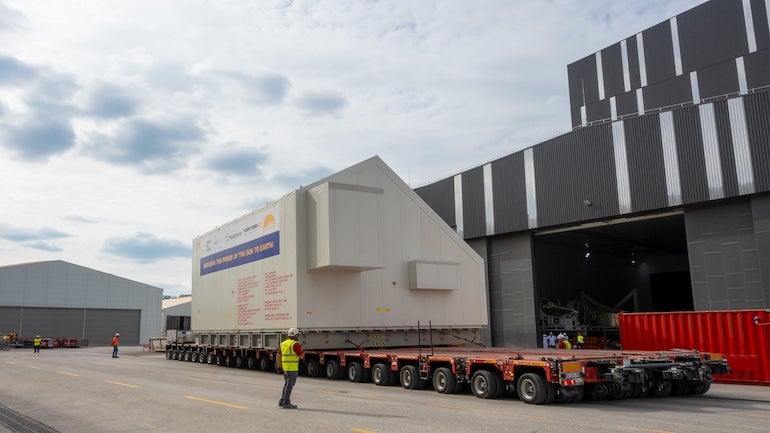
Europe has completed and delivered its fifth and final vacuum vessel sector for ITER, marking the end of a 16-year manufacturing programme involving Fusion for Energy (F4E), Ansaldo Nucleare, Westinghouse Electric Company and Walter Tosto.
The component was manufactured at Westinghouse’s facility in Monfalcone, Italy, before being transported by DAHER to the ITER site at Cadarache, France. F4E said it is the last large ITER component to be delivered to the site.
The vacuum vessel will contain the fusion plasma inside ITER, providing a controlled environment while superconducting magnets generate the fields needed to keep the plasma away from the vessel walls. The complete vessel will comprise nine sectors, with Europe supplying five and South Korea four. Once assembled, it will measure 19.4 metres across, stand 11.4 metres high and weigh about 5,200 tonnes.
The sectors were produced in sections at facilities in Monfalcone and Chieti before assembly and welding. Each completed sector was then transported by sea and land to Cadarache. The components also underwent detailed inspections to meet requirements set by France’s nuclear safety authority.
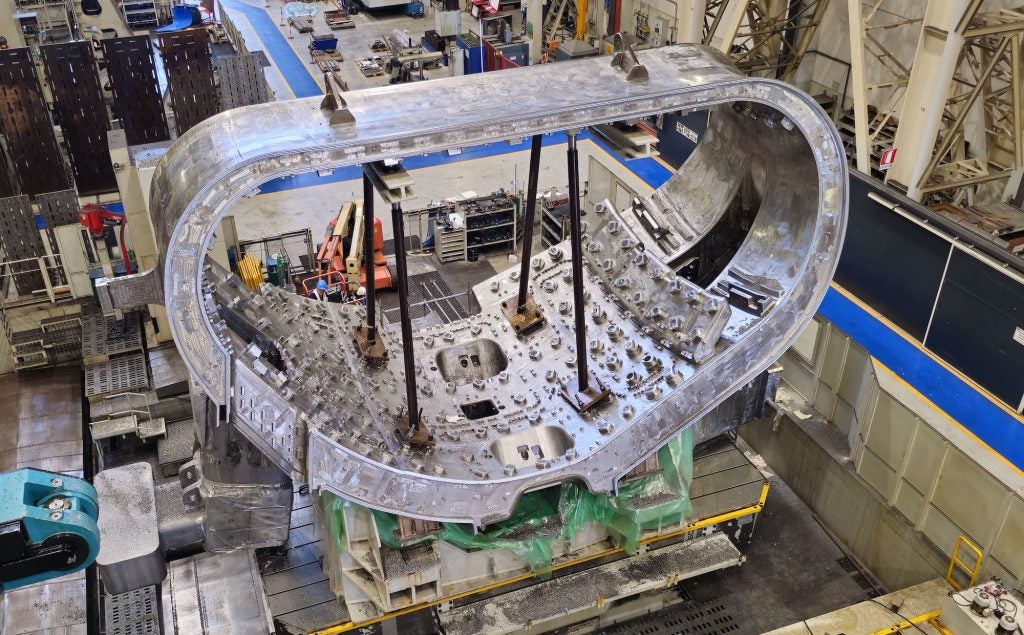
F4E said all five European sectors were delivered during the past two years, supported by detailed project planning and manufacturing controls. Artificial intelligence was also used to cross-check data collected by technical teams at production facilities.
“Europe’s final sector results from the strong partnership between F4E, the consortium of Ansaldo Nucleare, Westinghouse, and Walter Tosto,” said Marc Lachaise, F4E director.
Luca Oriani, president of New Plant Delivery at Westinghouse, said the delivery was “a significant achievement” and that the experience gained could be applied to future projects of similar scale.
The completed sectors represent a major European contribution to ITER, the international fusion experiment being constructed in southern France to investigate the feasibility of fusion as an energy source.


