
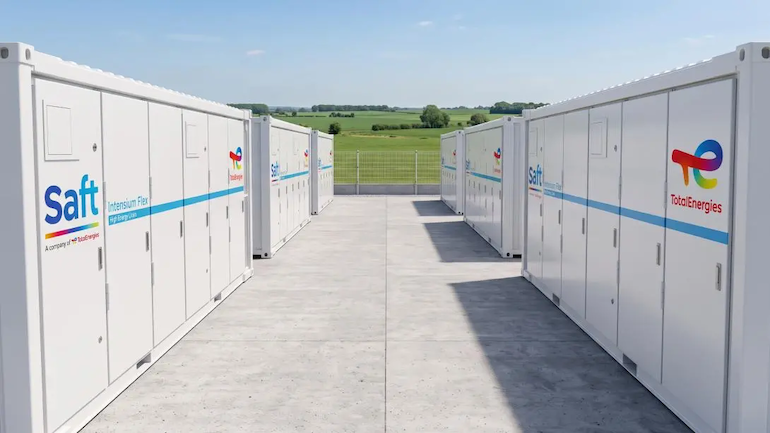
Saft, a wholly-owned subsidiary of TotalEnergies, is supplying battery energy storage systems (BESS) totalling 122 MWh and 55 MW for two projects being developed by Axpo in France, with deliveries scheduled for early 2027.
The contracts cover the 92 MWh/41 MW Orbec project in Normandy and the 30 MWh/14 MW Bois Paillet project in the Centre-Val de Loire region. The agreements represent the first collaboration between Saft and Axpo.
Saft will provide fully integrated systems for both sites. Orbec will use 18 Intensium Flex battery containers, while Bois Paillet will use six. The installations will also include power conversion equipment and energy management systems.
The projects are intended to provide additional flexibility as France increases its renewable generation capacity. Battery storage can respond rapidly to changes in electricity supply and demand, helping manage periods of variable renewable output and supporting grid operation.
Saft said its liquid-cooled battery technology is designed for intensive cycling and rapid response while maintaining performance over the operating life of the systems. Both projects will use the company’s I-Sight digital monitoring platform for performance monitoring, maintenance and asset management.
Noise requirements have also influenced the system design. Both sites will incorporate measures including low-noise operating modes, cooling-system optimisation, battery silencers and dedicated noise barriers to meet local limits.
“We are delighted to begin our collaboration with Axpo through these landmark projects in France,” said Vincent Le Quintrec, ESS sales director at Saft. He said the projects combined demanding technical requirements with accelerated delivery schedules.
Frank Amend, Axpo’s head of batteries and hybrid systems, said the projects were “an important step” in expanding the company’s battery storage portfolio in France.
The two installations will add to France’s growing fleet of grid-scale batteries, which are being deployed to provide short-duration flexibility as the electricity system incorporates more variable renewable generation.


