
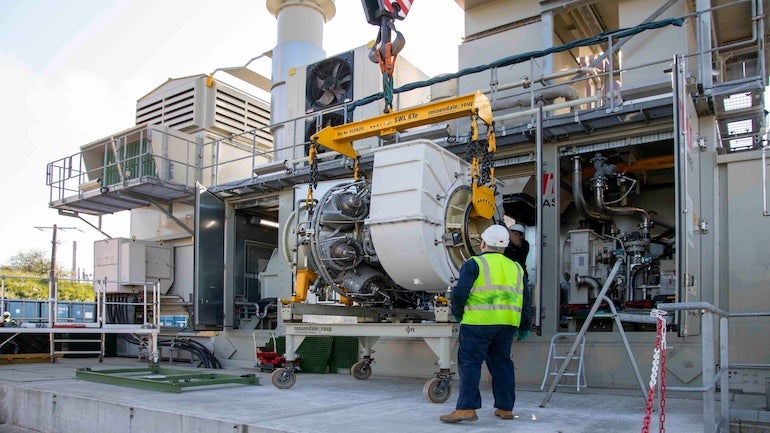
Partners in the HyCoFlex funded R&D project have achieved several key “firsts” and further validation of a power-to-hydrogen-to-power-and-heat pathway for real-world deployment. In addition to running at full load at 100% hydrogen with low emissions, the Siemens Energy SGT-400 gas turbine offered cogeneration operation at those levels and extended the entire whole operating range including start-up.
Through an extensive testing campaign now concluded at the Smurfit Westrock paper mill in Saillat-sur-Vienne, France, the project used 100% renewable hydrogen in a fully integrated combined heat and power plant to produce electricity and industrial steam. Across a wide range of operating conditions, the project expanded the operational envelope of hydrogen-fuelled CHP systems, demonstrating stable low-emission performance. The project builds on the successful EU-funded R&D project HYFLEXPOWER at the site, which showed that local hydrogen production and its efficient conversion into electricity can be integrated and operated in a CHP plant.
The installed Siemens Energy SGT-400 gas turbine can generate up to 12 MW of electrical output and 20 MW of thermal output. A key milestone was the successful operation of the integrated gas turbine and heat recovery steam generator cogeneration system at full load using 100% hydrogen. While earlier demonstrations focused primarily on hydrogen-fuelled electrical power generation, the HyCoFlex project expanded the scope to the entire cogeneration process, demonstrating the simultaneous production of electricity and industrial steam under real-world operating conditions.
During the test campaign, the gas turbine, equipped with advanced high-hydrogen dry low emissions (DLE) combustion technology, successfully operated on 100% hydrogen throughout the operating range including full load while maintaining low NOx emissions. The project also marked the first demonstration of a DLE gas turbine running on 100% hydrogen throughout an entire operating cycle at an industrial site, from ignition and start-up to grid synchronisation, full-load operation, load reduction, and controlled shutdown. The unit could be started successfully on hydrogen alone without requiring a start-up fuel. The plant successfully operated across a wide range of hydrogen-natural gas fuel blends and load conditions, including rapid changes in hydrogen content and power output, while maintaining stable and low-emission performance.
The test campaign generated a comprehensive dataset on emissions and operational performance for both pure hydrogen and blended-fuel operation.


