
Executing an intentionally intermittent electrolyser operational strategy means understanding regulations and complementary hydrogen infrastructure. Over the next ten years, intentionally intermittent operation is likely to be the only way that green hydrogen will be produced with viable un-subsidised business cases in much of Europe.
Breaking down the cost of electrolytic hydrogen
The main contributors to the levelised cost of green hydrogen (LCoH) are the capital expense of the electrolyser, the purchase price of renewable electricity and the efficiency at which the electrolyser converts electricity to hydrogen.
The cost of renewable electricity, when supplied on a stable basis through a power purchase agreement (PPA) in Europe, is around 50 €/MWh. When purchasing electricity at that price, the theoretical minimum LCoH is €2/kg H2.
To achieve this theoretical minimum, we must assume zero grid transmission fee, no degradation, no maintenance costs, 100% efficiency of the electrolyser, zero capital cost of the electrolyser, and zero financing cost. Clearly, each of these assumptions is wildly unrealistic.
The only way to reduce the LCoH below this theoretical minimum of €2/kg is to reduce the cost of electricity. That means purchasing off-peak electricity during periods when prices are low, zero or negative.
Renewables integration
As more non-programmable, renewable electricity generation capacity provided by wind and solar comes onto European grids, the periods where prices fall to zero are becoming longer and more frequent.
During peak solar hours and strong winds renewable power generation exceeds the capacity of the grid to absorb that power. The result is negative pricing to incentivise renewable electricity producers to curtail (AKA downward redispatch) their production. See Figure 1.
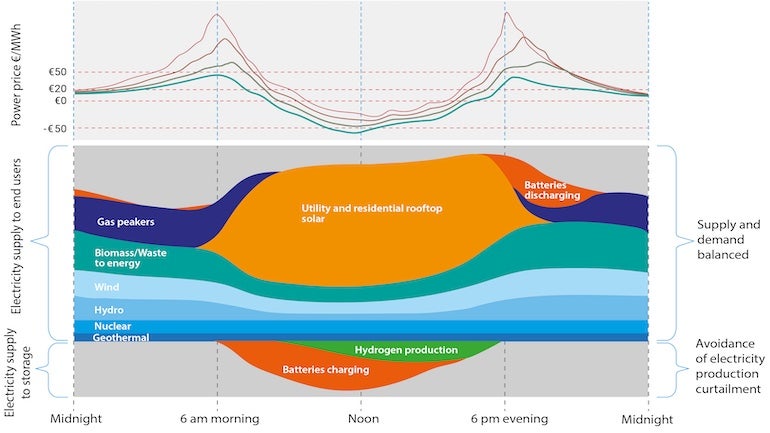
The ramp up in renewables enables a business model where green hydrogen producers operate only during periods of low, zero and negatively priced power. This serves the dual function of producing renewable hydrogen at the lowest possible cost and balancing supply and demand on the grid.
Grid frequency management services
As we are well aware, the electricity grid in Europe is designed to operate at a frequency of 50 Hz. Furthermore, motors and other electrical appliances consume electricity at this frequency.
When there is an imbalance between electricity supply and demand the frequency changes. Too much demand reduces the frequency; too much supply pushes it up. A key role of the grid operator is to maintain the frequency within extremely tight limits around the 50 Hz target.
However, electricity generation and consumption are not always within the direct control of the grid operator. They often perform this balancing task in collaboration with electricity producers and consumers. When the grid frequency drops, additional power generation capacity is requested to be brought online. This may be from gas peakers or battery energy storage systems (BESS). When the frequency increases, generators are requested to turn down or curtail electricity supply to the grid.
Demand side frequency control is also important. The grid operator can make agreements with large electricity consumers so that they will either increase or decrease their electricity consumption when requested. With such an agreement, the grid operator pays a fee to reserve this capacity adjustment. Additionally, a fee is paid when the capacity adjustment is implemented at the request of the grid operator.
For multi-MW electrolyser schemes with intentionally intermittent operation, the revenues associated with frequency regulation support can improve the project economics.
Regulatory alignment
The EU regulations that define green hydrogen and e-fuels are RED II/III and their Delegated Regulations (EU) 2023/1184 and (EU) 2023/1185. These refer to green hydrogen as a renewable fuel of non-biogenic origin, or RFNBO.
These regulations state that from 1 Jan 2030 strict additionality and an hourly matching temporal correlation will become effective. These are in addition to the requirement for proximity, meaning power for electrolysis must be drawn from the same bidding zone, or an adjacent one if the grid is not congested. When combined, these regulatory restrictions are likely to make high-utilisation green hydrogen schemes uneconomic in most European countries.
However, there are two exceptions to these regulations that soften their impact dramatically. First, electricity will be regarded as renewable and additional if it is produced from renewable power plants (of any age), drawn during an imbalance period and avoids downward redispatch of the renewable power. Furthermore, if the electricity for the electrolysis is purchased at a low price (<€20/MWh) the temporal correlation requirement is assumed to be met.
The basis for the above exceptions is that this electricity may otherwise have been curtailed or is being generated at a period of very low demand from other users. The implications for intentionally intermittent operation are positive.
Balancing electrolyser capex and efficiency
When an electrolyser is to be operated continuously at full load, efficiency is of primary importance in technology selection. A small improvement in the amount of hydrogen produced per MWh of electricity consumed will comfortably pay for the additional capital cost of a more efficient electrolyser. In these high utilisation green hydrogen schemes, solid oxide electrolysers or advanced alkaline electrolysers may be favoured.
On the other hand, intentionally intermittent operation of an electrolyser drives down utilisation because it is idle for a portion of the time. Low utilisation puts pressure on minimising capital. Also, since the electrolyser is not operating for so many hours, its efficiency plays a smaller role in the economic viability of such a scheme. With intermittent operation, low electrolyser capex becomes more important than high efficiency when considering technology selection.
For many green hydrogen schemes, pressurised alkaline electrolysers are selected due to their availability, technical maturity and low capital cost. A limitation of these electrolysers is that hydrogen begins to cross over the membrane to the oxygen side at low loads.
This generally limits their safe operating range to 30%-100% of nominal power consumption. However, at 30% power consumption, their hydrogen production efficiency can be cut in half. In the ideal case, pressurised alkaline electrolysers like to be turned on, ramped up and left alone.
Best fit technology
The key attribute of an electrolyser to exploit the concept of intentionally intermittent operation is hyper-flexibility. Hyper-flexibility means that an electrolyser can turn on and off rapidly, and can turn down to consume almost zero power.
Proton exchange membrane (PEM) electrolysers (Figure 2) are the best-fit for bankable projects exploiting intentionally intermittent operation today. PEM electrolysers can be more tolerant of rapid ramping and daily idle periods associated with intentionally intermittent operation.
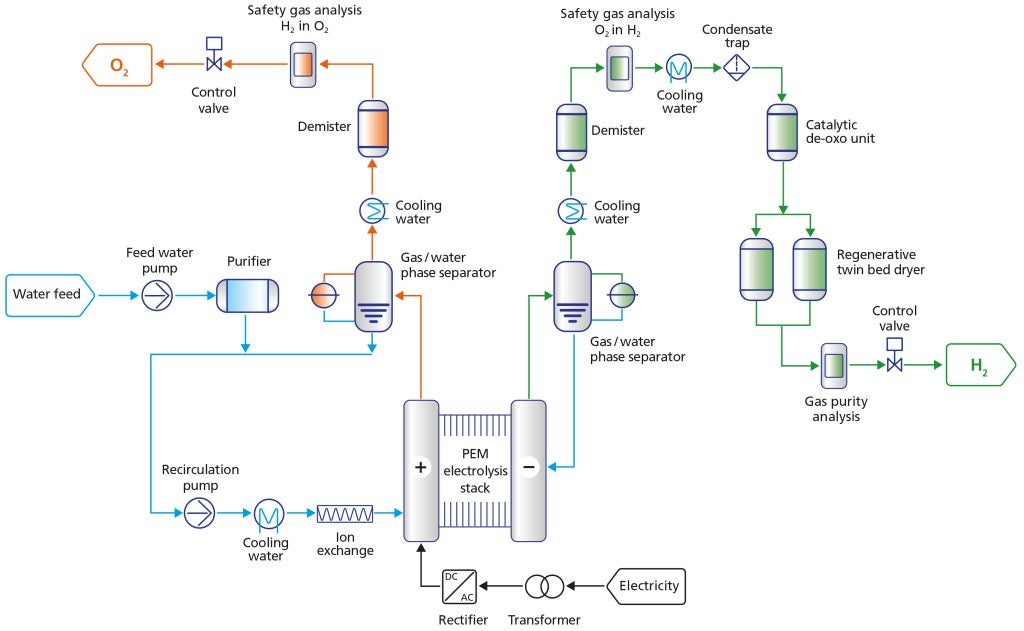
The capital cost of a PEM electrolyser stack can be up to twice that of a pressurised alkaline electrolyser stack sourced from China. However, this cost differential is progressively being eroded as PEM technologies mature and manufacturing scales up. Furthermore, when considering the balance of stack and total project costs, the difference in cost between PEM and pressurised alkaline stacks becomes less significant.
Complementary infrastructure
Balancing intermittent hydrogen production with the demand profile of end users requires hydrogen storage. The build out of hydrogen pipelines with integrated storage will serve the dual purpose of connecting suppliers with offtakers and be a hydrogen storage buffer.
The European Hydrogen Backbone plans to integrate pipelines in addition to high capacity underground storage (see Figure 3). In northern Germany and the Netherlands, salt cavern storage is proposed. Where the geological conditions make this possible, this technology offers the lowest levelised cost of storage (LCoS).
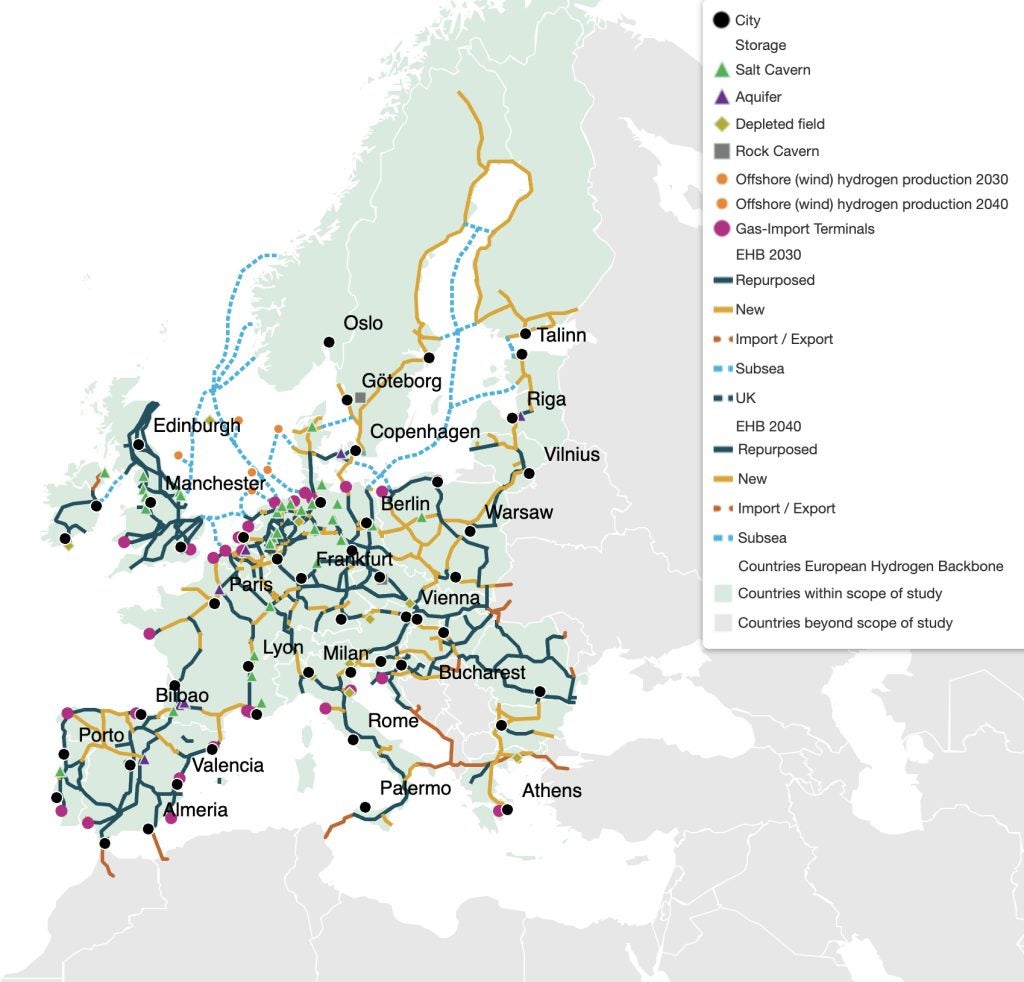
In Southern Europe and the Nordics the option to use salt cavern storage does not exist. Here, lined rock caverns are likely to be the technology that offers the lowest LCoS at scale.


