
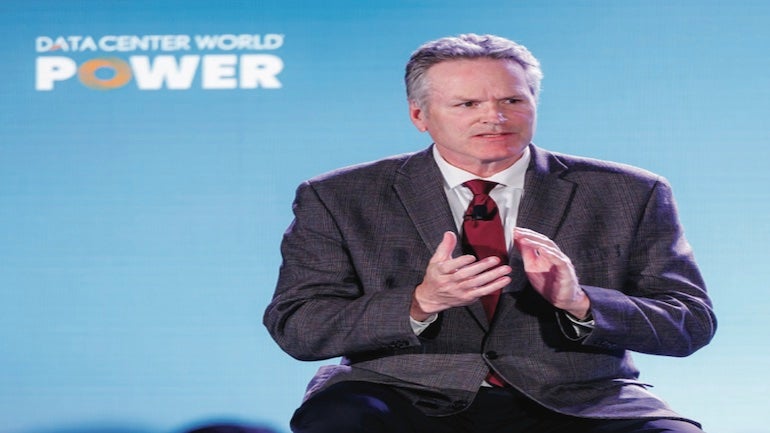
The inaugural Data Center World POWER conference held in San Antonio, TX, USA, autumn 2025, hosted more than 1100 attendees. They came in search of answers to the biggest problem facing AI data centres – finding enough power. Attendees included the Governor of Alaska who brought a large team with him to promote the benefits of locating data centres in his state. Other big topics included onsite power, why the grid is struggling to cope with AI, and who is winning the race to power data centres, between renewables, natural gas, nuclear, and batteries.
The case for Alaska
Mike Dunleavy, Governor of Alaska, extolled the virtues of his homeland as the next great tech hub. He cited the state’s motto ‘North to the Future’ and unveiled Alaska’s strategic vision to become the next epicentre for sustainable, scalable, and AI-ready data centre development. He argued convincingly: natural cooling due to ambient temperatures 15°C on average below those of Texas; abundant natural gas and oil resources; lower geopolitical risk; and tax advantages.
“A 1 GW data centre in Alaska will save $150 million a year in energy costs alone,”
said Dunleavy.
In addition, Alaska has the largest oil reserves in the USA, massive gas fields, and cheap land and water available in almost unlimited quantities. A large gas pipeline is about to be built to utilise even more of the state’s gas, making substantial gas resources available in Anchorage for North American consumption as well as for export to Asia. The state, he said, could set gas prices at very low rates for decades as it is not subject to Henry Hub pricing. The state plans to add carbon sequestration.
Big plans are afoot with renewables, too. Dunleavy said his state has 3600 GW of renewable potential, coming from wind, tidal, hydro, and geothermal. Alaska’s offshore wind potential is 12 087 TWh/year while onshore wind capacity forecasts go as high as 494 700 MW. Alaska even has the nation’s greatest potential for seaweed production for biomass energy and has 90% of US tidal energy resources for use in hydrokinetic electricity production.
Dunleavy said most of his residents need and want data centres. The legislature is even willing to consider changes to statutes to become yet more competitive.
“We have the energy, the fibre, the land, and the low cost that can propel us to the cutting edge of the digital world,” said Dunleavy. “Unlike places like Russia, Canada, or Scandinavia that are being touted as good data centre locations, we are subject to US law.”
Texas-sized power for data centers
While Alaska hopes to attract data centre business, Texas has already emerged as a major hub.
“Texas’s fast approvals and low-cost gas win when it comes to site selection,” said David Bell, Vice President of Utility and Microgrid Development at gas engine provider VoltaGrid. “While fibre connectivity, regulatory/tax incentives, operational costs, and availability of land are all important, power availability and reliability are now king.”
He said that Texas is the best place for access to firm, redundant power fuelled by natural gas and renewables. Virginia remains in the lead, possessing 24% of all US data centre capacity, but Texas is next at 15%. It leads VA in new construction and planned construction. As much as 16 GW of new data center capacity will be added in the Lone Star State between 2026 to 2030, far outpacing other markets.
“The big driver for data centre construction is power and behind the meter generation is leading the way,” said Bell. “50% to 65% of all data centres will be running behind the meter within 10 years.”
One of the big reasons Texas is doing so well is that it has massive natural gas fields in its vicinity. This translates into cheap, abundant and reliable power. Add to that a regulatory framework that gets permitting and approvals done three times faster than other states and you have a recipe for success – and Texas recently passed Senate Bill 6 which improves electric grid reliability by requiring large energy consumers like data centres to contribute to interconnection costs, provide information on backup generators, adhere to interconnection standards, and allow emergency dispatch of backup generators to manage grid stress during emergencies.
For example, Bell said his company applied for air quality approval at a 200 MW facility in Texas, which took three weeks. Other states, he said, have kept him waiting for more than eight months without a decision being made. Cost of energy, too, favours Texas. Bell cited $3.25 per million cubic feet (mcf) for gas compared to $4.38 in Virginia. A dollar more translates into millions of dollars a month in energy costs at a large data centre.
The extent of the data centre boom
Shane Mullins, Vice President of Product Development Energy Markets at Industrial Info Resources (IIR), laid out global statistics that demonstrate the extent of the data centre energy boom:
Total active data centre projects in the planning or engineering stages amount to 7895 at a value of more than $2.7 trillion.
Total active projects under construction amount to 3973 for a value of $1.26 trillion, the bulk of which is in North America.
The pipeline from large developers amounts to 266 GW with 57 projects of more than 1 GW in the works.
Amazon has more than 15 GW of planned new data centre capacity.
“We are seeing high, post-ChatGPT demand coming from AI as well as the internet of things, the cloud, and digitisation,” said Mullins. “Renewables will probably meet at least half of overall data centre demand, but natural gas and coal also play a significant role.”
Mullins notes a consistent month-over-month increase in project announcement numbers and capacities.
“The pace of development is accelerating and it is set to continue for the foreseeable future,” he said. “The hottest areas are Texas and Virginia, with places like Georgia, Nevada, Ohio, and Arizona also doing well.”
US growth adds up to 60 GW of planned data centres and $1.7 trillion in investment. IIR numbers show that data centre electricity demand is on a path to grow from 20 GW in 2023 to more than 100 GW by 2030. By 2028, they could be consuming 12% of the nation’s electricity.
Estimates from Kinder Morgan and Energy Transfer put the total natural gas demand for the US between 6 and 10 Bcf/day within a couple of years.
“A lot of this will be for behind the meter power,” said Mullins. “More than 25% of new facilities above 500 MW will have behind the meter power by 2030, up from 1% today.”
He cited examples such as Meta using gas turbines for its Hyperion project in Louisiana. Also, the Stargate project in Texas will be powered by natural gas and fuel cells, while xAI is ordering up to 60 gas turbines as well as battery energy storage for a supercomputer project in Memphis, Tennessee.
Coal, solar, and batteries
Britt Burt, senior vice present of power industry research at IIR, said that, nevertheless, coal would not be going away quite as fast as expected. There are already announcements about planned closures being delayed and he expects this trend to continue. This ultimately means more investment in aging coal plants to increase efficiency and reduce emissions.
He predicted that solar investment would continue to lead in North America as it has done since 2020. Battery storage investment, too, will be strong. Wind investment, on the other hand, peaked in 2019 and investment in offshore wind is drying up. Natural gas investment has been flat for a decade and has been surpassed by wind or solar (or both) each year since 2015. That just changed, with a surge in 2025. IIR expects natural gas power plant investment to top $35 billion by next year and stay there for several years.
“Natural gas is being built-out to levels we haven’t seen in many years and that will continue for years to come,” said Burt. “In the early 2000s, everyone was building natural gas and it is like that again or perhaps even stronger.”
Most of that investment is in brand new facilities. But there is plenty of money being sunk into expansion of existing facilities, upgrades, and maintenance. Texas leads with 51 active natural gas projects totalling around $31 billion, followed by Alberta, Canada with 19 projects of almost $10 billion then North Dakota with three projects of almost $8 billion.
Despite an apparent slowdown, he says renewables (especially solar) are going to continue to expand. Some timelines might be adjusted but the overall trend toward solar adoption will continue
“More solar farms and battery plants will be built with or without the tax credits,” said Burt. “Land-based wind is also moving forward and repowering of old wind farms is growing in investment.”
Nuclear energy is another beneficiary of the investment boom. The money is being spent on small modular reactor (SMR) development, improvements to existing plants, bringing decommissioned plants back online, and even on plants that were stopped mid-construction almost a decade ago.
“There is a major wave of nuclear capacity on the long-term horizon and a lot of it will be used for data centres,” said Burt.


