

Improving the efficiency of electrochemical processes is one of the strongest levers to increase the efficiency of battery electricity storage system (BESS) technology. In turn, battery electricity storage is an essential link in the chain between non-programmable renewable power generation and a stable grid.
Better BESS efficiency means better economics. More of the generated electricity is stored and released. Systems either shrink in size for the same capacity, or provide more capacity from a given unit.
The end-to-end system benefits from improved battery efficiency. Less power is wasted during battery charging and discharging, meaning fewer wind turbines, solar panels and inverters are required. Less land is used. Capital costs are reduced through the entire value chain.
Spin alignment drives economics
In support of this energy efficiency improvement imperative, Chiral Energy has unveiled a technology which aligns electron spin to improve the performance of battery anodes and cathodes. It reduces the resistive losses of these battery components using a nano-coating of a chiral-spin-inducing particle, thereby creating an orderly flow of electrons.
And, there is meaningful scope for improvement. State-of-the-art lithium ion batteries (LIBs) convert around 5% of their electricity input into heat, not released power. When considering the inverter and rectifier losses, the battery is generally responsible for between 30 and 50% of the BESS energy loss.
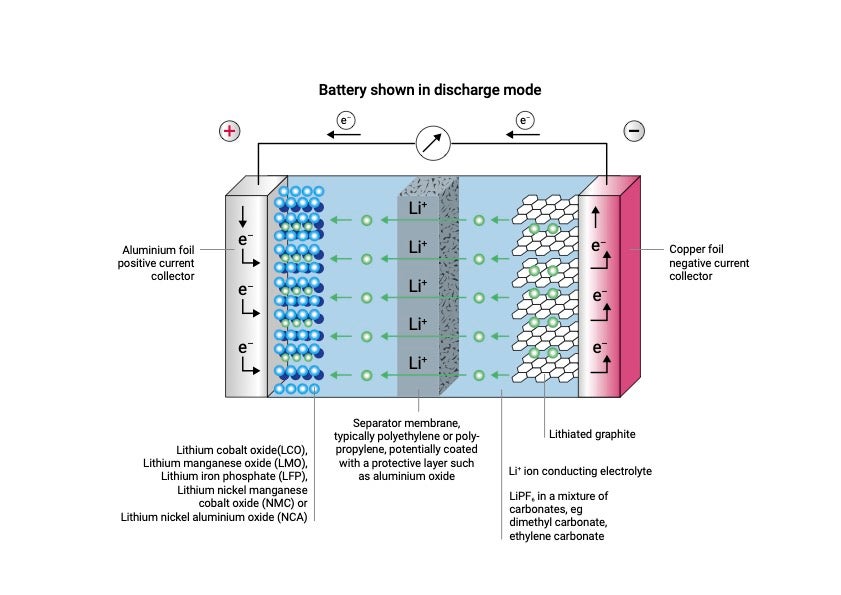
Whilst the percentages are small, the monetary value is huge. A utility scale BESS with 240 MWh of storage capacity would lose 12 MWh of power due to battery inefficiencies per cycle. At a discharge value of €200 per MWh, that represents €2 400 per cycle which would be more than €800 000 per year, based on one full cycle per day. Reducing this waste is essential to reduce the levelised cost of storage (LCoS).
Understanding chirality
The term chirality is used to describe two physical manifestations of a molecule such that each has the same number of chemical atoms connected in the same way, but where the shapes of the two molecules are mirror images of each other, which cannot be superimposed onto each other.
“A left glove and a right glove are mirror images, but you can’t put the left glove on your right hand comfortably”, says Nir Marom, CEO of Chiral Energy. This analogy explains the origins of the word “chiral”. Its roots are in the Greek word “cheir”, which means “hand”.
Often, large chiral molecules have helical shapes, like a bolt. The bolt can only work when turned in the correct direction. A right handed bolt thread can only fit into a right handed nut thread. And rotating the bolt in the wrong direction will not allow it to marry with the nut.
An analogy from power management systems would be to consider the two helical screws of a screw compressor.
Their shapes are similar but they rotate in opposing directions to compress natural gas or instrumentation air.
“In the field of electrochemistry,” continues Marom, “it can be understood that the direction of electron spin is a particle-scale manifestation of larger chiral objects. Aligning the direction of spin of electrons is the key to efficient electrochemical processes. And it has its roots in energy-efficient bio-processes.”
Natural efficiency
The technology that Chiral Energy has introduced to batteries is grounded in biochemistry and life sciences. It exploits what nature has been doing for millennia.
Plants convert water, soil nutrients, carbon dioxide from the air, and energy from the sun into polysaccharides and sugars. Marom explains that “sugar beet produces sucrose, and grapes are rich in glucose. These sugars are chiral molecules.”
But nature tends to produce only one of the two chiral shapes for each molecule, rather than a random mix of both chiral forms. Creating this ‘order’ requires additional energy in the first instance. But there is a payoff to come.
The benefit behind nature’s use of chiral chemistry is that once the chiral molecule has been created, it helps to align electron spin. This, in turn reduces the energy requirement in key bio-processes like photosynthesis and cellular respiration.
Controlling spin to avoid chaos
Electrochemical processes rely on the transfer of electrons. If they spin in random directions, their movement is chaotic. Marom says that “creating an orderly flow of electrons can be achieved by chirality-induced spin selectivity, or the ‘CISS’ effect. This is a phenomenon where the chirality of a molecule influences the spin of electrons that pass through it. Nature uses one-sided chiral molecules so that all the electrons pass with the same aligned spin.”
When a chiral molecule is applied to an electrode, the spin of the electrons flowing through the electrode is systematically aligned, and they flow smoothly with less friction. The result is less wasted energy and a more efficient flow of electrons.
“Our chirality-inducing coating works as a filter to other processes as the electrons flow through our coating into the next process stage. It’s a bit like a polaroid filter in your sunglasses”, suggests Marom.
“Through our deep understanding of how the CISS effect works, we will be able to apply it to many electrical and electrochemical processes that will be central to achieving energy efficiency. It is a foundation technology which will improve many types of equipment and will help pave the way to net-zero.”
Bringing nature’s lessons to modern power systems
The founders of Chiral Energy have extensively researched how nature uses chirality to its advantage. And, they have used their insights to improve electrochemical processes which are being industrialised today. Lithium ion and vanadium flow battery technologies can both benefit from a more orderly flow of electrons.
Electrolysers for green hydrogen production also benefit from electron spin alignment. Less electrical power is required to produce each kg of hydrogen, reducing the LCoH. Chlor-alkali electrolysers could similarly benefit from chiral electron spin alignment to reduce their power consumption when producing chlorine gas.
Chiral’s breakthrough is equally relevant to improving the efficiency of fuel cells, whether they are fed with natural gas or hydrogen. With electron spin alignment, they can generate more power, and less heat. In these applications, it is also the electrodes which are treated with the chiral electron spin alignment nano-coating.
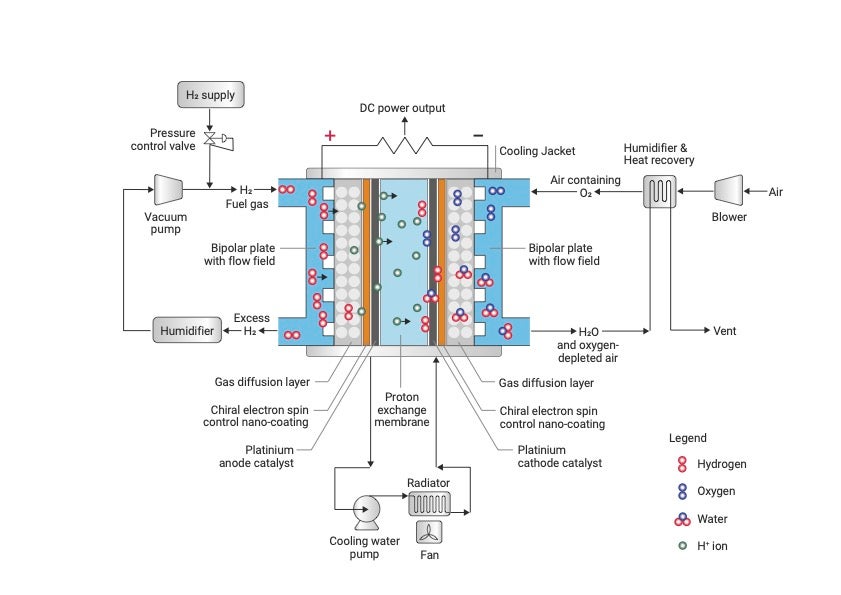
Chiral Energy has developed a nano-structure that is coated as an additional layer on top of the conventional electrode. As such, it works in synergy with existing technologies. “As the electrons flow through our nano-coating, their spin orientation is aligned by the chiral molecules in this layer resulting in a more orderly flow and better system efficiency”, explains Marom.
Robust and versatile
Because the Chiral Energy spin-selective nano coating is synergistic with other catalysts, it can be equally relevant to PEM, pressurised alkaline and low-pressure advanced alkaline electrolyser stacks.
“We’re currently engaged in proof of concept studies with companies across several mainstream electrolyser technologies” says Marom. “Our solution is a broadly applicable technology which enhances electrolysis performance across the board.”
The Chiral Energy coating is robust and can be applied onto existing electrolyser electrodes. It can operate comfortably at a wide range of temperatures, from the lower end of the range at 60 °C for PEM systems to the upper end of the range at 90°C for alkaline electrolysers.
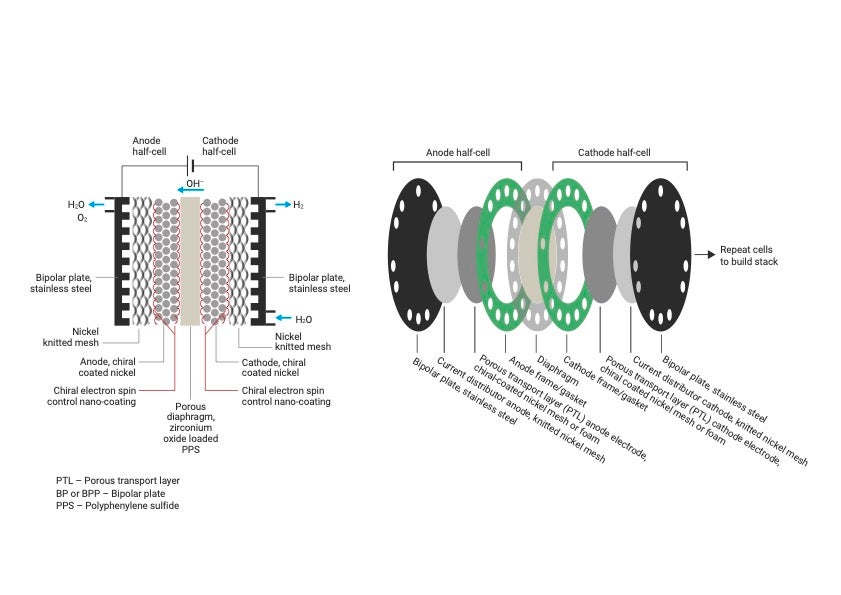
It is also unaffected by the highly alkaline electrolyte in alkaline electrolyser stacks. Furthermore, it can support current densities that are commercially relevant to all systems, including the higher current densities observed in advanced alkaline electrolysers and the most modern PEM electrolysers.
PEM, AEM and many alkaline electrolysers operate in the range of 15 to 35 bar. “Our electron spin filtration nano-coating can support all these environments”, declares Marom.
Integration with LIB production lines
As with electrolyser electrodes, Chiral Energy’s CISS inducing coating can be applied directly onto existing LIB electrodes. Its adhesion is excellent, which enables the coating to be applied with minimal modifications to existing high-throughput battery production lines.
The nano-layer coating is also extremely thin, meaning changes to existing components can be avoided and there are no significant changes to the dimensions of the end product.
“We look forward to extending our scope of deployment into utility-scale BESS”, says Maron. “It would be ideal to partner with some players involved in lithium-ion battery production to demonstrate the efficacy of our CISS inducing nano coating in this space”.


