
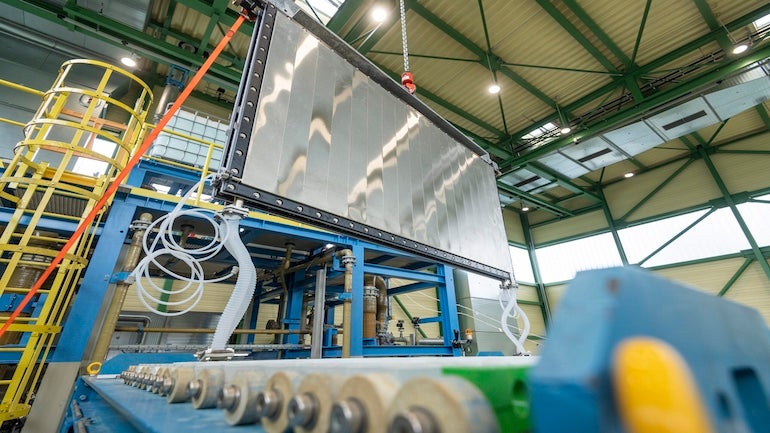
Power management equipment represents around 20% of the equipment capital cost of a typical electrolytic hydrogen scheme. This cost is generally shared equally between the switch gear, transformers and rectifiers.
Transformers cascade high voltage electricity from the transmission grid to the lower voltage required by electrolysers. Rectifiers convert the alternating current that is used in the grid to the DC required. Harmonic filters ensure that the electrolyser park does not disrupt the grid. Power factor correction may also be required.
Transformers – on the critical path
Transformers for electrolyser parks are no different from those used in conventional applications. However, the demand for this equipment is high as there is an increasing level of electrification in many countries.
On the other hand, transformer assembly and component manufacturing is dominated by incumbent firms with a high degree of inertia, which rely on aged factories with extensive use of highly skilled manual production techniques, which are difficult to scale rapidly. Another major bottleneck in transformer supply is sourcing the high-tech ceramic insulators that connect the power cables to the transformer.
Transformer supply has simply not kept up with demand. The result, is that the delivery lead time can range from 18 to 36 months and transformers will often be on the critical path for equipment procurement, construction and commissioning. To mitigate the risk of delays in bringing electrolytic hydrogen projects to commercial operation, specifying and ordering the transformer must be done early in the project timeline.
Rectifiers – a range of technology options
In contrast to transformers, which have barely evolved in recent decades, rectifier technology has advanced significantly. In part, this has been driven by the increased use of PV solar and battery energy storage systems (BESS), both of which employ DC power.
There is now a range of rectifier technology classifications available on a commercial basis. They offer technology selection options for electrical engineers when specifying power management equipment for electrolyser schemes.
Thyristor-based SCRs
Thyristor-based silicon-controlled rectifiers (SCRs) have been used for decades to power electrolysers used for chlorine and sodium hydroxide production in the chlor-alkali industry. More recently, they have become the default choice for advanced alkaline electrolyser systems for hydrogen production. High current density advanced alkaline electrolysers, traditionally the domain of thyssenkrupp nucera, are also being offered by challengers such as INEOS Electrochemical Solutions, Sany and HydoTech. Thyristor rectifiers are the only technology that can provide the combination of high current at low voltage that is required by this generation of electrolysers.
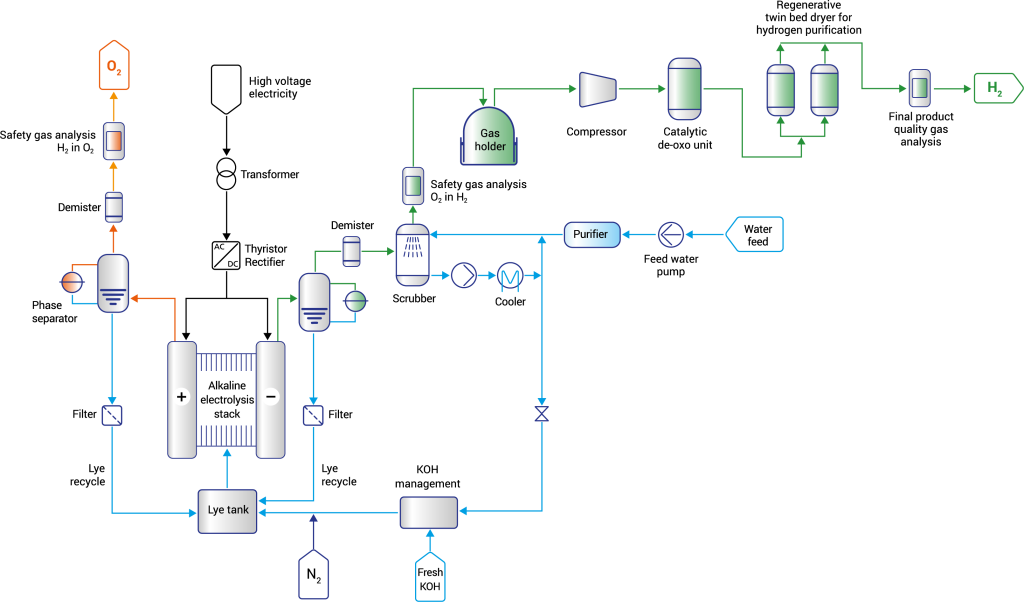
Despite their robustness, thyristor rectifiers have severe limitations regarding grid compliance. Their power quality is low, characterised by a poor power factor and high harmonic content. Grid compliance requires integrating complicated multi-pulse systems (18-pulse or 24-pulse) or external filter banks, adding to the capital cost, complicating the design and increasing system size.
Thyristor rectifiers are phase-controlled, semi-controlled devices. They leave a large ripple in the DC current flowing to the electrolyser. This means the electrolyser oscillates around its point of maximum efficiency. Thyristor rectifiers themselves are less expensive than more modern technologies. However, when the cost of the additional conditioning equipment is considered, the total capex will be similar to more advanced technologies. Furthermore, the lower efficiency of thyristor rectifiers increases their lifetime cost of ownership significantly versus more efficient modern technologies.
Diode and IGBT topology
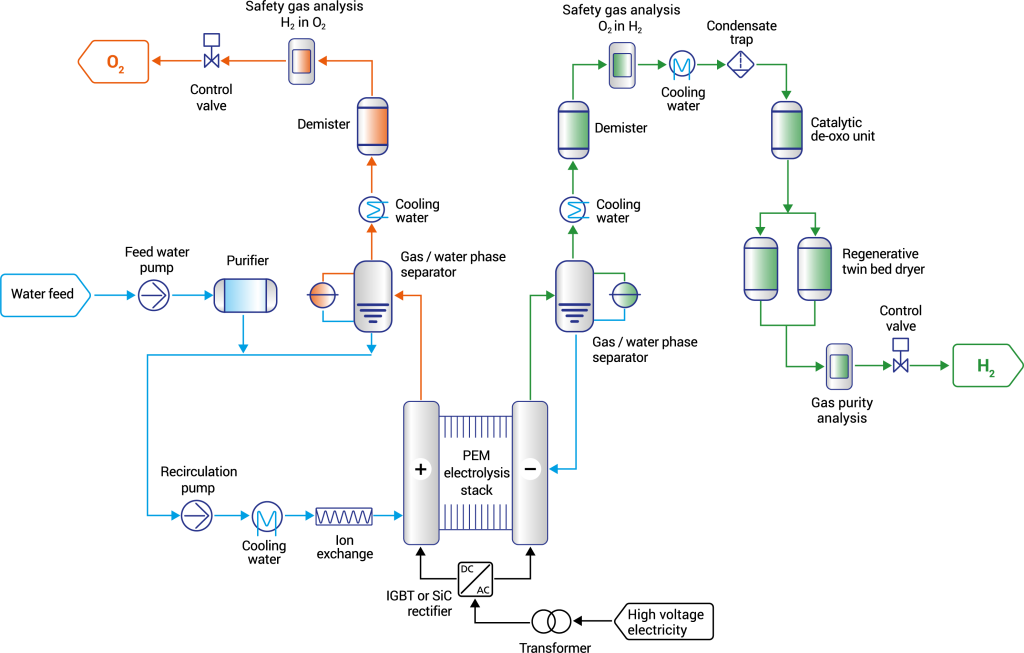
Passive diode rectifiers represent the simplest solution for AC/DC conversion. However, they have a potential for introducing severe harmonic distortion into the grid because they are based on passive components without internal control circuitry. Modern diode rectifiers can include an active component to manage the DC output. A common configuration incorporates a buck-type chopper utilising insulated gate bipolar transistor (IGBT) switches after the diode rectifier. The combined diode and IGBT rectifier topology achieves high efficiency and low harmonics and has resulted in IGBT rectifiers becoming the default choice for modern PV solar parks and lithium-ion BESS.
Compared with thyristor rectifiers, IGBT technology reduces the DC ripple supplied to the electrolyser stack and ensures the electrolyser is operating at its optimum Faradic efficiency. Overall, IGBT rectifiers can achieve an efficiency of around 98.5% and can reduce the overall power consumption of an electrolyser park by up to 10%, compared to a thyristor rectifier.
IGBT rectifiers generally offer a total harmonic distortion (THD) below 5%. This performance satisfies stringent grid compliance requirements without the need for external passive filters and capacitor banks which would be required to achieve this low THD when using a thyristor rectifier.
A limitation of IGBT technology is that it cannot supply the high current density required by advanced alkaline electrolysers. It is therefore better aligned with PEM or traditional alkaline water electrolysers, which operate with a lower current density. The dynamic performance of IGBT rectifiers is excellent. This aligns them with variable and intermittent renewable power supply – situations where PEM electrolysers are often specified.
Silicon carbide semiconductors
Silicon carbide (SiC) is a wide bandgap (WBG) semiconductor material which may challenge silicon IGBTs. It is a relatively new technology with limited commercial availability. Furthermore, it has a higher capex cost than IGBT equipment. SiC semiconductors are around four times the price of silicon semiconductors used in IGBT rectifiers.
When considering the semiconductors in the context of the overall rectifier system, SiC can add several percentage points to the total capital cost. However, the cost of SiC semiconductors is likely to fall as the technology is adopted and production scales. SiC offers faster switching speeds, superior thermal properties, and reduced losses versus IGBT, yielding an efficiency improvement of more than 1% and resulting in a rectification system efficiency of more than 99%.
Electricity is an ongoing cost of electrolyser operation. The capital cost is depreciated over the lifetime of operation, generally 20 to 25 years. Investing in a 1% efficiency improvement will cost more on day-1, but over the lifetime of the project the efficiency gain may save many times the additional capital cost due to reduced electricity consumption.
The cost of energy and the cost of finance for capital vary from project to project, so each case must be assessed individually. However, it is likely that there will be increasing demand for the most advanced SiC rectifiers for electrolytic hydrogen projects in the coming decade.
The ability for SiC to switch at very high frequency leads to a high power density and a small footprint. This means SiC rectifiers can fit into small containerised electrolyser systems and will offer advantages for offshore electrolysers exploiting renewable wind power.
Part of the broader trend towards industrial electrification
Aluminium smelting, via the Hall-Héroult process, is a major consumer of DC electricity. Large graphite anode electrodes are plunged into the melt. DC electricity flows from these anode electrodes to the cathode electrode, which lines the base of the electrolyser bath. The electron flow reduces the molten cryolite to molten aluminium metal. Thyristor electrolysers are required in this application.
Electrification of many more industrial processes using nuclear, hydro, solar and wind power generation is inevitable. This will support a reduction in greenhouse gas emissions and support climate change mitigation. Electrolytic hydrogen production
is an example of this broader trend.
Several other electrification transitions will require DC electricity.
Electric arc furnaces (EAFs) are increasingly being used for scrap steel processing. Modern EAFs use DC electricity to increase the life of the electrodes and improve the system efficiency. To supply the high currents and voltages for this application, thyristor rectifiers are the best fit technology.
DC EAFs range from 20 to 100MW in size: a similar spectrum of power required by many electrolyser schemes which are currently being deployed.
Turquoise hydrogen production can be achieved using DC plasma in which case, it requires rectification of AC to DC electricity. Large DC plasma torches consume more than 10 MW of power, so this will also be an application where schemes will be deployed at a similar scale to hydrogen electrolysis.


