
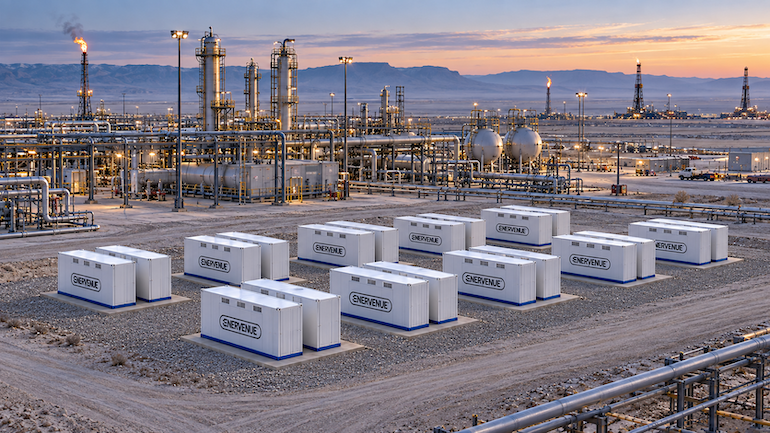
US-based energy storage company EnerVenue has secured its first commercial battery storage order at multi-megawatt-hour scale, with 26 Energy Prism containerised systems totalling 11 MWh to be installed at an oilfield in northern China.
The project will pair the storage units with an onsite solar array, allowing daytime generation to be stored and supplied to the oilfield as electricity demand changes. The first three units are scheduled for shipment in December 2026, followed by the remaining 23 in March 2027.
The order comes from a major Chinese oil and gas producer for an existing production site. EnerVenue has not disclosed the customer or the specific location.
Safety requirements were a key consideration in the battery selection, according to EnerVenue. The Energy Prism systems use the company’s fourth-generation Aqueous Metal Cell, a water-based nickel-hydrogen chemistry that does not use lithium.
EnerVenue says the cells do not present the thermal-runaway fire mechanism associated with conventional lithium-ion batteries and have passed UL 9540A testing without cell-level fire propagation. The company says the chemistry is intended for applications where fire and process-safety requirements place tight constraints on energy storage equipment.
The project also marks the first deployment of EnerVenue’s technology at this scale. Its initial Aqueous Metal Cell installation, a 150 kWh system combining renewable generation with electric bus charging, has been operating in Changzhou since November 2025.
The batteries for the new project will be manufactured at EnerVenue’s new production facility in Changzhou, Jiangsu, which is due to open on 24 September. The first phase has an annual capacity of 250 MWh, with expansion planned to 1 GWh in 2027 and multi-gigawatt-hour production from 2028.
EnerVenue specifies a design life of up to 30,000 cycles for its Aqueous Metal Cell, equivalent to three cycles a day for 30 years. The company says the technology does not require scheduled augmentation over that period.
The northern China installation will provide an early commercial test of the technology in a heavy-industrial setting, where storage must operate alongside an existing production facility and meet stringent safety requirements.


