
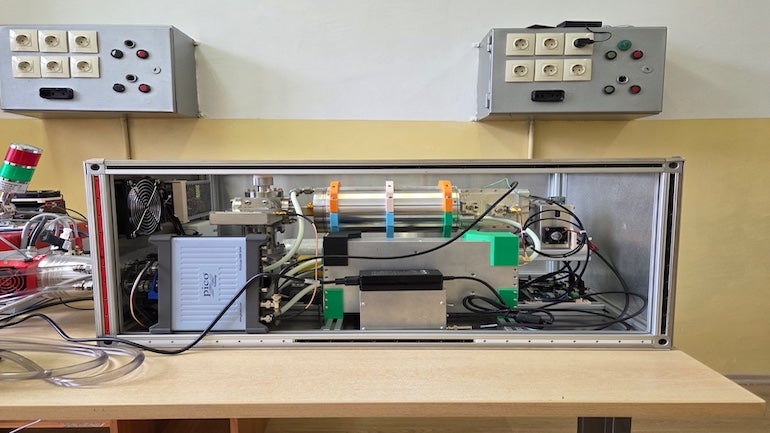
Alpha Ring, a prominent company in micro-fusion technology, has permanently installed its Alpha-E tabletop fusion device at Sofia University, marking a major milestone in the expansion of global access to hands-on fusion education. This is the first time fusion experiments have been available in a classroom in Europe.
The installation supports the launch of a new undergraduate course, Introduction to Nuclear Fusion Systems, within the University’s Department of Radiophysics and Electronics. Built around the Alpha-E device, which is being donated to Sofia University by alumnus Dr Kosta Yanev, the course gives students direct experience generating and diagnosing fusion reactions, allowing students to move beyond theory and into practical fusion experimentation for the first time.
Through 15 structured modules, students are to receive training in high-voltage systems, microwave plasma generation, ion beam formation, vacuum engineering, fusion reaction diagnostics, and cross-section measurements, culminating in direct observation and analysis of fusion products.
The permanent deployment formalises a Memorandum of Understanding signed between Alpha Ring and Sofia University two years ago. Since last April, the university has been trialling the Alpha-E device, integrating it into its Physical Electronics curriculum and enabling students to conduct laboratory-based plasma and fusion experiments.
Most notably, an undergraduate student has successfully used the Alpha-E device to complete a thesis titled “Measurement of Radiation in a Plasma Setup for Thermonuclear Fusion Research.” The project demonstrated deuterium-deuterium (D-D) fusion using the Alpha-E’s Electron Cyclotron Resonance (ECR) plasma source, with neutron detection confirmed via both internal detectors and an independent external system. The results validate the device’s capability as a working neutron source and a robust platform for university-level fusion research.
The Plasma Module expands the Alpha-E device’s capability from particle detection and fusion diagnostics into broader plasma physics education, a critical cornerstone of fusion physics. The combined system can operate as a standalone plasma source or integrate into larger experimental setups, giving institutions flexibility in how they structure laboratory teaching.
The installation follows Alpha-E’s first permanent installation at Purdue University in March and reflects Alpha Ring’s broader strategy for 2026: scaling its global footprint, embedding fusion devices into academic programmes, and building a distributed talent pipeline to support the commercialisation of fusion energy.


