
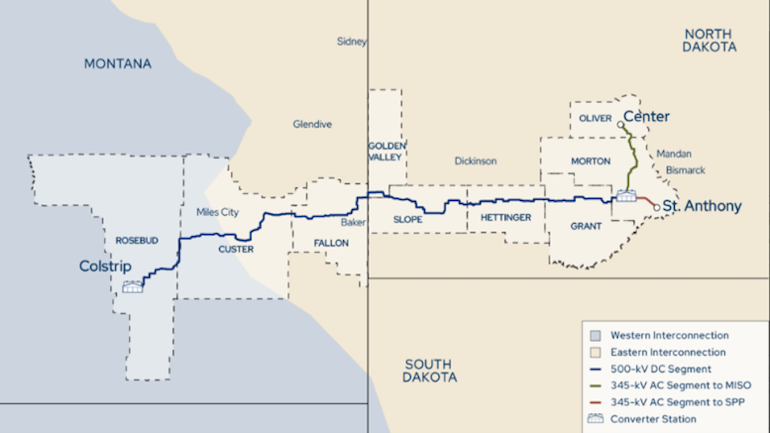
The proposed North Plains Connector transmission project has reached a major regulatory milestone, with the US Department of Energy (DOE) and Montana Department of Environmental Quality (MTDEQ) issuing the Final Environmental Impact Statement (FEIS) for the planned link between Montana and North Dakota.
The 422-mile, 525 kV HVDC overhead line is designed to connect the Western and Eastern US power grids, providing up to 3,000 MW of bidirectional transfer capacity. The project would run between Colstrip, Montana, and North Dakota, creating a new high-capacity connection between the two previously separate interconnections.
The FEIS follows publication of a Draft Environmental Impact Statement in January 2026 and incorporates comments received during the subsequent 45-day public consultation. It also reflects changes to the proposed route and construction plans made by the project developer during the environmental review.
For the regional electricity system, the proposed interconnection could allow power to be transferred between the Western and Eastern Interconnections in response to changes in generation and demand. That could provide an additional source of flexibility during periods of high demand or supply disruption, while also increasing access to generation resources on either side of the connection.
“Connecting our nation’s eastern and western power grids is a critical step toward ensuring long-term energy affordability and reliability for millions of Americans,” said Catherine Jereza, assistant secretary for the DOE’s Office of Electricity.
The FEIS does not itself constitute final approval to build the line. Rather, it represents a further step in the federal and state environmental review process.
The project is particularly significant because the proposed 525 kV HVDC connection would operate across the boundary between the country’s two major synchronous grid regions. Its 3,000 MW transfer capability would provide a substantial new pathway for moving electricity between them.
The environmental review will now feed into subsequent federal and state decisions concerning the project. Further route and construction refinements may also be required before development can proceed.


