
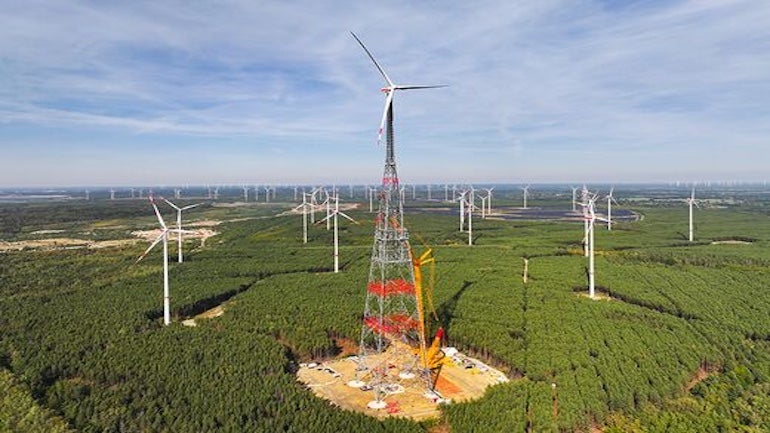
A high-altitude wind turbine developed by GICON has reached a total height of 365 metres at a pilot site in Schipkau, Germany, with its telescoping tower now extended to its final position.
The inner tower was raised to a hub height of 300 metres using a strand jack system. The tower was then locked into its extended position. Final construction work is expected to continue for several days, with commissioning of the tower planned for November.
The pilot project was commissioned by Germany’s Federal Agency for Disruptive Innovation (SPRIND) and is designed to test whether wind turbines can produce more energy by operating at greater heights, where wind conditions can be stronger and more consistent.
GICON says the 3.8 MW pilot turbine could produce roughly twice the energy of a conventional turbine with the same rotor diameter. Future versions are planned with rated outputs above 7 MW.
“This is an overwhelming moment for our entire team,” said Prof Dr Jochen Großmann, founder and CEO of GICON. “What was long a challenging idea and then an equally challenging construction project now stands as a globally unique facility in Schipkau.”
The project uses a telescoping tower rather than a conventional fixed-height structure, allowing the turbine to be raised to a hub height substantially above that of most existing onshore wind installations.
Dr Martin Chaumet, innovation manager at SPRIND, said the project had moved from an experimental concept to a working installation, describing the achievement as an important milestone for the technology.
The completion of the pilot is also intended to provide a basis for developing commercial versions. GICON estimates that as many as 4,000 high-altitude turbines could potentially be installed as a second tier at existing German wind farms, adding generation without requiring additional wind farm sites.
The 365-metre structure is described by GICON as the world’s tallest wind turbine and the second-tallest structure in Germany. The project is now moving towards commissioning and assessment of its performance before potential commercial deployment.


