
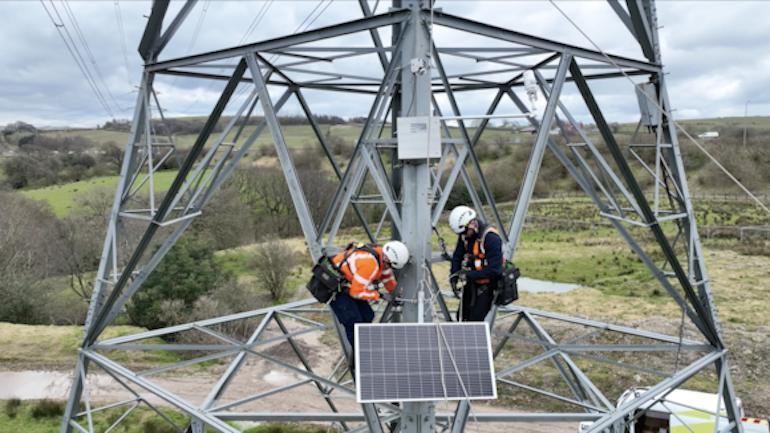
The UK’s National Grid has announced a significant expansion of Dynamic Line Rating technology across its electricity transmission network in England and Wales. Under a new five-year contract, DLR will be deployed across an additional 585 km of key north-to-south transmission routes, potentially saving consumers up to £50 million.
Meeting the growing demand for electricity requires both new infrastructure and smarter use of what already exists. DLR, says National Grid, is an ‘innovative yet proven’ technology that continuously monitors overhead line conditions to calculate a real-time capacity rating based on actual conductor behaviour and local weather, rather than the fixed conservative assumptions that have historically governed line ratings.
The result is a reliable optimisation of available capacity on existing infrastructure, with the sensors and data analytics platforms allowing for a safe increase by an average of 8% of the power carrying capacity of a circuit. This reduces the need for constraint payments, where a generator is paid to stop generating to avoid overloading the electricity network.
Installations will take place across three network boundaries (in the Northeast on 345 km of overhead line, in the Humber area and East Anglia covering an additional 240 km) with further installations planned over the five year contract period. This additional rollout means that 39 circuits, covering over 900 km of National Grid’s transmission network, primarily key north to south power flow routes, will now have the technology installed.
DLR is one of a number of innovative technologies National Grid is deploying to manage and upgrade its network. Initiatives include deploying advanced power flow controllers, which intelligently and instantly route power through circuits which have available capacity, artificial intelligence, which allows data centres to adjust their energy use in real time and drones to capture images and data to inform maintenance and investment programmes. Across the RIIO-T2 regulatory period (2021 to 2026), National Grid Electricity Transmission’s DLR installations are said to have saved £21 million in constraint costs and formed part of the deployment of grid enhancing technologies and upgrade of existing lines that has added over 16 GW of new transfer capacity to the network.
The work is being completed in partnership with three companies, LineVision, Ampacimon, and Heimdall. The majority of installations are expected to be complete by 2028 and will be delivered through a variety of different solutions, including using drones to mount sensors to live power lines, avoiding the need to wait for planned outages of key transmission routes.
Transmission power lines have historically been operated using a ‘static’ line rating calculated using conservative and static values for assumed weather conditions. Sensors that continually monitor lines provide continuous data in order to calculate a dynamic line rating that can be used by network operators to maximise the amount of power that can safely be transmitted through that transmission line.
Testing process
This expansion of DLR across National Grid’s network follows 8 years of testing and expansion with US-based DLR provider LineVision. Following successful implementation of the technology on National Grid’s networks in New York and Massachusetts, National Grid ran a two-year trial on a 275 kV transmission circuit between Penwortham and Kirkby in Cumbria between 2022 and 2024.
In 2025 the technology was expanded to cover nine further circuits, together increasing the capacity of over 275 kilometres of OHL conductor.


