
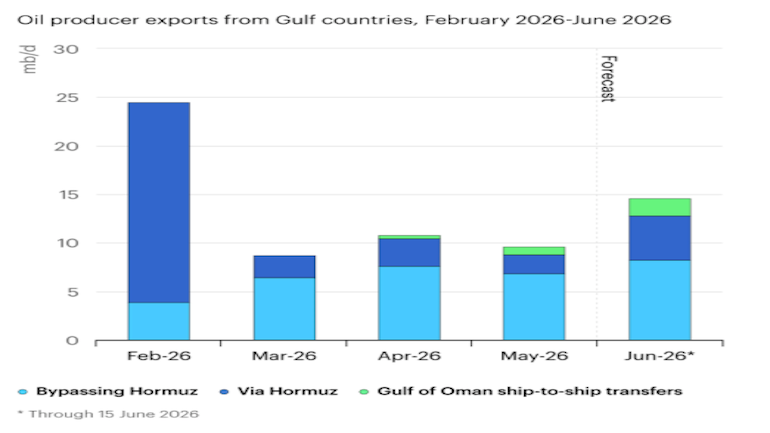
The international Energy Agency reports that oil prices have eased substantially in recent weeks on signs that fuel exports through the Strait of Hormuz have started to recover, underpinned by the interim agreement between the United States and Iran in mid-June seeking to reopen the Strait and to lay the foundations for ‘a lasting peace’.
A full recovery will nevertheless take time, according to the IEA’s latest monthly Oil Market Report. Mines must be cleared from shipping lanes while tanker traffic and supply chains need to normalise. Nonetheless, the prospect of higher export flows provides some relief ahead of the peak summer demand season.
Oil demand has shifted considerably over the past four months in response to the crisis, with many consumers scaling back their energy use and governments taking steps to shelter households and businesses from the impacts, particularly in the Asia-Pacific region. The IEA’s latest forecast sees global oil demand falling by almost 5 million barrels per day in the second quarter of 2026 compared with the same period a year earlier.
There have also been three crucial adjustments on the supply side, as the IEA’s commentary highlights. First, a surge in oil prices incentivised market participants to draw down inventories at record rates, while the IEA’s largest-ever release of emergency stocks brought additional barrels to market. Second, there have been key responses from exporters, with some Gulf producers using alternative routes to market that bypassed the Strait, and a surge in crude exports from other suppliers, most notably the United States. Thirdly, the global refining system has made rapid adjustments to compensate not only for losses of Middle Eastern crude oil, but also for the collapse in exports of refined products from the region.
Another major factor in the readjustment was the steep drop in China’s crude oil imports, which fell by 40%, 4.6 million barrels per day, between February and May, helping significantly to ease wider pressures in the global market. But oil market outlook nonetheless remains highly uncertain.
Security issues
Disruptions to oil and gas flows through the Strait of Hormuz have drawn attention to structural risks in Southeast Asia’s energy sector, the IEA’s report finds – with stronger action needed to bolster energy security and affordability as the region’s energy use soars.
The 2026 edition of its Southeast Asia Energy Outlook provides what is said to be a comprehensive assessment of the latest energy developments across a fast-growing region, as well as updated projections for the coming decades. As energy security concerns move progressively higher on the policy agenda for countries in Southeast Asia and beyond, this year’s report explores the trajectory that the region was on prior to the current energy crisis, and considers the potential implications of the crisis for policy priorities and investment strategies.


