

US-based PVFARM has launched the commercial version of RE STACK, a software platform designed to help developers and engineering, procurement and construction (EPC) companies explore layouts for utility-scale battery energy storage systems before detailed engineering begins.
The commercial launch follows a beta programme involving more than 80 companies, with 45 organisations signing up within its first month.
PVFARM has developed RE STACK alongside its existing renewable energy design tools, including RE PILOT. The platform is aimed at BESS developers and EPC teams that need to assess equipment configurations and site constraints at an early stage.
Utility-scale battery projects can require numerous layout iterations before a practical design emerges. PVFARM says RE STACK is intended to move more of that exploration earlier in the development process, when changes are easier and less costly to make.
The platform allows engineers to work from battery manufacturer specifications and investigate equipment configurations, site layouts, access roads and medium-voltage collection topologies. It can generate and compare multiple layout options, helping teams assess equipment density and the effect of different design assumptions on site utilisation.
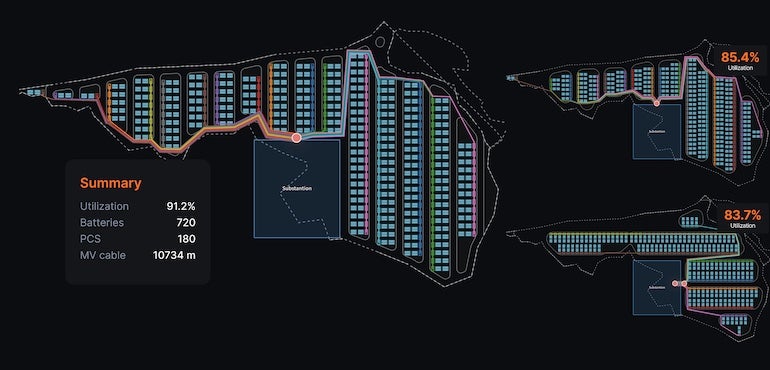
The beta programme also exposed the software to practical project issues including power conversion system architecture, augmentation planning, fire-access requirements and site topology.
Vatan Kumar, Vice President of Development Engineering at Sun2O, said the platform had helped his team assess sites and save time.
“At Sun2O, we’ve received a lot of value and saved a lot of time from the platform,” he said. “RE STACK is a highly useful tool for evaluating our sites, understanding the challenges we face.”
For PVFARM, the underlying idea is to change how early-stage engineering decisions are made. Instead of starting with a desired storage capacity and working backwards towards an equipment arrangement, RE STACK focuses on what can actually be accommodated on a site and how different configurations affect the project.
“The future of engineering isn’t just designing faster. It’s exploring more before you design,” said Maksim Markevich, PVFARM’s Chief Technology Officer.
The launch comes as battery storage deployment accelerates and projects become more complex. Developers must increasingly weigh equipment selection, safety requirements, access, electrical infrastructure and land use before committing to detailed design.
By automating the concept-layout stage, PVFARM is betting that developers can compare more alternatives before locking in engineering decisions, potentially reducing redesign work later in a project’s development.


