
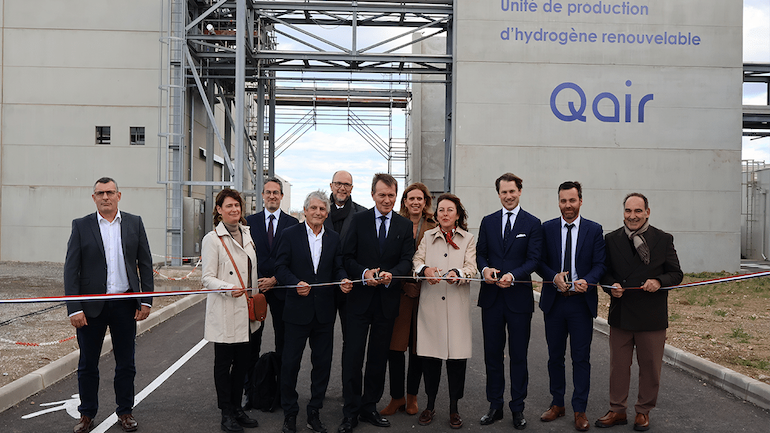
Qair has inaugurated the first phase of its Hyd’Occ renewable hydrogen production facility at Port-la-Nouvelle in southern France, marking a further development in the integration of renewable electricity with transport and industrial energy systems. The 20 MW facility uses water electrolysis powered by renewable electricity and is designed to produce up to 2,700 tonnes of renewable hydrogen annually.
Construction began in June 2023, with the plant producing its first hydrogen during trials in December 2025. Qair is now completing final adjustments and seeking certification under the EU’s Renewable Fuels of Non-Biological Origin (RFNBO) framework, which verifies the renewable origin of the hydrogen produced.
The project represents a total investment of €130 million, including €55 million in bank financing arranged with Crédit Agricole and Bpifrance for the production facility and associated refuelling infrastructure. A second phase is planned to increase electrolysis capacity to 40 MW and annual hydrogen production to 5,400 tonnes. Qair estimates that the initial 20 MW phase could avoid approximately 27,000 tonnes of CO₂ emissions annually.
From a power systems perspective, the facility demonstrates how electrolysers can connect renewable electricity generation with other energy sectors. By converting electricity into hydrogen, the plant provides a potential route for using surplus renewable generation and storing energy in chemical form for later use. Electrolysers can also offer demand-side flexibility if their operation is adjusted in response to electricity availability, prices and grid conditions.
Hyd’Occ is supported by a regional network of hydrogen refuelling stations, with facilities in Béziers and Narbonne commissioned in spring 2026. Each station is designed to supply up to 600 kg of hydrogen per day, primarily for heavy goods vehicles, buses, coaches and commercial fleets. Both form part of the Corridor H2 Occitanie initiative, which aims to establish a hydrogen transport corridor linking the Iberian Peninsula with northern Europe. The Béziers station already supplies 13 hydrogen-powered buses operated by the local urban authority.
The project also extends into maritime applications. Hydrogen produced at Hyd’Occ will supply HydrOMer, a dredger equipped with a 200 kW fuel cell and intended to operate partly on hydrogen in ports including Port-la-Nouvelle, Sète-Frontignan and Le Grau-du-Roi. Qair estimates that the vessel could avoid approximately 700 tonnes of CO₂ emissions annually.
Jean-Sébastien Lasbouygues, director of Qair France’s hydrogen business unit, said the project is intended to support the development of both renewable hydrogen supply and demand across the region.
The development highlights the growing role of power-to-hydrogen technologies in modern energy systems, particularly in connecting renewable electricity with long-duration energy storage opportunities and hard-to-electrify sectors. While hydrogen production involves conversion losses and its contribution to grid flexibility will depend on how electrolysers are operated, projects such as Hyd’Occ demonstrate the potential for greater integration between electricity, transport and industrial energy infrastructure.


