
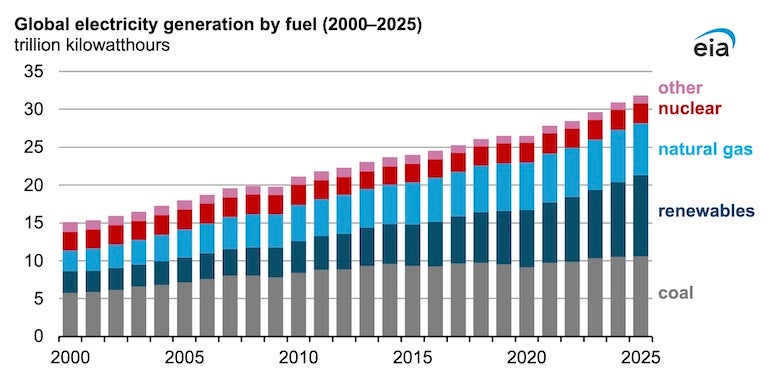
Global electricity generation reached 31.8 trillion kilowatt-hours (kWh) in 2025, more than twice the 15.1 trillion kWh recorded in 2000, according to updated International Energy Statistics.
Renewable energy became the largest source of global electricity for the first time in 2025, accounting for 34% of generation, compared with 33% from coal. Renewable generation rose from 2.9 trillion kWh in 2000 to 10.6 trillion kWh in 2025, while coal-fired output increased by 83% between 2000 and 2024, from 5.8 trillion kWh to 10.5 trillion kWh. Coal’s share of the global mix has fallen from a peak of 41% in 2007.
China, the United States and India remained the world’s three largest electricity generators. Together, they produced 17.3 trillion kWh in 2025, exceeding the combined output of all other countries.
China generated 10.7 trillion kWh, more than one-third of the global total. Its output has grown at an average annual rate of 9% since 2000, when generation stood at 1.4 trillion kWh. Coal supplied more than half of China’s electricity in 2025, while renewables contributed over one-third.
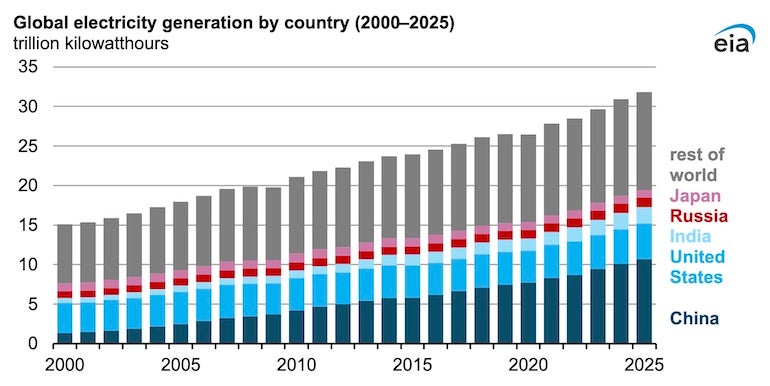
The US produced 4.5 trillion kWh, with natural gas accounting for 40% of generation, renewables 26% and nuclear 17%. After average annual growth of less than 1% between 2000 and 2020, US generation expanded by 2% a year from 2020 to 2025. Rising commercial-sector demand, including from data centres, contributed to the increase.
India generated 2.1 trillion kWh, around 70% of it from coal. Its electricity output more than tripled between 2000 and 2025, growing by an average of 5% annually. Population growth and expansion of manufacturing have contributed to rising demand.
The figures highlight both the scale of global electricity demand growth and the changing composition of the generation mix, with renewables now providing the largest share worldwide.
* Renewables includes electricity generation from hydroelectricity, geothermal, solar, wind, tidal and wave power, biomass and waste. Solar generation covers photovoltaic and solar thermal power, as well as distributed solar generation where available. US biomass and waste generation includes wood and waste, alongside other generation sources. Other comprises generation from oil, other gases and pumped-storage hydropower.


