
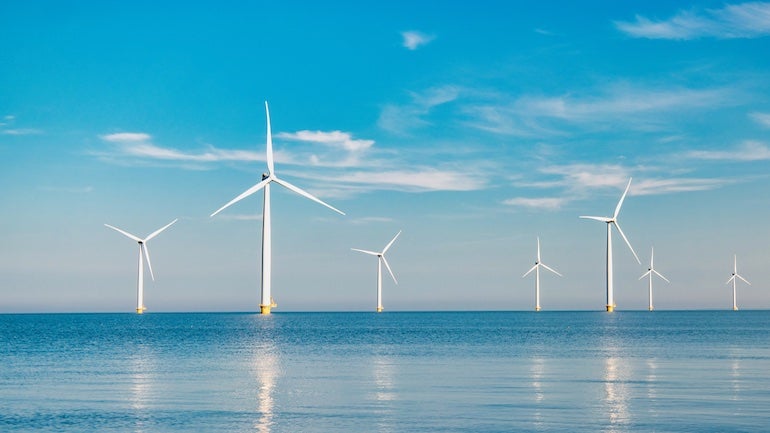
RWE and investment firm KKR have secured £12bn in financing for two major offshore wind farms in the North Sea, clearing a significant hurdle towards construction of what will be one of the UK’s largest offshore wind developments.
Financial close has been reached on the 1.4 GW Vanguard West and 1.4 GW Vanguard East projects, which will have a combined generating capacity of 2.8 GW.
Located between 50 km and 80 km off the Norfolk coast in East Anglia, the projects are scheduled to enter offshore construction in early 2027, with both expected to be fully operational by 2030.
The financing comprises £11.1bn in cash facilities and £1.7bn in ancillary facilities from a consortium of 35 international banks. RWE says this represents the largest project financing secured to date for UK offshore wind.
The package also includes a £1bn commitment from the UK’s National Wealth Fund, alongside credit cover from Germany’s Euler Hermes and Denmark’s EIFO. It marks the first participation by the National Wealth Fund and Euler Hermes in a UK offshore wind project financing.
The investment will be supported by equity from both partners and non-recourse project financing. KKR has acquired a 50% stake in each development, completing the joint venture announced in January 2026. RWE will lead project development and delivery, bringing its offshore wind experience together with KKR’s infrastructure investment expertise.
Both projects secured 20-year, inflation-indexed Contracts for Difference in the UK’s seventh allocation round, at a strike price of £91.20/MWh in 2024 prices.
Preparatory work is already well advanced, with onshore cable installation and substation construction under way. The projects will use coordinated grid infrastructure, designed to reduce environmental and community impacts. The first foundation installation for Vanguard West is planned for the first half of 2027, with Vanguard East to follow.
RWE chief executive Markus Krebber said the financing demonstrated lenders’ confidence in the projects and their delivery prospects.
“Securing the largest ever project financing in UK offshore wind also demonstrates our lenders’ trust in these projects and our ability to deliver them,” he said.
He added that the combined capacity would strengthen domestic electricity generation and contribute to a more resilient energy system, energy security and affordability.
For KKR, the investment represents a substantial commitment to UK energy infrastructure. Vincent Policard, co-head of European Infrastructure at KKR, said developments of this scale required significant private investment.
“Delivering at this scale requires substantial private investment, and KKR brings long-term capital, global infrastructure expertise and the ability to support complex projects through construction and operation,” he said.
The government has also highlighted the projects’ potential contribution to domestic energy security and industrial development.
Prime Minister Andy Burnham described the investment as a vote of confidence in UK renewable energy, linking increased domestic generation with reduced exposure to international energy market volatility.
“It is great news for billpayers because every turbine we put up is power under British control, not at the mercy of events on the other side of the world,” he said.
Energy Secretary Miatta Fahnbulleh said investment in offshore wind was supporting employment and industrial regeneration alongside the transition to lower-carbon electricity.
“Investment in offshore wind and clean power is creating quality jobs and rebuilding industry, while delivering the clean power we need to lower bills and reach net zero,” she said.
RenewableUK chief executive Tara Singh also welcomed the financial close, describing it as an important development for the sector. She noted that Vanguard East and West were the first projects from the seventh Contracts for Difference allocation round to reach this stage of development.
“RWE’s £12 billion announcement marks a great step forward for our world-leading offshore wind industry,” she said.
Singh also pointed to the next allocation round, with more than 17GW of offshore wind capacity eligible to compete in Allocation Round 8.
With financing secured and preparatory work progressing, attention now turns to construction. Delivering the two projects will require the installation of foundations, turbines, subsea cables and associated transmission infrastructure, with the 2030 commissioning target marking the next major milestone for the development.


