
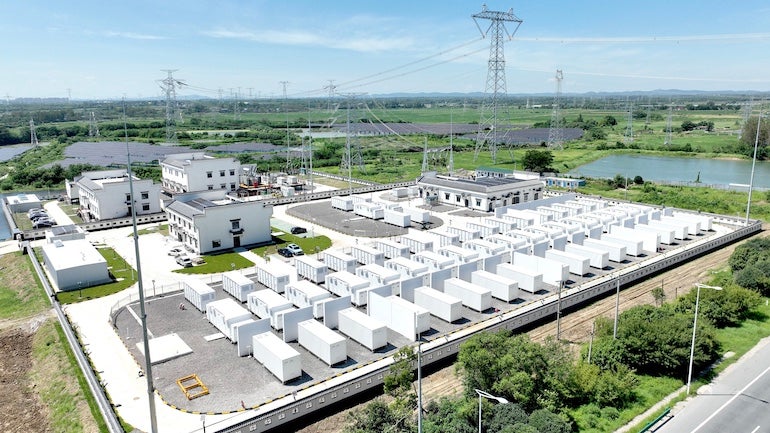
A 200 MW/400 MWh battery energy storage project has entered commercial operation after connecting to the grid, using Sungrow’s PowerTitan 3.0 storage system and 600 Ah-plus battery cells.
Sungrow said the project achieved grid connection, including commissioning, in just 17 days. The company did not disclose the project’s location or operator, although industry reports suggest the facility is in Anhui province, China. Sungrow said it supplied the energy storage technology and used its digital delivery and commissioning platform to coordinate manufacturing, logistics, installation and testing.
The rapid deployment highlights the growing focus across the battery storage industry on reducing construction and commissioning times as projects become larger and more complex. Sungrow’s full-chain intelligent delivery system provides digitised and visualised management across the project lifecycle, from order placement and intelligent manufacturing through logistics, commissioning and intelligent O&M. By enabling multiple activities to run in parallel rather than sequentially, the platform is designed to improve delivery efficiency and standardise project execution.
Sungrow said its self-developed delivery platform enables one-click self-configuration and self-check, while pre-installation and pre-commissioning allow equipment to be configured and tested before reaching the site. This reduced the final grid-connection commissioning process from more than 10 days to one hour. The plant subsequently achieved grid connection on its first attempt, according to the company.
The project is also designed to operate in high ambient temperatures, with temperatures at the site reaching 40°C. High temperatures can increase auxiliary power consumption and contribute to uneven battery ageing, making thermal management an important consideration for system performance and efficiency.
PowerTitan 3.0 uses a top-exhaust air outlet to reduce heat accumulation around the equipment. Sungrow’s Bionic Thermal Balance 2.0 system provides container-level thermal management and maintains temperature differences within 1°C, according to the company. Sungrow said the combined measures have reduced the project’s operating energy consumption by 10%.
Lower auxiliary power consumption can increase the proportion of stored electricity available for grid services, particularly during periods of high temperatures when cooling requirements are elevated.
The project illustrates how speed, standardisation and repeatability are becoming increasingly important alongside battery performance as energy storage projects scale up. For developers and system suppliers, the ability to streamline delivery, shorten commissioning and maintain performance under demanding operating conditions could become an increasingly important differentiator.
In May, Sungrow signed an agreement with Masdar to supply 7.5 GWh of PowerTitan 3.0 energy storage systems and 2.6 GW of PV inverters for the UAE’s gigascale round-the-clock renewable energy project in Abu Dhabi. The project, being developed by Masdar and Emirates Water and Electricity Company, will combine 5.2 GW of solar PV with 19 GWh of battery storage and is expected to begin operations in 2027.


