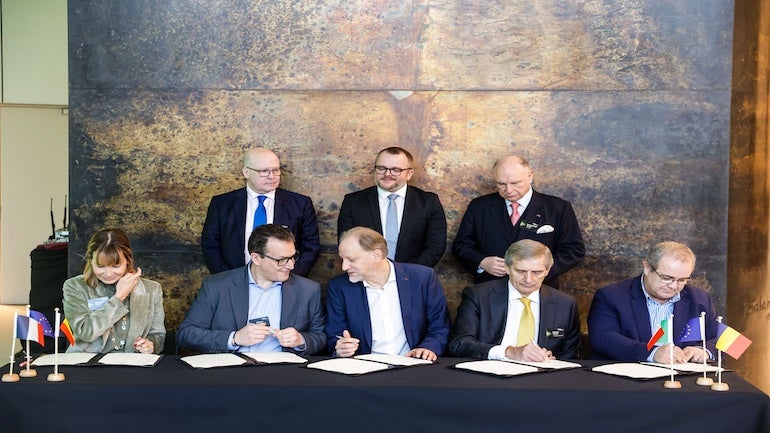
Belgium’s Minister of Energy, Mathieu Bihet, has announced a new collaboration between the EAGLES (European Advanced Generation IV Lead-Cooled Energy System) consortium and French nuclear technology company newcleo. The partnership was unveiled during the high-level “Taking the Lead” event on EAGLES‑300 and marks a significant step towards the development of advanced lead‑cooled Small Modular Reactors (SMRs) in Europe.
The EAGLES consortium – comprising Ansaldo Nucleare, ENEA, RATEN and SCK CEN – will work with newcleo on the LEANDREA project, a limited‑power reactor scheduled for completion by 2034 at the Belgian Nuclear Research Centre (SCK CEN) in Mol. LEANDREA will serve as both a technology demonstrator and a research and test facility for materials and fuel experiments designed to support fast‑reactor innovation.
The aim is to pool expertise and resources to accelerate progress in lead-cooled fast reactor (LFR) technology, a field seen as crucial to Europe’s low‑carbon energy transition. Once operational, LEANDREA will provide new irradiation capacity for testing next‑generation nuclear materials, creating a cornerstone for future commercial reactors.
The initiative forms part of a broader European roadmap: LEANDREA will precede ALFRED, a performance demonstrator planned for Romania, paving the way for the commercial deployment of the 300 MWe EAGLES‑300 SMR by 2039. In parallel, newcleo continues to develop its own LFR design, targeting early 2030s commercialisation.
By joining forces, EAGLES and newcleo aim to align research, share engineering support, and reduce duplication of effort within Europe’s fast‑reactor programs. The partnership also reinforces alignment with nuclear safety regulators under the International Atomic Energy Agency’s Nuclear Harmonization and Standardization Initiative (NHSI) – a pioneering step towards coordinated, multinational licensing of advanced SMRs.
According to the partners, the cooperation reflects Europe’s determination to strengthen energy autonomy and build a sustainable, secure reactor technology base. As Minister Bihet noted, ensuring extensive testing and cross‑border collaboration is vital to keeping European nuclear innovation at the forefront of the global energy transition.


