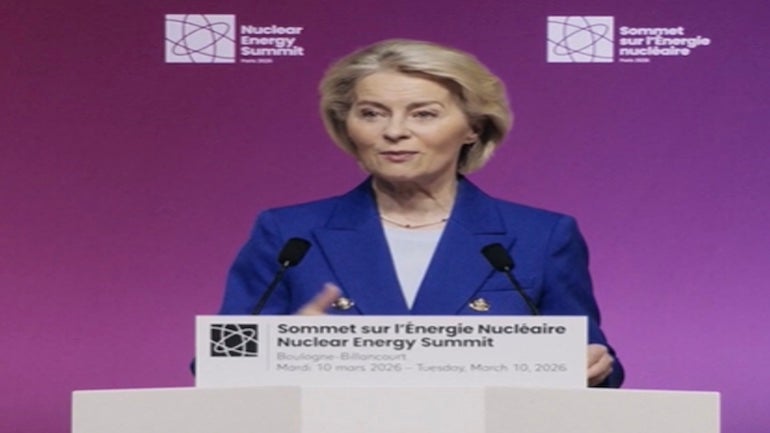
European Commission President Ursula von der Leyen, in a speech to the second Nuclear Energy Summit in Paris, said reducing Europe’s nuclear energy was a “strategic mistake”. Noting that Europe’s electricity prices are structurally too high, she said: “This matters enormously because affordable electricity is not only important for our citizens’ cost of living, but it is also decisive for our industrial competitiveness.” Robotics and AI will drive the next wave of innovation and productivity, across all industrial sectors and both require affordable electricity in abundance.
Europe is neither an oil nor a gas producer and is completely dependent on expensive and volatile imports, she said, citing the current Middle East crisis as “a stark reminder of the vulnerabilities this creates”. But “we have home-grown low-carbon energy sources: nuclear and renewables – together, they can become the joint guarantors of independence, security of supply, and competitiveness if we get it right now”
While Europe has made great progress on renewables, “the nuclear story, unfortunately, is different,” she noted. “While in 1990 one-third of Europe’s electricity came from nuclear, today it is only close to 15%. This reduction in the share of nuclear was a choice, I believe that it was a strategic mistake for Europe to turn its back on a reliable, affordable source of low-emissions power.”
She added: “Nuclear energy is reliable, providing electricity all year, around the clock. So the most efficient system combines nuclear and renewables, and is underpinned by storage, flexibility, and grids…. Europe has been a pioneer in nuclear technology and could once again lead the world in it. Next-generation nuclear reactors could become a European high-tech high-value export.”
Europe wants to be part of the global revival of nuclear energy. “Last year, we changed our State Aid rules to expand support for nuclear fission and fuels. We launched the world’s first industrial alliance for small modular reactors and proposed to invest over €5bn ($5.8bn) in our next budget on fusion research, notably through ITER. But after years of declining investment, we need more to turn the tide.”
Von der Leyen presented a new European Strategy for small modular reactors (SMRs). “Our goal is simple. We want this new technology to be operational in Europe by the early 2030s, so that it can play a key role alongside traditional nuclear reactors, in a flexible, safe, and efficient energy system.
She said the EC is proposing three main sets of measures. “First, we need simple rules. We will create regulatory sandboxes so that companies can test innovative technology. And we will work with member states so that rules are aligned across borders. The logic is clear. When it is safe to deploy, it must be simple to deploy – all across Europe.”
Second is the need to mobilise investment. “Today I can announce that we will create a €200m guarantee to support private investment in innovative nuclear technologies. And the resources will come from our Emissions Trading System. Not only will we derisk investments in these low-carbon technologies, we also want to give a clear signal for other investors to join. This is one concrete step and part of a broader effort to improve the investment conditions for Europe’s nuclear sector.”
Third, this must be a joint European effort. The SMR business model needs scale, so cooperation across European borders is vital. “This is why we will work with member states to align their regulatory frameworks, speed up permitting, and develop the skills the sector needs. Companies from member states and trusted partners should also come together. For instance, they could co-invest in research, in testing facilities and in creating European value chains for nuclear fuels.”
But EC ambition is not limited to SMRs. “We also need to strengthen the wider nuclear ecosystem – from fuel to technology, from supply chains to skills. This is also the purpose of our Clean Energy Investment Strategy – to lower energy costs, to accelerate the deployment of clean technologies and to open up more financing opportunities.”
She concluded: “The nuclear tech race is on. But we know that Europe has everything it needs to lead. We have half a million highly skilled workers in nuclear – far more than the US and China. We lead global innovation in modular reactors. And now we have the ambition to move at speed and scale for Europe to be a global hub of next-generation nuclear energy.”
However, Von der Leyen’s home country of Germany took a political decision under Chancellor Angela Merkel to phase out NPPs in the wake of the 2011 Fukushima disaster. Von der Leyen was a minister in Merkel’s government when that decision was made and did not oppose it but publicly supported the decision at the time. In a 2011 interview, as the then-Minister for Labour, she hailed the phase-out as a necessary response to the Fukushima disaster, stating, “We must say goodbye to old certainties, even if it is difficult”. She was a senior member of Angela Merkel’s cabinet during the 2011 decision-making process and continued serving as Defence Minister (2013–2019) while the policy was being implemented.
Despite rapidly expanding renewables, fossil fuels still dominate energy consumption in sectors such as transport and heating not only in Germany but in Europe in general. Dependence on imported oil and gas resulted in rising energy prices in 2022, after the EU sanctioned Russian oil and gas – a situation now massively exacerbated by the effects on Middle East supplies due to the US-Israeli war on Iran.
This makes the nuclear option increasingly attractive. However, the EU budget does not directly fund nuclear energy projects because nuclear is not unanimously supported by its 27 member governments. Only 13 member states have nuclear generation, with some, such as Germany, Luxemburg and Austria, remaining adamantly opposed to it. This is why the EC’s proposed €200m guarantee for private investments in innovative nuclear technologies will be financed through the EU’s carbon market.


