
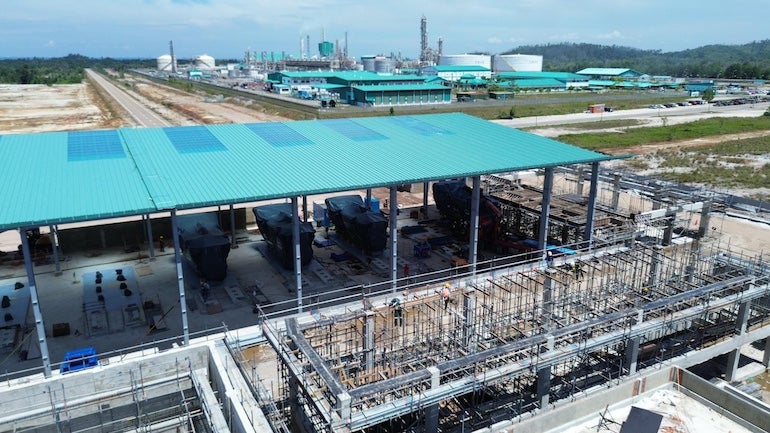
Everllence (formerly MAN ES) is supplying a total of 14 large engines with a combined output of over 240 MW to three new power plant projects on the Malaysian part of the island of Borneo. The plants will supply power to a solar-glass production facility as well as to the Malaysian national grid.
Malaysia is pursuing ambitious decarbonisation targets with climate-neutrality to be achieved by 2050, primarily through the expansion of hydropower and solar energy. In a market traditionally dominated by gas turbines, piston engine based power plants are gaining importance. Thanks to their rapid response times and high efficiency at partial loads, such engines are ideally suited to balancing fluctuating renewable input – whether for grid stabilisation or providing continuous power.
Martin Chmiela, Head of Power, Asia Pacific, at Everllence, said: “Malaysia is a market with enormous momentum in terms of industrial development, energy demand and climate goals. The state of Sabah alone aims to increase its share of renewable energy to 35% by 2035. With our efficient and flexible engine technology, we are making a decisive contribution to the energy transition as a partner to renewables, rendering them a reliable grid power source.”
One of the new Malaysian contracts signed by Everllence is that with KAB Energy Holdings to supply seven 18V51/60DF engines with a total output of 120 MW. These are for a new gas fuelled power plant being built on Labuan Island, a key industrial area off the coast of Borneo. The new power plant is being built to replace retiring assets and to supply the local grid as well as to serve a region that has seen strong growth in manufacturing in recent years. KAB Energy Holdings is responsible for engineering, procurement and construction. Commissioning is planned for the end of 2026.
In addition, Everllence is supplying six 18V51/60DF engines for a power plant in Kimanis, Sabah. With a total output of around 100 MW, the plant will help meet rising power demand from the grid. One key factor favouring Everllence for this project was its fast delivery capability for the main equipment.
“The 18V51/60DF engines allow seamless switching between gaseous and liquid fuels during operation,” said Martin Chmiela. “This makes a significant contribution to energy security for a Sabah grid which is still dependent on natural gas in its energy mix.”
The Kimanis order builds on the success of a previous Everllence project, in Sipitang, Sabah, where a 7x20V35/44G power plant is currently under construction to provide decentralised energy for an FLNG extraction platform.
For the end user, deploying Everllence engines in both Sipitang and on Labuan Island significantly simplifies maintenance and staff training – a real advantage in day-to-day operations.


