
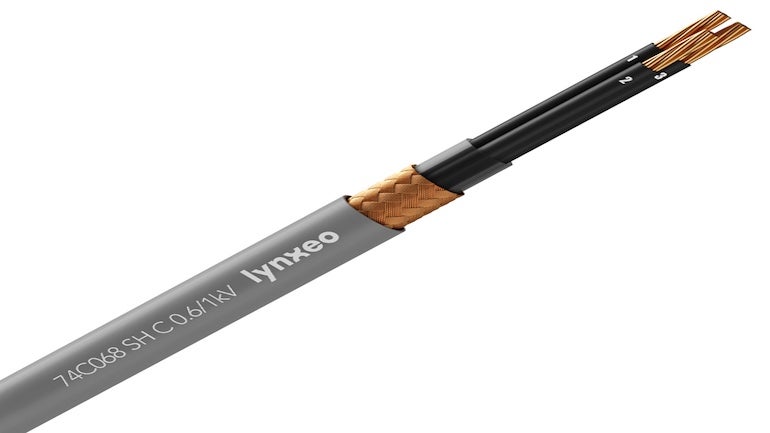
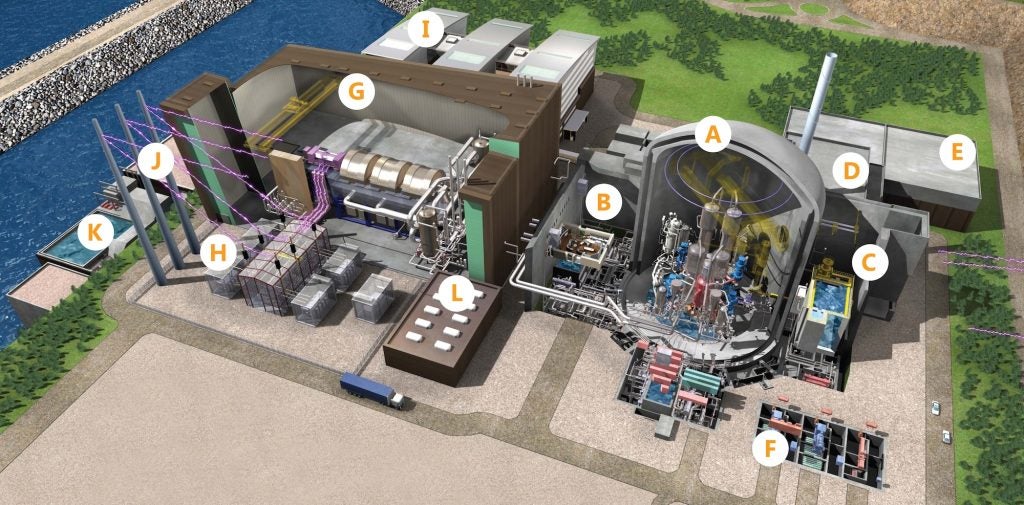
Within the hostile environment of the pressurised water reactor nuclear island – which includes reactor vessel, steam generators, and safety systems – electrical equipment must be able to function reliably and safely under elevated temperatures, high humidity, and substantial levels of radiation. Most importantly, this equipment must remain operational during and after severe accidents, such as a loss of coolant accident (LOCA) or a steam line break accident (SLBA), where sudden environmental changes occur within the containment.
Cables specifically designed and qualified for use in the nuclear island environment are classified under very stringent standards. These low voltage (LV) and medium voltage (MV) cables must meet rigorous criteria for thermal and radiological ageing resistance, as well as accident scenarios within the containment zone:
K1 cables are qualified for the most demanding conditions, including exposure to gamma radiation and proven performance in LOCA scenarios. They are installed in areas where both high radiation and accident conditions are possible.
K2 cables are designed to be gamma radiation resistant, for use in areas where significant radiation exposure is anticipated, but not necessarily under LOCA conditions.
K3 cables are intended for use in the conventional island, also known as the non-nuclear or turbine island. This includes systems such as turbines, generators, condensers, feedwater systems, and auxiliary power supplies. They are exposed to normal industrial conditions rather than radiation.
In addition, all nuclear safety cables must demonstrate proven performance in accordance with IEC 60216. This guarantees reliable operation over a service life of 60 years under continuous exposure to an ambient temperature of 90°C.
By adhering to these protocols and standards, and by carefully selecting the cable types appropriate to their installation environment, nuclear facilities ensure the long-term safety, reliability, and compliance of their electrical infrastructure. A single EDF EPR third generation PWR might require around 5000 km of various types of cable.
Accelerated ageing
The main concern for nuclear power plant operators is of course safety. They must be able to achieve a controlled shutdown of the reactor under all projected scenarios and prevent any release of radioactive material. All equipment must be qualified to operate in these conditions, even in the event of the most severe accidents.
Cables must continue to serve numerous systems, such as pumps, valves, generators and all kinds of essential monitoring equipment for pressure, temperature, radiation, etc. Special cable qualification procedures are applied to confirm ability to survive severe irradiation and hot steam/water at high pressure. In addition to qualification procedures prior to installation, cables undergo mandatory condition monitoring on site to ensure sustained performance over time.
It is extremely important for cables to be resistant to degradation over time, to be able to fulfil their expected safety function over the full lifetime of the power station. If cables don’t last long enough, they are very difficult to replace because they are often installed in inaccessible or sealed areas. That means cable replacement would result in very long outage times. That is why Lynxeo ENERGEN® cables are designed to meet the industry expected lifetime of 60 years.
To reduce susceptibility to ageing, we expose cables to artificial ageing procedures that reproduce the actual damage that occurs over time. For cables outside the reactor core, the biggest concern is degradation of polymers by oxidation. Since oxidation is caused by ambient air, and accelerated by heat, the ageing tests are conducted by exposing the cables to very high temperatures. Additionally, cables have to resist high levels of radiation.
Thermal ageing
Ageing refers to a loss of certain properties over time. Oxygen reacts with the polymer chains, making them hard and brittle. This process is strongly correlated with temperature and can be described by the Arrhenius model. This provides a basis to extrapolate the expected lifetime at low temperature from experimental data obtained at high temperature in a relatively short period. According to this model, the logarithm of the lifetime is a linear function of the inverse absolute temperature (1/Kelvin).
Arrhenius test results are used to define specific accelerated ageing test conditions for the whole cable, representing the expected lifetime. For non LOCA cables, the evaluation stops there. For LOCA cables, further tests are required. To ensure good ageing resistance, our R&D laboratories have developed, tested and applied special polymer formulations.
Radiation ageing and accident radiation
Radiation can cause and accelerate the same degradation mechanisms as thermal ageing, especially when the cables are exposed to air. Depending on three main parameters, dose rate, integrated dose, and temperature, polymers can become hard and brittle. The dose absorbed by the cable varies depending on its location within the reactor building. It is low under normal operating conditions. To confirm a cable’s resistance during an accident, much higher doses are applied during the qualification process.
In case of an accident, cables must resist strong radiation with both high dose rate and high integrated dose. The resistance of a cable to both ageing and radiation is tested with a single cumulative dose of up to 2 000 kGy, depending on reactor design. This dose is very high compared to a lethal dose for humans of about 0.005 kGy.
Loss of coolant accident
The safety of a PWR relies on the safe transfer of heat produced within the reactor vessel. PWRs use water as their cooling fluid and one of the most severe accident scenarios involves a leak in the primary cooling circuit.
In this scenario, large quantities of radioactive water at high temperature are released within the reactor containment, resulting in high pressures, temperatures and radiation levels. Design-specific emergency cooling and shutdown systems then reduce temperature and pressure until they return to nominal levels. In the meantime, safety-related equipment must continue to operate.
Cables qualified to 1E LOCA ensure power is delivered to the equipment and instrument readings are fed back to the control room.
The precise LOCA scenario depends on reactor type, location in the reactor and the actions/reactions of the safety systems.
LOCA cable tests are carried out in specially equipped autoclaves that allow the application to the cable samples of conditions arising from prescribed scenarios. At Lynxeo we have our own autoclave. This enables us to carry out tests beyond the usual specified parameters to anticipate future customer needs (up to 250°C and 20 bar).
Fire reaction
Fire reaction is also a vital consideration for nuclear cables. For a fire to form and spread, three elements must be present: combustible material; oxygen; and a heat source. There are two main phases in the development of a fire:
- The initial spreading phase, when the fire spreads slowly and can be kept under control.
- The combustion phase, when it can no longer be kept under control.
- The transition between the two phases is called the “flash over point.”
Cables are classified according to:
- fire reaction, which refers to their role as passive elements during a fire, characterised by flammability, fire spread, heat release, smoke emission and toxicity.
- fire resistance, which reflects their role as active elements characterised by electrical continuity under fire conditions.
Fire resistance is a key consideration as circuit integrity must be maintained when cables are subjected to fire under specified conditions. This includes the standard procedure for checking continuity as well as evaluating test results for low voltage power cables and control cables with rated voltage. Depending on which section of the standard is referenced, two different temperatures are used for fire resistance assessment: 750°C (IEC 60331-11); or 830°C (IEC 60331-1 & -2).
The cable must demonstrate electrical continuity – its ability to continue to operate in the designated manner whilst subjected to a specified flame source for a certain period (90 minutes of flame application is typical).
Smoke and gas emissions during fire
Also critical to fire safety are smoke and gas emissions. Smoke can be more dangerous than the fire that creates it, due to its opaque and toxic nature.
Cables are installed throughout the entire facility. Therefore, during a fire, they can increase emissions of dense, corrosive and toxic smoke. To greatly reduce the level of emissions, as well as their toxicity and corrosivity, materials which do not contain halogens, known as Halogen Free Fire Retardant (HFFR) or Low Smoke Zero Halogen (LSOH), are used for both cable insulation and sheathing.
Certified expertise
Nuclear safety is not limited to just the designers and manufacturers of power plant components such as cables. It involves all players in the value chain, from engineers to operators, subcontractors and suppliers. Each link plays an essential role in guaranteeing a safe environment.
That is why we have implemented a comprehensive set of rigorous measures to ensure that all our employees and partners fully understand their responsibilities. Our goal is to ensure that everyone involved in our operations – regardless of their function – is thoroughly aware of, and trained in, the safety requirements unique to the nuclear industry.
The ISO 19443 certification of Lynxeo’s lead manufacturing factory in Mehun-sur-Yèvre, France, provides a reference framework that guarantees risk control and the continuous improvement of safety practices. The standard defines the requirements for quality management systems in the nuclear supply chain. It imposes rigorous risk management, full traceability throughout the product lifecycle, and a strengthened safety culture among suppliers.
For major projects such as Hinkley Point C, Sizewell C, and the French EPRs, ISO 19443 guides audits and the qualification of subcontractors, enhancing transparency and accountability within the supply chain. It promotes continuous improvement of processes and helps reduce potential failures, thereby improving the overall reliability of civil nuclear stakeholders.
For Lynxeo, ISO 19443 certification reflects a high level of commitment to quality and nuclear safety. It positions us as a reliable partner, capable of contributing to complex and highly regulated projects, while ensuring controlled risk management and a continuous improvement approach within the supply chain.
For more information, visit: lynxeogroup.com


