
Grid-scale battery energy storage system (BESS) projects are now dominated by lithium iron phosphate (LFP) batteries, where they have overtaken nickel manganese cobalt (NMC) technology. This is due to their cost-effectiveness, durability, reduced safety concerns, and supply chain advantages. But LFP technology comes with a persistent challenge: accurately estimating the battery’s state-of-charge.
Traditional battery management systems (BMS) use two methods to estimate SOC: Coulomb counting; and the voltage method. Coulomb counting tracks current flow, in and out, but is prone to error accumulation. Voltage-based calibration can correct this persistent drift, yet LFP cells have a flat open-circuit voltage (OCV) curve that makes voltage a poor indicator of charge. The result is widespread inaccuracy.
For operators, unreliable SOC estimation is more than a nuisance. Their dispatch and trading decisions depend on these values. Overestimation risks overselling power and triggering penalties, causing operators to implement wide safety margins in their trading decisions, directly cutting into usable capacity and potential revenue. Underestimation, on the other hand, leaves capacity idle and unsold.
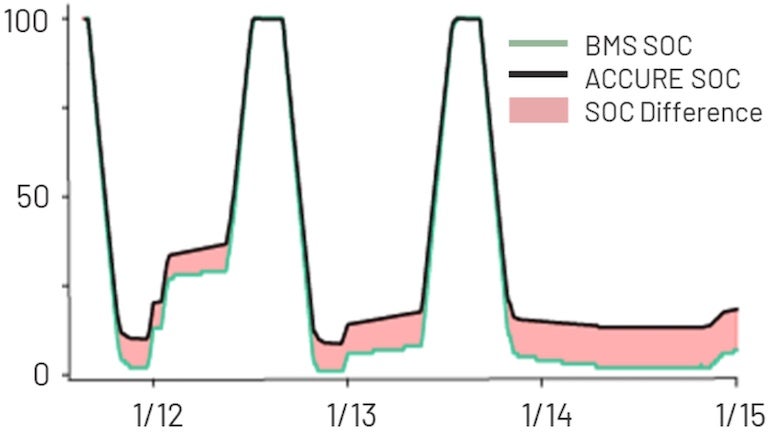
SOC errors can reach up to ±15%
To gauge the true impact of the problem, we investigated SOC field data as part of the 2025 ACCURE Energy Storage System Health & Performance Report. This brought together findings from over 100 commercially operating BESS sites around the globe, sourced from our monitoring database of more than 20 GWh of battery capacity, the world’s largest independent dataset of its kind. We found SOC errors up to ±15%, with some outliers deviating more than 40% from true value. A typical example is shown in Figure 1, which plots SOC estimate (%) vs day. This suggests a daily difference of over 12% between the BMS-estimated SOC and what’s provided by the capability of ACCURE’s SOC Correction feature.
This level of misalignment in fast-moving electricity markets, such as ERCOT (Electric Reliability Council of Texas), can reduce annual revenue for a typical BESS by more than $1 million per gigawatt-hour of installed capacity. For a BESS operating in ERCOT, that’s roughly 5% of annual trading revenue, indicating the scale of impact that might be rectified with reliably accurate SOC estimation. Outside ERCOT, the financial impact can be similar, or even greater. Taking the UK as an example, a BESS operator recently lost 7-10% of total revenue over two months to frequency service penalties directly caused by inaccurate energy estimation.
Exploring the hidden cost of SOC inaccuracy and how to correct it
To understand the full practical impact of SOC misalignment, ACCURE worked with Gore Street Capital, the international renewable energy and private equity investment manager. Together, we analysed operating data over three months at the 75 MW Dogfish BESS in Pecos, Texas. This 1-hour facility is designed to support the ERCOT power grid and began commercial operation in April 2025. Our analysis uncovered an example that illustrates the issue perfectly. During a two-hour price peak, when the BESS index reached $267/MWh, 3.8 MWh of tradable energy was left idle because the reported SOC did not reflect the true available capacity. By the time the energy management system (EMS) recalibrated, the price window had already closed, and the estimated revenue loss exceeded $1000 in just that single discharge cycle.
This was not a one-off anomaly. It reflected a structural mismatch between what the system reported as being available and what the battery could realistically and reliably deliver to market.
To address the issue, we implemented SOC Correction directly through the site’s EMS, using the existing infrastructure with no additional hardware or laboratory testing required. This has allowed Gore Street Capital to improve confidence in available energy and dispatch precision, without placing additional burden on its operations and maintenance teams.
Based on historical analysis, the estimated financial benefit at Dogfish exceeds $110 000 annually, with further optimisation potential already identified.
On a market-wide basis, this corresponds to roughly a 5% uplift relative to average BESS trading revenues in ERCOT.
The improvement comes from more precise dispatch, better spread capture, and more accurate accounting for tradable energy that EMS estimations would otherwise leave as buffer. At the same time, deviation risk declines, reducing the risk of non-compliance penalties and limiting revenue volatility. The result is higher top-line performance with stronger risk mitigation.
Cloud-based predictive battery analytics
The key to improving SOC accuracy beyond the capability of the BMS is to adopt cloud-based predictive battery analytics that combine physics-based modelling, portfolio-wide intelligence, and long-term historical data analysis to produce accurate SOC estimates that the BMS alone cannot deliver. Three core capabilities make this possible:
- cloud computational power;
- historical data; and
- comparisons across the whole asset portfolio.
Cloud computational power. Cloud-based analytics draw on significantly more computing power than a traditional BMS. This enables advanced physics-based models to be deployed that can resolve the flat open-circuit voltage curve that plagues LFP systems and is one of the main drivers of SOC inaccuracy. The result is precise mapping of voltage to SOC, especially useful in the mid-range SOC where BMS algorithms routinely lose accuracy.
ACCURE’s SOC algorithm is built on a foundation of Coulomb counting combined with voltage-based recalibrations, the industry standard for BMS SOC estimation. It implements significantly more recalibrations using an advanced, field-data-driven electrical model. For LFP cells, this is enhanced with a hysteresis model that provides many more orientation points beyond the typical full charge and discharge references used in standard BMS systems. On top of this, machine learning models, including neural networks trained on large-scale field data, are used to validate and refine the physics-based outputs, adding an additional layer of accuracy and confidence.
Processing historical data. The BMS is short-sighted by default. It operates iteratively, processing a new set of measurements at each time step, and then immediately calculating the next step. While the BMS does operate in real-time, it has limited ability to process larger coherent datasets and track long-term trends. This means it lacks context to draw accurate conclusions.
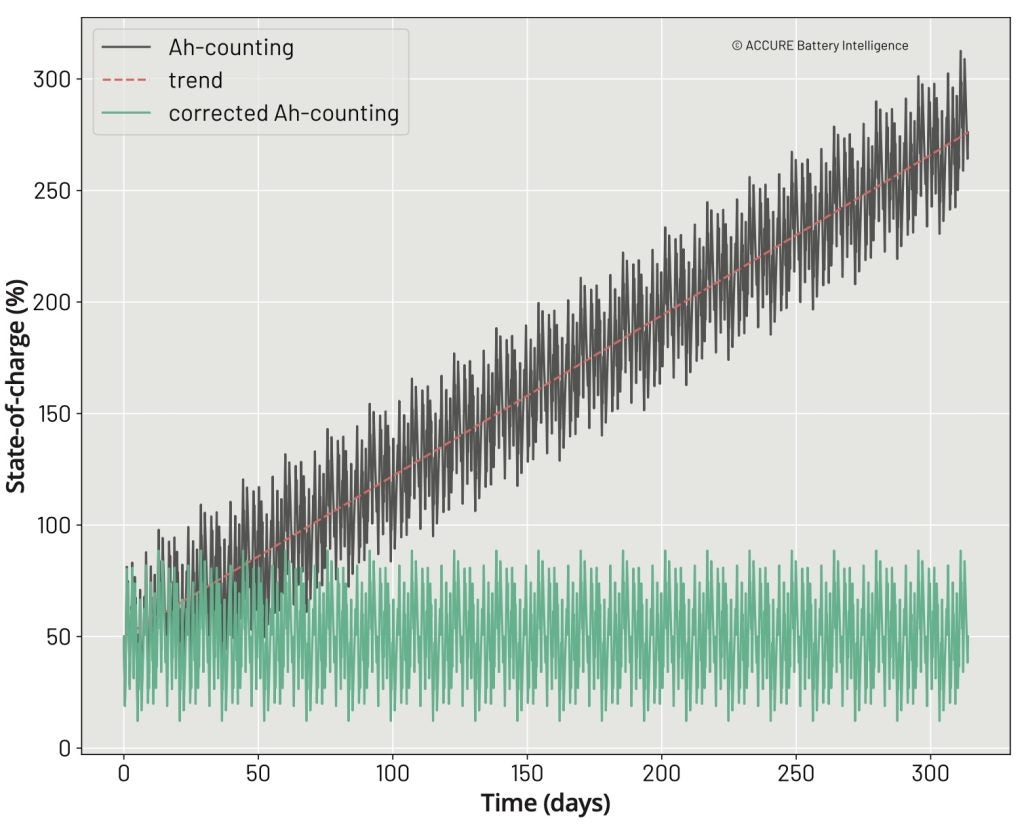
Cloud-based analytics, on the other hand, have access to all the historical data from a battery, making it easy to monitor long-term trends, and detect and compensate for issues like SOC drift from Ah-counting (as shown in Figure 2).
Cloud-based predictive battery analytics can detect and quantify this trend by estimating the offset current causing the SOC estimate to drift away from reality. Once this trend is identified, it can be compensated for, resulting in a corrected SOC curve with Ah-counting (light green trace, Figure 2). Instead of reaching a 10% SOC error after 14 days, this method ensures that the cloud-computed SOC remains accurate for weeks and even months without needing frequent recalibration.
Beyond drift compensation, historical data also enables accurate internal resistance and state-of-health (SOH) calculations. These are both long-term KPIs that directly determine how much energy can be extracted from a battery and are otherwise difficult to derive reliably from the BMS’s step-by-step view alone.
These capabilities enable cloud-based predictive battery analytics to achieve accurate SOC estimates within 2% of the actual value.
Comparisons across the whole asset portfolio. A primary challenge for a BMS is that it only monitors the battery it is connected to. Even an advanced BMS capable of learning from past operations remains limited to data from its own single battery. But what happens when that battery encounters conditions it hasn’t experienced before, like extreme temperatures or a safety-critical state? In this case, it has no data from which to draw informed conclusions on SOC.
In contrast, cloud-based predictive battery analytics can tap into data from across an entire portfolio of battery assets to offer unprecedented accuracy in SOC estimation. Predictive analytics can transfer insights gained from one battery to the entire network, enabling comparative analysis that quickly identifies outliers. By benchmarking SOC errors across all deployed batteries, cloud-based analytics can zero in on the exact conditions that are causing the BMS to inaccurately estimate SOC, identify these patterns and help mitigate them to determine an accurate SOC.
Using cloud-based SOC estimation to boost revenue
Inaccurate SOC estimation can lead to significant financial consequences, especially for a BESS engaged in energy markets and grid services. To capitalise on cloud-based insights, they must be actively integrated into the operational strategy.
One approach is to manually adjust the trading algorithm using cloud-provided offsets to correct SOC discrepancies. While this can improve trading accuracy and reduce financial risk, it is only a partial solution. The true value of analytics is only realised when the trading algorithm is fully integrated with the cloud platform, allowing continuous, near-real-time updates of the SOC. This ensures that trading decisions are always based on the most accurate and up-to-date data, delivering these commercial benefits:
- more precise dispatch and better spread capture;
- minimised risk of penalties for non-compliance with contractual obligations;
- enhanced revenue streams as more of the energy stored in the BESS can be sold; and
- optimised asset utilisation, which reduces the conservative buffers that eat silently into capacity and revenue.
At its core, integrating advanced analytics with the trading algorithm provides a dynamic and responsive approach to SOC management, turning a potential liability into a competitive advantage in the energy market.
In summary: cloud-based predictive battery analytics turn a potential liability into a competitive advantage
Inaccurate SOC is not an inevitable drawback of operating LFP-based BESS. Cloud-based predictive analytics, backed by physics-based modelling and portfolio-wide intelligence, can now bring SOC estimation accuracy to within 2% of actual value, and the commercial case for making the change is clear. Operators that integrate SOC Correction into their trading workflows dispatch with greater precision, reduce deviation risk, and recover revenue that BMS inaccuracy has been quietly eroding. The assets are already built. The question is whether they’re earning what they were built to earn.
Learn more about the financial impact of SOC inaccuracy and how to fix it at https://www.accure.net


