
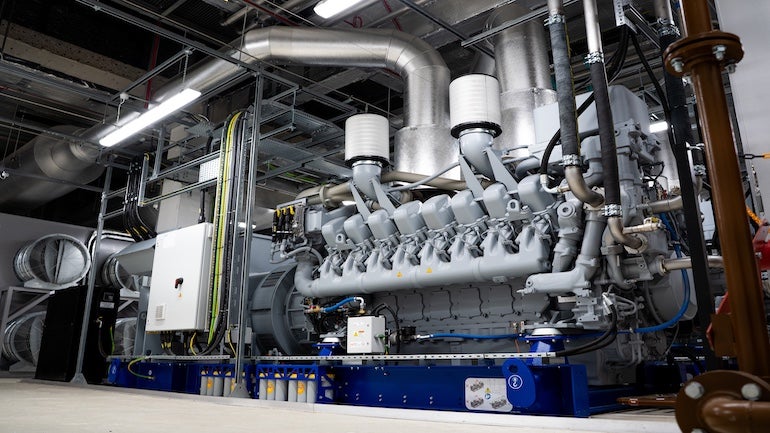
On-site prime power generation is transforming the datacentre industry. A recent survey by Bloom Energy highlighted the sudden rise in the datacentre industry´s approach to microgrids. It found that, faced with lengthening queues for grid connections, datacentre decision makers expect that by 2030, 38% of facilities will have at least some onsite power generation, and 27% of facilities will be 100% independently powered. This is in striking contrast to last year’s survey, which predicted that 13% of facilities would be partially self-powered and 1% fully self-powered by 2030.
Where interconnection queues are very long, full BtM builds can be completed before a grid connection becomes available, with timeframes as short as 18-24 months for solar and storage or natural gas. In addition to faster access to power, BtM solutions can contribute to peak shaving. Where a mix of grid and on-site power is required, grid support can accelerate connection times significantly, bringing major business benefits. And microgrids also enable new renewables to be added, filling the gaps in supply when the sun does not shine or the wind does not blow.
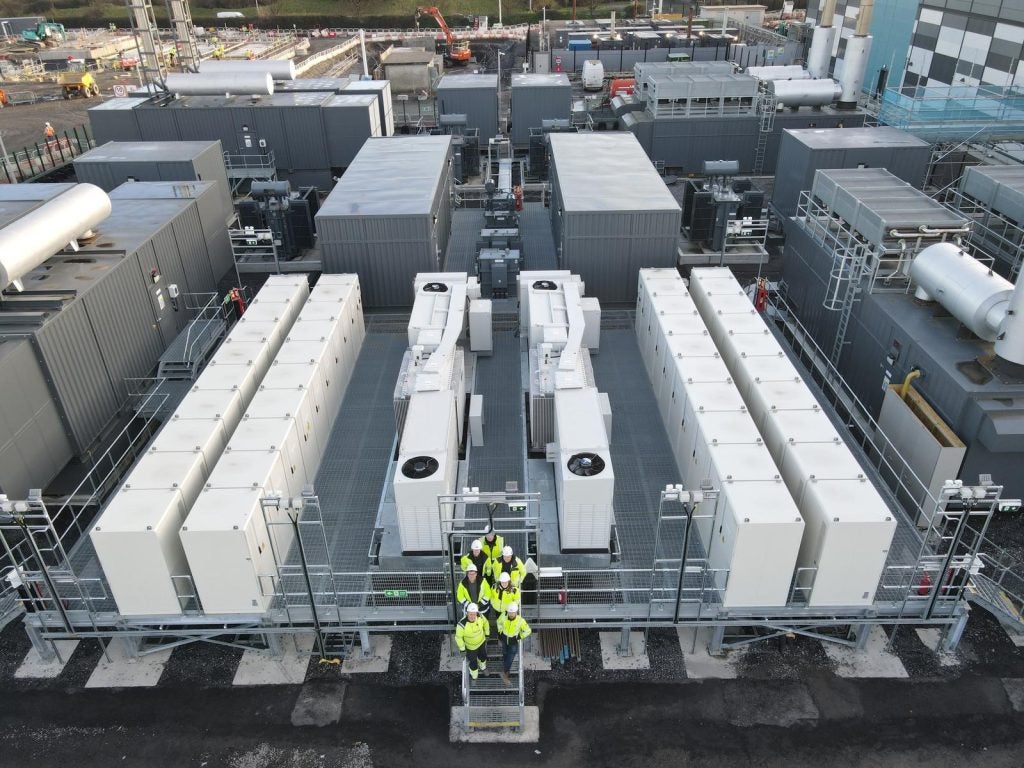
Other technological improvements are also coming thick and fast, particularly when it comes to emission management. New low carbon fuels, carbon capture and reuse, better exhaust after treatment for generators, can all be incorporated in the planning concept. These drive down environmental impact, but they all take up space and require detailed calculations.
New skills, new pitfalls
This exciting new era requires an additional skillset, which AVK can provide. However, in our experience, power design considerations are frequently not fully thought through in advance of business cases or planning applications. At the least, this causes inefficiency and slows project commissioning. In some cases it is far worse, requiring wholesale redesign, or causing wrong-sizing of the power overhead, unwanted emissions and financial waste.
Stories illustrating these design issues are widespread. On the power side, they include preliminary designs in which engines are stacked on top of each other, and where CFD (computational fluid dynamics) modelling has not been done, or no provisions made for secondary fluid obligations (alternative onsite fuel storage requirements). These sorts of issues don’t just add millions to construction costs. They require additional consultation and planning submissions and they change the fundamental design. They can lead to component changes, they delay completion, and can also have an impact on reliability/uptime numbers and operational maintainability. The right-sizing of power is also critical to efficiency and environmental impact. Power requirements can get hugely over-inflated in the name of “future-proofing”. Excessive system redundancy can multiply the energy used by several times. This is inefficient and unsustainable.
Three steps to better design
How can these sorts of errors be avoided? Taking a prime gas-powered microgrid design as an example, there are three steps which will give datacentre operators peace of mind and enable efficient power design and delivery:
Early engagement: Involving someone who understands all the necessities and requirements of an integrated power scheme at the “strategic definition” stage of the project (as defined in the RIBA Plan of Work) is critical. At AVK we will generally field our technical sales team along with our solutions engineers at this stage, to discuss client requirements, project risks, and budgets. They will also undertake initial site appraisals with other team members as appropriate.Following this assessment and agreement on client requirements, a pre-contract service agreement (PCSA) will be signed. The core statutory processes will be researched and agreed, covering planning, building regulations, health and safety and licence requirements. The outcome from these initial meetings will be a comprehensive project brief for client approval, covering project and sustainability outcomes, quality aspirations and spatial requirements. These will form the basis of design (BoD) on which feasibility studies and a detailed project execution plan can be developed and agreed.
Engineering expertise: Prime power is not a plug and play component, and cannot be treated like a conventional standby system. There are a lot of moving parts and safety and regulatory challenges. Many of these challenges may be new to datacentre operators, but they are everyday considerations for our team. AVK has been dealing with prime power generation for many years, for major civil engineering and industrial projects as well as for datacentres.
In addition to bid and concept managers, an AVK prime power team will generally be led by an electrical engineer, a mechanical engineer, a power systems engineer and a gas safety specialist with dozens of years of hands-on experience, and the resources and the knowledge base to understand the varying requirements of these systems. Our long-term relationships with specialist suppliers for everything from grid-scale turbines to battery storage and energy management systems also enables us to integrate components that are a good match and use the latest emissions mitigation technology.
The full design process, from BoD to BIM: When the basis of design has been agreed, full concept design and spatial co-ordination (RIBA Work Plan Stages 2 and 3) can take place, and a planning application can be submitted. Once approved, full technical design (Stage 4) can begin, culminating in a building regulations application and a full construction plan. Two critical roles in this phase are the appointment of a full-time SCADA (supervisory control and data acquisition) integrator and BIM (building information modelling) co-ordinator. A collaborative, 3D BIM allows for ongoing design optimisation, better energy efficiency and management of construction and operation of the project through its complete lifecycle.
Prime examples
Datacentre microgrids are still few and far between, but AVK has a number of projects in the UK, Ireland and Europe which are either up and running, fully designed, or undergoing commissioning. We can reference these projects when designing new systems and pass on knowledge from one project to the next, as well as internally through the AVK Academy.
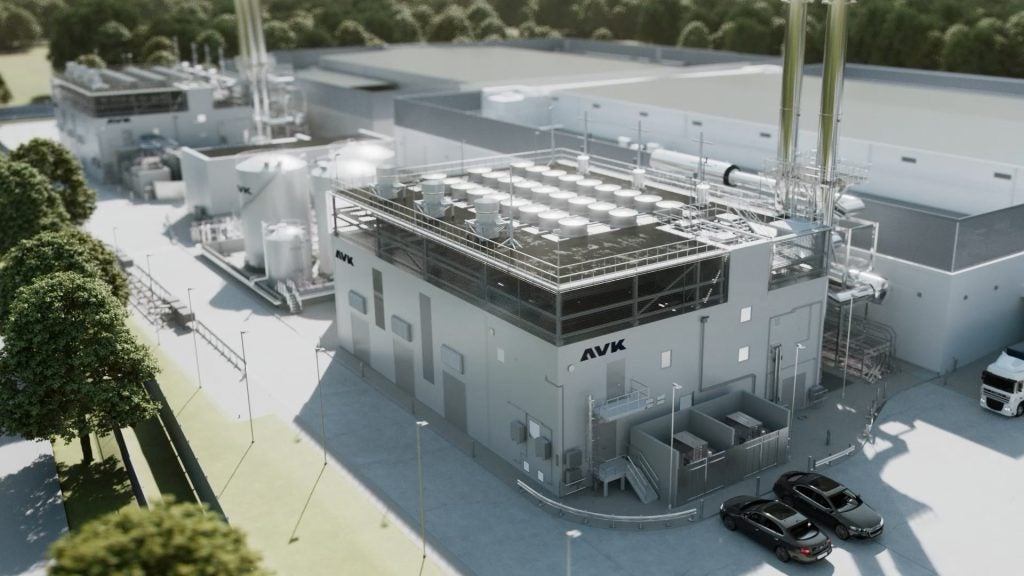
One of our most successful projects is a 110 MW primary power scheme in Dublin, one of the best fully-operational off-grid datacentre projects in Europe. It uses a battery energy storage system (BESS) and hydrotreated vegetable oil (HVO) for backup, and self-generates power using natural gas with onsite dual-fuelled generators. It’s an early-phase on-site power solution that supports the datacentre campus while grid capacity is secured.
The campus is growing fast, supported by a 200 MW gas connection to support phase 2.
In a recent interview with AVK project director, Jason Harrison (https://www.avk-seg.com/post/microgrids-power-dcs-of-tomorrow), he discusses the design challenges we tackled on the Dublin site, in particular the integration of battery energy storage and biofuels.
Another of our current projects includes an on-site 100 MVA multi-fuel power generation plant capable of running on a combination of fuels (primarily HVO) and gas.
A new paradigm: datacentres as energy centres
The move behind-the-meter puts power front and centre.
If managed correctly, this will drive a rethink of the datacentre’s function and value to society. Flexible, efficient and sustainable power system design will be the key to this transformation, meeting the needs of accelerated computing and supporting the grid in the process.
The critical role of microgrids in providing balancing power to accelerate renewables targets is described in our joint report with Wärtsilä (https://www.avk-seg.com/data-centre-dispatchable-capacity), which provides great further reading.


