
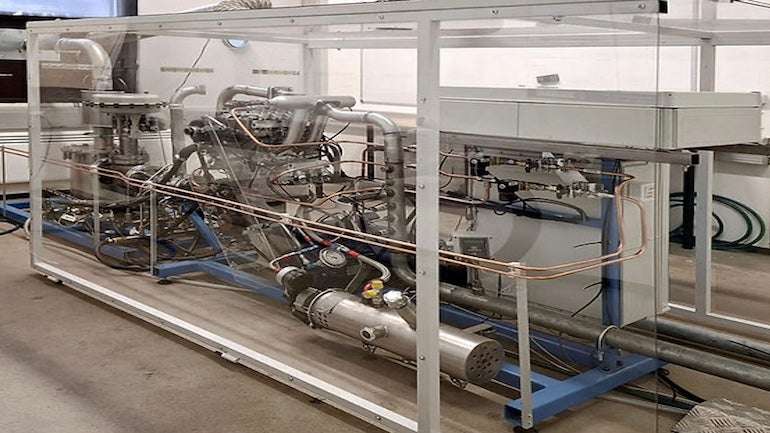
Gas turbines will continue to play an important role in global energy systems for decades. They provide dispatchable electricity, mechanical drive for industrial processes and flexibility for power systems incorporating increasing shares of variable renewable generation. They are also widely used in pipeline compressor stations, liquefied natural gas plants, combined heat and power installations and energy-intensive industrial sites. At the same time, the gas turbine market is entering a period of renewed demand. Rapid growth in electricity consumption, electrification and the construction of large data centres — particularly those supporting artificial intelligence applications in the United States — are driving investment in new dispatchable generating capacity.
This growth is putting pressure on a supply chain that cannot be expanded overnight. Order backlogs are increasing, manufacturing slots are filling years in advance and the prices of new gas turbines have risen. For asset owners, replacing an ageing industrial gas turbine may now involve not only substantial capital expenditure and plant modifications, but also a long and uncertain delivery schedule.
Meanwhile, many existing industrial gas turbines remain robust and maintainable assets with considerable operational value. The industry therefore needs solutions that can extend their useful life while reducing fuel consumption and carbon dioxide emissions.
Finno Exergy, a Finnish deep-technology company founded in 2013, is developing a new approach to gas turbine combustion that could deliver such an improvement. Its patented pressure gain combustion, or PGC, technology is designed to increase, rather than reduce, the pressure of the working fluid during combustion.
By changing this fundamental part of the gas turbine cycle, the technology has the potential to reduce fuel consumption by more than 10% in suitable industrial gas turbine applications.
Combined with a comprehensive life-extension programme, the Finno Exergy retrofit concept could offer asset owners an alternative to purchasing a new gas turbine. The objective is to refurbish the existing machine, extend its operating life and deliver a step change in efficiency at a fraction of the capital cost and implementation time associated with complete replacement.
In selected applications, this combination could allow an older industrial gas turbine to approach the efficiency range of newer machines while retaining much of the existing package and site infrastructure. Following several years of prototype development, testing and simulation work, Finno Exergy is now preparing for the design and demonstration of a full-scale industrial system.
Rethinking the G combustor
The conventional gas turbine has been continuously improved over many decades. Compressor pressure ratios have increased, turbine inlet temperatures have risen and major advances have been made in aerodynamics, materials, coatings, cooling systems and emissions control.
Nevertheless, its basic thermodynamic cycle has remained largely unchanged.
In a conventional gas turbine, the compressor raises the pressure of the incoming air. Fuel is then added and burned in the combustor. The hot combustion gases expand through the turbine, producing the work required to drive the compressor and deliver useful shaft power.
While combustion increases the temperature and energy content of the gas, it does not increase its total pressure. Instead, the combustor normally introduces a pressure loss, reducing the expansion ratio available to the turbine. Pressure gain combustion changes this relationship.
Instead of burning fuel in a continuous, approximately-constant-pressure process, a pressure gain system uses a pulsating combustion process to generate a pressure increase. If the pressure of the combustion products at the combustor outlet is higher than that of the air entering the combustor, the turbine can extract more work from the same amount of fuel.
This additional thermodynamic potential can be used to increase power output for a similar fuel input or to reduce fuel consumption while maintaining the same output. For many existing industrial applications, fuel consumption reduction is likely to be the most commercially attractive option. Lower fuel consumption translates directly into lower operating costs and carbon dioxide emissions. In gas transmission and LNG production, the benefit can be even greater because gas that is no longer consumed as turbine fuel can instead be transported, liquefied or sold.
Fast deflagration not detonation
Pressure gain combustion is frequently associated with detonation-based concepts, including pulse detonation engines and rotating detonation combustors. These technologies offer theoretical thermodynamic benefits, but also create demanding integration, durability and control challenges.
Finno Exergy has taken a different approach.
Its system is based on controlled, pulsating fast deflagration rather than detonation. Deflagration is the combustion mode already used in conventional gas turbine combustors and internal combustion engines, although the Finno process is considerably faster and operates cyclically.
At the centre of the system is a proprietary combustion chamber incorporating controlled air and fuel delivery, ignition and valve systems. Air and fuel are introduced into the chamber, rapidly combusted and discharged towards the turbine in a repeating sequence. The pressure generated during each combustion event is higher than the pressure of the compressed air entering the chamber. When the full cycle is considered, the system can therefore produce a net pressure gain across the combustor.
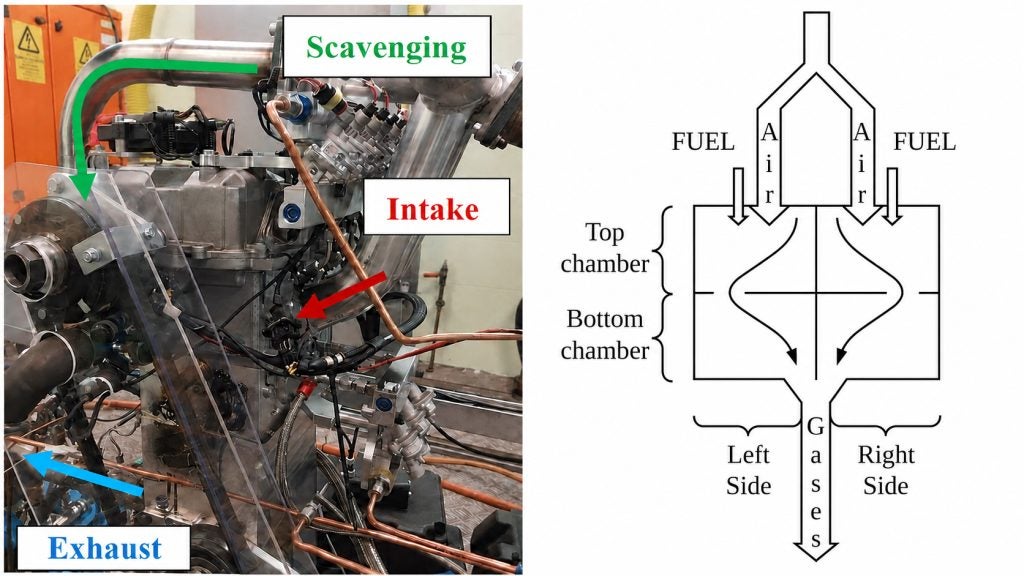
The combustion process consists of four phases:
● Intake: Air and fuel are introduced in the first chamber via intake valves
● Combustion: A controlled ignition source positioned in the top chamber starts the combustion process. The flame front propagates to the entire combustor. Once the bottom chamber is reached, combustion is completed in a lean environment.
● Exhaust: This phase continues until scavenging valves are opened.
● Scavenging: Air flows in via scavenging valves placed in the top chamber and scavenges combustion products of the previous cycle. (Images: Finno Exergy)
The combustor outlet remains open towards the turbine during operation. The turbine is consequently exposed to pulsating flow rather than the relatively steady flow produced by a conventional combustor.
This interaction is a critical aspect of the concept. The combustor cannot be considered in isolation: its interaction with the turbine, compressor, shaft system and engine controls must be understood as part of an integrated transient system.
Finno Exergy combines its combustion hardware with a dedicated control system co-ordinating valve timing, fuel injection, ignition and the combustion cycle. The objective is to produce rapid and repeatable combustion while maintaining stable operation across the required operating range. The use of fast deflagration is expected to provide a controllable route towards industrial implementation while retaining the thermodynamic advantage of pressure gain.
Building on recip and gas turbine technology combined
The origins of Finno Exergy’s technology are closely linked to large reciprocating engine combustion systems. The company’s development team combines experience from piston engines, gas turbines, combustion research and energy technology commercialisation.
The Finno concept incorporates characteristics from both reciprocating engines and gas turbines. As in a piston engine cylinder, the Finno PGC combustor operates cyclically and generates a pressure rise through rapid combustion. Unlike a piston engine, however, it has no piston and delivers its high-energy exhaust directly to a turbine. The system can therefore be viewed as a bridge between two established technology families: the pressure-rise combustion of an internal combustion engine; and the high power density and continuous shaft output of a gas turbine. For industrial users, the objective is not to replace the complete gas turbine architecture. Finno Exergy is developing the technology so that the conventional gas turbine combustion system can be replaced while retaining the principal compressor and turbine components.
The retrofit would ideally be implemented during a planned major overhaul or life-extension programme. The asset owner could inspect, repair or replace life-limited components while installing the new combustion technology within the same project. The result would not simply be an old machine with a new combustor, but a comprehensively refurbished asset combining renewed mechanical life, upgraded controls and improved thermodynamic performance.
Development with Shell
A major milestone for Finno Exergy came in 2020, when the company won the New Energy Challenge, an innovation competition organised by Shell and its partners. Finno Exergy subsequently entered the Shell GameChanger programme. Between 2021 and 2024, the company worked with Shell to develop and test a small-scale prototype of its pulsating combustion system.
The programme demonstrated the fundamental operating principle and generated experimental data for further development. It also supported improvements to the combustion system, control strategy and simulation tools required for scale-up.
In parallel, Finno Exergy and Shell assessed potential applications and routes to market. Industrial gas turbines were identified as the most suitable initial opportunity because they typically operate for high annual hours, consume large quantities of fuel and remain in service for several decades. Even a moderate efficiency improvement can therefore create considerable lifetime value. The assessment also highlighted the importance of selecting the right gas turbine architecture.
Modern aeroderivative and highly integrated annular-combustor machines can be difficult retrofit targets because of their compact layouts and close interaction between the combustor and turbine design. Older heavy-duty machines with can-type combustion systems offer a more practical starting point.
In these machines, individual combustion cans are arranged around the engine, providing more physical space and a clearer interface between the combustion system and the existing turbomachinery.
Frame 3 and Frame 5 gas turbines were therefore identified as priority platforms for piloting and early market deployment.
Why Frame 3 and Frame 5?
Frame 3 and Frame 5 gas turbines have been used extensively in power generation, oil and gas facilities, pipeline compressor stations and industrial mechanical-drive applications. Many have been operating for decades but remain valuable because of their robust construction, maintainability and established service infrastructure. Their efficiency, however, is generally lower than that of newer gas turbines, creating a potentially strong business case for an efficiency retrofit. The Frame 3 offers a suitable platform for an initial demonstration because of its smaller size and accessible combustion architecture. The Frame 5 represents a larger commercial opportunity because of its installed base and higher fuel consumption.
A pressure gain retrofit could be combined with a major overhaul or life-extension programme covering, as required, the rotor, compressor, turbine, bearings, casings, auxiliaries and controls.
This combined approach would extend the operating life of the asset, reduce fuel consumption and avoid or defer the cost and delivery time associated with a new turbine.
It could also limit the risks of replacing an existing mechanical-drive machine. In pipeline compressor stations and LNG facilities, the gas turbine is often closely matched to its driven compressor and integrated into a larger process system. Replacement can affect package layout, controls, process interfaces, foundations and operating permits. Retaining the existing core architecture therefore has value beyond the purchase price of the gas turbine itself.
Current supply constraints strengthen this business case. With new turbine manufacturing slots committed years in advance, maintaining and upgrading the installed fleet is becoming a strategic capacity option rather than simply a maintenance decision. For operators that need additional years of reliable service but cannot justify or wait for complete replacement, a life-extended and efficiency-upgraded machine could offer an attractive solution.
Assessing a 10 MW retrofit
In 2025, Finno Exergy completed a simulation-based feasibility study in co-operation with a gas turbine original equipment manufacturer.
The study examined the potential replacement of the conventional combustion system of an existing 10 MW industrial gas turbine with Finno Exergy’s pulsating pressure gain system.
The work considered not only the theoretical cycle benefit, but also how the compressor and turbine would respond to the unsteady flow produced by the combustor.
Conventional gas turbine performance tools are generally based on steady-state or quasi-steady assumptions. A pressure gain combustor requires a transient approach because pressure, temperature and mass flow vary during each combustion cycle. The simulations assessed whether the turbine could convert the pulsating flow into useful shaft power and whether the compressor could remain within an acceptable operating range.
The results indicated that a reduction in fuel consumption exceeding 10% could be achievable at the assessed operating point while retaining the existing principal turbomachinery.
A reduction of this magnitude would also result in an approximately corresponding decrease in direct carbon dioxide emissions when the same fuel is used and the same useful output is produced. For an industrial gas turbine operating for several thousand hours per year, the economic value could be considerable. The exact benefit would depend on operating hours, fuel price, baseline efficiency, load profile and retrofit cost. The result also demonstrates why combining pressure gain combustion with life extension may be more valuable than either intervention alone.
A conventional life extension programme restores the condition and availability of an ageing asset, but does not normally transform its cycle efficiency. A combustion retrofit improves performance, but the investment becomes more compelling when the remaining life of the complete machine has also been secured.
Together, the two elements could create a refurbished asset with an extended operating horizon and an efficiency level much closer to that of newer machines. The project should require substantially less capital, site modification and implementation time than complete replacement. The study also identified areas requiring further validation, including sealing, combustor durability, thermal management, emissions, controls, turbine response, rotordynamics and transient engine behaviour.
Fuel flexibility and hydrogen
Efficiency improvement is only one part of the technology’s potential value. Industrial gas turbine operators are also considering how their assets can adapt to a future energy system incorporating lower-carbon fuels. A combustion technology intended for long-term deployment must therefore retain fuel flexibility.
Finno Exergy’s system is being developed for operation on natural gas and blends of natural gas and hydrogen. The fast, controlled combustion process and flexible fuel delivery architecture could also support other gaseous fuels as they become available. A combustion system designed from the beginning around flexible injection and active cycle control may offer advantages compared with conventional systems that must be progressively modified to accommodate increasing hydrogen content. In the near term, however, the largest environmental benefit may come from using less natural gas. A substantial efficiency improvement can reduce emissions immediately, without waiting for new hydrogen infrastructure.
In the longer term, efficiency and fuel flexibility can work together. A more efficient turbine requires less fuel regardless of whether that fuel is natural gas, hydrogen or another renewable gaseous fuel.
Building the industrial demo
The next step for Finno Exergy is to move from small-scale validation and simulation to full-scale industrial hardware. The programme will include the design and manufacture of a full-scale combustor, followed by testing under representative pressure, temperature and mass-flow conditions. High pressure rig testing will be essential to validate combustion performance, pressure gain, cooling, durability, fuel flexibility and emissions before installation in a complete gas turbine. The programme must also demonstrate reliable operation during start-up, shutdown and load changes. Industrial gas turbines are not evaluated solely on peak efficiency: availability, maintainability and predictable operating behaviour are equally important. A successful pilot will therefore require co-operation between Finno Exergy, an asset owner, a gas turbine OEM or experienced independent service provider, research and testing organisations, component manufacturers and control-system specialists.
A life extension partner will be particularly important, as the intended commercial offering combines the pressure gain combustion retrofit with inspection, refurbishment and life extension services appropriate to the selected machine.
Finno Exergy is currently engaging with industrial partners and asset owners to establish such a consortium. Pipeline compressor stations, LNG facilities and industrial cogeneration plants are among the applications being considered.
A new route to GT modernisation
Gas turbine decarbonisation is often discussed in terms of fuel substitution, carbon capture or replacement with renewable generation and storage. All may have a role, but improving the efficiency of the installed fleet should not be overlooked. A gas turbine consuming 10% less fuel can reduce operating costs and carbon dioxide emissions from the moment the upgrade enters service. It can also reduce the amount of future low-carbon fuel required to produce the same output.
At the same time, the current gas turbine supply shortage is changing the economics of asset replacement. Strong electricity-demand growth, AI data-centre development and limited manufacturing capacity mean that a new machine may be more expensive and less readily available than operators previously expected.
Existing gas turbines should therefore not be viewed only as ageing equipment approaching retirement. Machines with robust core architecture and established service support may represent strategic assets that can be refurbished, modernised and operated for many additional years. Combined with an appropriate life-extension programme, PGC could offer an alternative between continuing to operate an inefficient ageing machine and purchasing an entirely new gas turbine.
The value proposition is straightforward: retain the serviceable core of the existing asset; restore its mechanical life; replace the conventional combustion system; and achieve a step change in efficiency. In selected applications, the resulting machine could approach the performance range of newer turbines at a fraction of the capital cost and with a substantially shorter delivery and installation schedule. Finno Exergy has demonstrated its combustion concept at small scale, completed an initial gas turbine feasibility study and identified a practical route towards industrial deployment.
Full-scale performance, durability, emissions, controls, turbine interaction and long-term availability must still be demonstrated. However, the potential reward is significant: a retrofit and life-extension solution capable of delivering renewed operating life, lower fuel consumption and reduced emissions while helping asset owners respond to an increasingly constrained gas turbine supply market. By bringing together technology developers, OEMs, independent service providers and asset owners, Finno Exergy aims to transform pressure gain combustion from a promising prototype into a commercially deployable gas turbine modernisation solution.


