
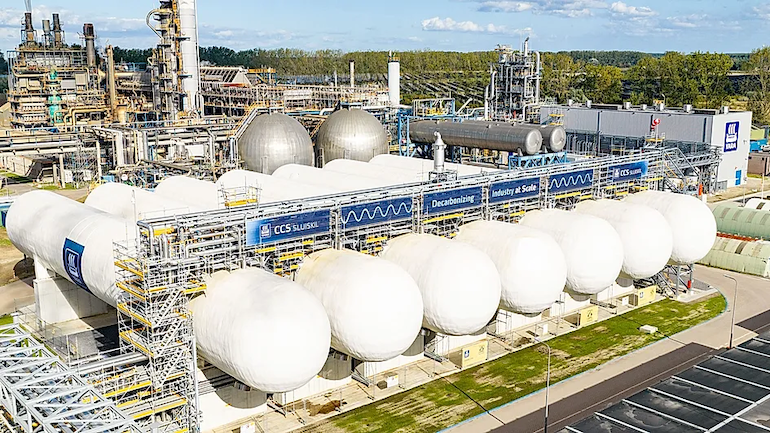
Yara has inaugurated an industrial carbon capture facility at its ammonia and fertilizer plant in Sluiskil, the Netherlands, which can capture and liquefy up to 800,000 tonnes of CO2 per year.
The project links CO2 capture at the Dutch plant with transport by sea and permanent geological storage in Norway. It is being delivered with Northern Lights, which will transport the liquefied CO2 by ship to its storage facilities at Øygarden on the Norwegian coast.
The captured CO2 will be temporarily stored at Sluiskil before being transported to Norway. Northern Lights will inject it approximately 2,600 metres below the seabed for permanent storage.
The project is notable for connecting facilities in two countries into a single CCS chain, covering capture, conditioning, shipping and offshore storage. Yara said the system is expected to capture and store about 12 million tonnes of CO2 over 15 years, subject to the necessary framework conditions.
At Sluiskil, the captured emissions originate from ammonia production. Carbon capture at this stage targets process emissions that are difficult to eliminate through changes to the plant’s energy supply alone.
The project also illustrates the infrastructure requirements for deploying CCS at industrial sites. Rather than requiring storage close to individual emitters, the Northern Lights system provides access to offshore geological storage through a shared transport network.
Northern Lights Managing Director Tim Heijn said the project demonstrates that cross-border CO2 transport and storage can operate as a practical solution for European industry.
For Yara, the captured volumes will reduce the carbon intensity of ammonia and fertilizer production while providing a route towards lower-carbon products. The company also identifies potential applications for low-carbon ammonia in industrial processes, energy and maritime fuels.
The Sluiskil project adds to the emerging European CO2 transport and storage infrastructure, where cross-border networks are expected to connect industrial emitters with permanent storage sites.


