Pacifico Energy has declared more than $1 billion of investment in two offshore wind projects in South Korea, as the country looks to expand clean power supplies for electricity-intensive industries.
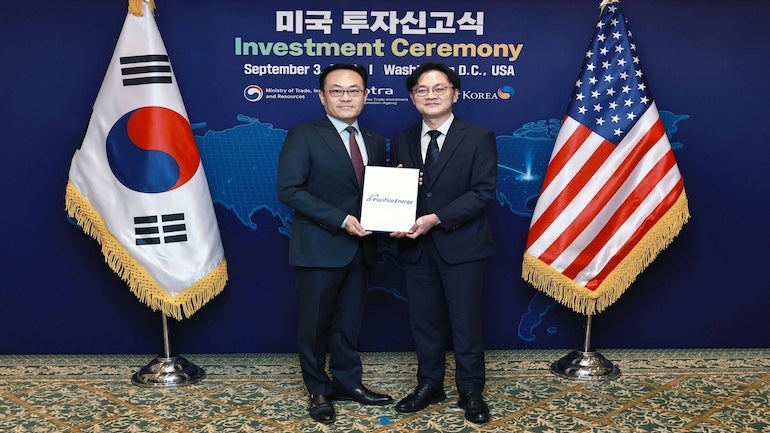
The declaration, covering the 990 MW Manho Offshore Wind Project and 1.8 GW Jindo Baram Offshore Wind Project, was made on 3 September at an investment ceremony hosted by South Korea’s Ministry of Trade, Industry and Resources (MOTIR) and KOTRA in Washington, DC. The investment will be allocated entirely to the two projects.
The announcement is Pacifico Energy’s second Korean investment declaration. In 2024, the developer declared investment in the 420 MW Myeong Ryang Offshore Wind Project and the development of a regional supply chain.
The three projects form a planned 3.2 GW offshore wind cluster off Jindo County in South Jeolla Province. Myeong Ryang, the first phase, has secured an Electricity Business License and completed a preliminary environmental impact assessment. Manho and Jindo Baram were selected in August as the sole developers of the government-designated 2.13 GW Jindo Phase 2 Offshore Wind Integrated Cluster.
Pacifico Energy said the projects are intended to support rising electricity demand from sectors including semiconductors, data centres and cloud computing. The Jeonnam-Gwangju region is also being developed as a base for the Honam Semiconductor Cluster and other energy-intensive industries.
Seung-Ho Choe, Pacifico Energy Korea’s global head of offshore wind and representative director, said the portfolio would help “bolster Korea’s export competitiveness” while supporting semiconductor and RE100-ready industrial development.
The investment also reflects Pacifico Energy’s wider focus on power infrastructure for large industrial loads. In the US, the company developed and permitted the 7.65 GW GW Ranch data centre campus, acquired by Amazon, with first power targeted for the first quarter of 2027.
For Korea, the Jindo cluster represents a significant planned source of locally generated renewable electricity, although the projects remain at different stages of development.


