
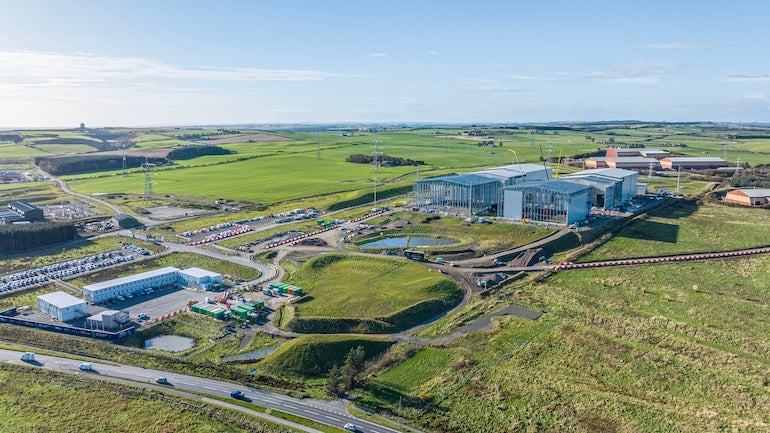
Construction of the UK’s £4.3bn Eastern Green Link 2 (EGL2) transmission project has reached its two-year milestone, with converter stations, cable routes and grid connections now moving from site preparation into major construction.
Being delivered jointly by SSEN Transmission and National Grid Electricity Transmission, EGL2 will provide a 2 GW transmission link between Peterhead in Aberdeenshire and Drax in Yorkshire. The project is scheduled to be energised in 2029 and includes a 436km subsea high-voltage direct current (HVDC) cable, which will be the longest of its type in the UK.
At Peterhead, construction has progressed from preparation of the converter-station platform to the erection of permanent buildings. The steel frame for the first converter building and the first AC hall are complete, while concrete works for both transformer buildings have been completed and cladding is under way.
A key connection to the existing transmission network is also progressing. Horizontal directional drilling beneath the U66 road has been completed to install ducts for the new 400 kV connection between the converter station and the existing Peterhead Substation.
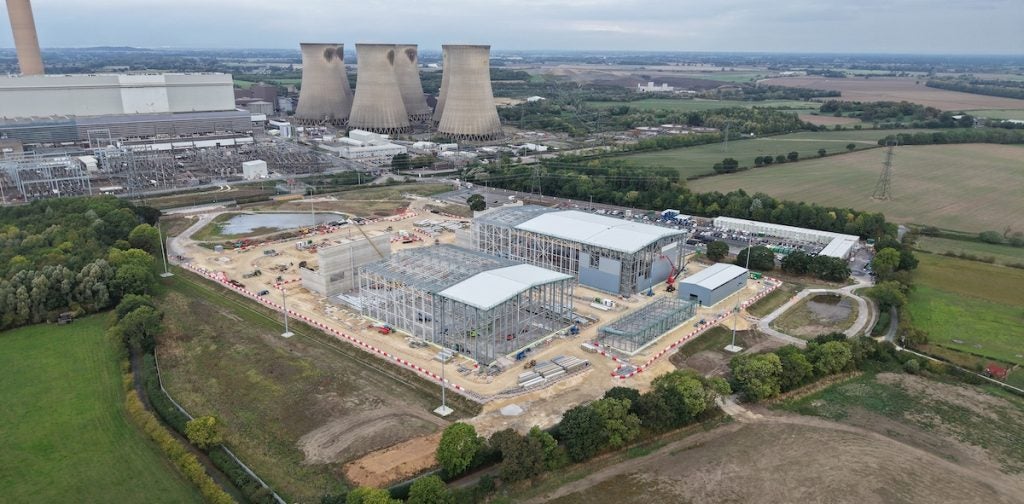
At the other end of the link, the converter station at Wren Hall near Drax has similarly moved beyond initial earthworks. Foundations, concrete structures and permanent buildings are now taking shape.
The civil engineering programme extends well beyond the two converter stations. Along the Yorkshire onshore cable route, almost 70km of land is being prepared for cable installation. Since enabling works began in August 2025, more than 25km of haul road has been installed, over 8km of trenching completed and nine horizontal directional drilling operations carried out.
Further work is required to integrate the onshore and offshore sections. Horizontal directional drilling at Sandford Bay in Peterhead has been completed, while work is under way at Fraisthorpe near Bridlington.
Meanwhile, manufacture of the HVDC cable and specialist electrical equipment is continuing away from the main construction sites.
The combination of converter stations, underground cables, subsea infrastructure and 400 kV connections makes EGL2 a substantial systems-integration project as well as a civil engineering programme. Its eventual 2 GW capacity is intended to increase the ability of the transmission network to move electricity from Scotland to centres of demand in England, including electricity from growing renewable generation.
Fionán Doonan, EGL2 project director, said the change at Peterhead demonstrated the transition from preparation to permanent construction.
“Two years ago we were preparing the ground at Peterhead. Today, you can stand on the site and see the scale of what we are building, with the converter station rising out of the ground and the permanent buildings taking shape.”
The project has now recorded around three million working hours, with hundreds of people involved across the construction programme and supply chain.
At Wren Hall, EGL2 deputy project director Neil Lyons said the shift was similarly evident.
“We began with site preparation and earthworks and today the permanent structures of the converter station are becoming increasingly visible.”
For the transmission industry, the significance of the two-year milestone lies less in the volume of civil works completed than in the transition towards installing and integrating the electrical infrastructure. Converter stations, cable systems and network connections will ultimately have to operate as a single HVDC transmission scheme.
The project has an Ofgem investment figure of £3.4bn in 2018/19 prices, equivalent to around £4.3bn when adjusted for inflation.
With construction now advancing across both converter-station sites, the Yorkshire cable route and the onshore-offshore interfaces, the next stage will focus increasingly on cable installation, equipment integration and the connections required to bring EGL2 towards commissioning in 2029.


