

For over a decade, US power demand was essentially flat. Now data center growth, retiring units and multi-year turbine lead times are pushing operators to squeeze more from the existing fleet.
Many of those units are running extended baseload or cycling duty their designers never planned for. There is less margin for error and less slack in the outage calendar. Vibration monitoring remains essential, but it sees only a machine’s mechanical side. Three challenges show why operators are looking further.
1. Faults That Hide Between Inspections
Insulation defects rarely announce themselves mechanically. At an East Coast generating facility facing recurring generator issues, periodic data collection missed weather-related discharge activity. Continuous monitoring with a Cutsforth Electromagnetic Interference (EMI) system caught it, and the next outage inspection found moisture damage on 13 isophase bus insulators that would otherwise have forced an outage.
Inside the generator, rotor flux monitoring tracks shorted turns, while shaft voltage and current monitoring expose grounding and bearing problems. Infrared thermography extends the same watchfulness to transformers and the switchyard. Paired with vibration, these show what is happening inside the machine, not just on its surface.
The common thread is timing. A fault that develops between quarterly or annual rounds can progress from early-stage degradation to failure before anyone is back on site. Continuous monitoring closes that gap by trending subtle changes in partial discharge, shaft voltage and thermal patterns, so analysts see a developing problem while there is still time to plan around it. It also builds a baseline for each asset, making abnormal behavior easier to spot.
2. Cycling Stress That Baseload-Era Inspections Miss
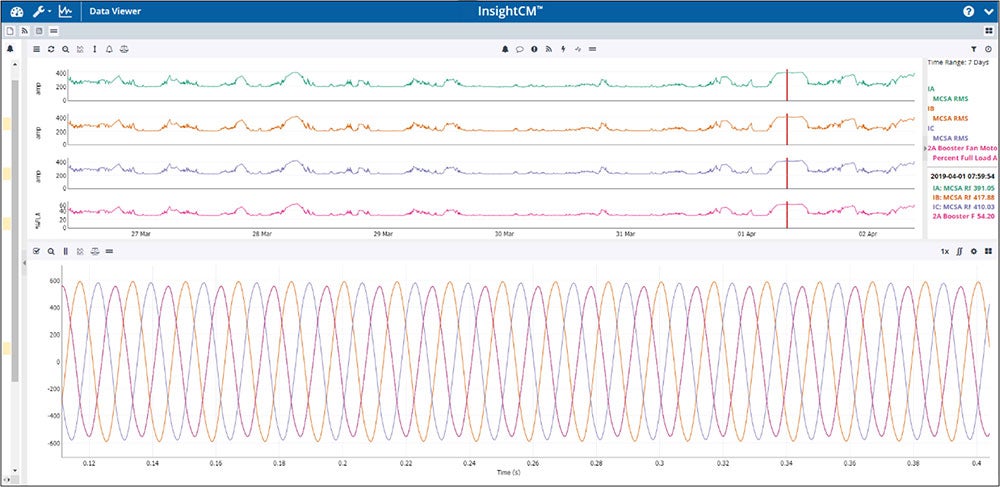
Routine inspections designed for baseload duty do not always catch the failure mechanisms that cycling and flexible dispatch introduce. Continuous Electrical Signature Analysis (ESA) watches every start, stop and load change, with intelligent edge gating so no startup is missed.
By analyzing three-phase voltage and current, ESA can reveal rotor bar defects, eccentricity, misalignment, bearing wear and insulation problems in plant motors, whether fixed-speed or VFD-driven. The system often uses existing current and potential transformers, and one acquisition device can monitor up to nine motors on a single voltage bus.
Flexible operation changes how equipment wears, and how quickly. Frequent starts put repeated thermal and electrical stress on motor windings, rotor bars and connections, and the damage can build over many cycles rather than steady running hours. Because ESA captures the electrical behavior of every transient, plants can compare one start against the last and trend degradation over time. That lets teams prioritize the motors that are actually changing instead of following fixed calendar intervals.
3. Too Much Data, Too Few Analysts
More sensors without more insight simply mean more alarms. Cutsforth’s multiphysics approach integrates Vibration, ESA, EMI, Infrared Thermography, generator monitoring and process data on one platform, InsightCM™. Expert-built diagnostic models cross-check these signals to find faults earlier and cut false positives.
Integration is what turns data into decisions. When a vibration trend, a change in current signature and a thermal reading all point to the same asset, confidence rises and the call to act gets easier. When only one signal moves, the system can flag it for review without triggering a false alarm. Analysts also work from a single view and a shared history, so less time goes to switching between tools and reconciling separate data sets.
The payoff is time: one large US utility that replaced manual data collection with automated online monitoring found its analysts could spend about 80% of their time on analysis instead of gathering data.
See the Whole Machine
Moving beyond vibration does not mean starting over. Plants can begin by adding ESA, EMI or generator monitoring to the data they already collect and viewing it in one place. The result is earlier warning and fewer surprises, with repairs planned into scheduled outages instead of forced by failure.

Tel: 800.290.6458
Email: info@Cutsforth.com
www: Cutsforth.com


