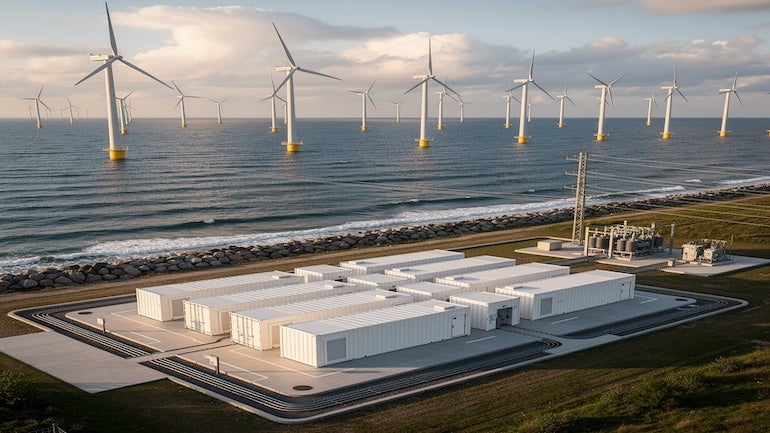
Arenko has been selected to provide its Nimbus optimisation, trading and asset management platform for Ørsted’s 300 MW/600 MWh Iceni battery energy storage project in the UK, which is scheduled to begin operating in the first quarter of 2027.
The battery is being developed alongside Ørsted’s 2.9 GW Hornsea 3 offshore wind farm. Rather than having its own grid connection, Iceni will share Hornsea 3’s onshore connection and transmission infrastructure.
Iceni is among the UK’s first large-scale projects under the Offshore Transmission Network Review (OTNR) pathfinder programme, which is exploring how generation and storage can share grid infrastructure.
The arrangement is intended to make more efficient use of the network, but it also presents a more complex optimisation task. Wind generation and battery storage must be coordinated through a single connection, with decisions on charging, discharging and market participation changing as generation and power prices move.
Arenko will use Nimbus to manage the battery’s trading, optimisation and asset management. The company said the platform has been deployed on 14 large-scale co-location projects.
“What makes Iceni interesting for us isn’t just the scale of the battery, but how it works alongside Hornsea 3,” said Katinka Hussmann Palbo, Ørsted’s vice president for global trading and revenue. “We are aiming to optimise two very different assets, wind and storage, through a shared connection point, while ensuring that both deliver significant value to the grid.”
The project will require close coordination between forecasting, market trading and the technical controls linking the battery and wind farm.
“Iceni is a highly sophisticated project, coupling a grid scale battery with one of the UK’s biggest offshore wind farms,” said Rupert Newland, Arenko’s chief executive. “This creates significant opportunities, but also operational and trading challenges, from forecasting and deciding how and when to allocate capacity in real time, to the technical, data and controls integrations between the two assets.”
The wider significance of Iceni lies in whether this model can demonstrate a practical alternative to building separate network connections for co-located generation and storage. If successful, it could provide a template for using existing transmission infrastructure more intensively as the UK adds both offshore wind and flexible storage.
“We’ve worked closely with Ørsted over time as their thinking around flexibility has evolved,” Newland said. “With projects like Iceni they are taking a pioneering role in bringing truly significant generation capacity and utility-scale storage together.”
Ørsted’s Iceni director, John Kinsella, said: “Iceni is the first of its kind, and that demands a platform built for genuine complexity. Nimbus delivers that.”


