Belgian marine engineering group DEME has been selected to install foundations for the first phase of the Zeevonk offshore wind project in the Dutch North Sea, supporting plans for one of the Netherlands’ next large-scale renewable energy developments.
The contract, awarded by Zeevonk – a joint venture between Vattenfall and Copenhagen Infrastructure Partners (CIP) – covers the transport and installation of 69 monopile foundations. DEME will also provide intermediate transport of monopiles, marshalling services for primary and secondary steel components, and installation of a filter layer for scour protection around the foundations.
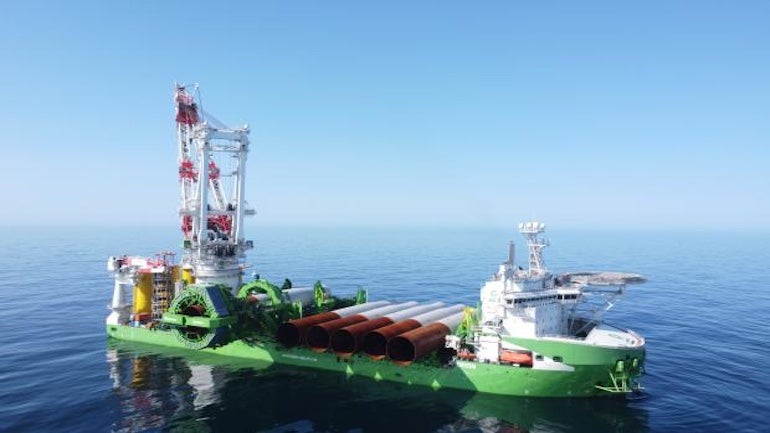
The agreement remains subject to Zeevonk reaching a final investment decision. If approved, installation work will involve several vessels from DEME’s offshore fleet, including the installation vessel Orion for monopile placement, a jack-up vessel for secondary steel installation and a fallpipe vessel for seabed scour protection measures.
The first phase of Zeevonk is planned to deliver 1 GW of offshore wind capacity by 2029. Located between 63 km and 84 km off the Dutch coast near Bergen aan Zee, the project covers approximately 650 km2 of the North Sea.
Felix Würtenberger, CEO of Zeevonk, said “Developing a project of this scale requires strong partnerships and deep offshore expertise”. DEME’s involvement adds another major supplier to the development as the project moves towards construction readiness.
Bas Nekeman, Business Unit Director Northern Europe at DEME said the contract builds on its existing relationship with Vattenfall and CIP and strengthens its position in the Dutch offshore wind market, where new projects are expected to play a key role in meeting national renewable energy targets.
The wider Zeevonk development is planned in two stages. Following the initial 1 GW wind farm, a second phase is expected to add another 1 GW of offshore wind capacity by 2032, alongside 500 MW of system integration infrastructure. This includes plans for an electrolyser at the Port of Rotterdam to support green hydrogen production.
As the Netherlands expands offshore wind capacity in increasingly challenging marine environments, projects such as Zeevonk are relying on specialised installation contractors and larger vessels to manage complex foundation and seabed engineering requirements.


