
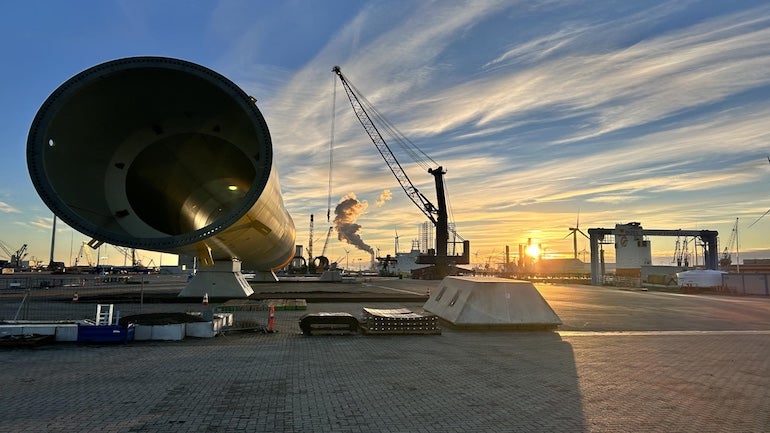
The first 10 monopile foundations for the second phase of RWE’s Nordseecluster offshore wind project have arrived at Eemshaven in the Netherlands, bringing the next stage of construction into focus ahead of foundation installation in the German North Sea.
The foundations, manufactured by Dajin Heavy Industry, are around 81m long and weigh approximately 1,350 tonnes apiece. Sixty monopiles will be handled at Buss Ports’ heavy-lift terminal during 2026 and 2027, making Eemshaven a key logistics base for the project.
“The arrival of the first monopiles for the second phase marks an important milestone in the development of our Nordseecluster,” said Tobias Keitel, CEO of RWE Offshore Wind. He described the project, with a planned total capacity of around 1.6 GW, as “one of the largest wind farms currently being built off the German coast”.
The Nordseecluster is located about 50km north of the island of Juist and is being developed in two phases. The first, Nordseecluster A, comprises 660 MW and is scheduled to be fully operational in early 2027.
Work on Nordseecluster B’s foundations is due to begin in 2027, with installation of its 60 turbines planned for 2028. The 900 MW second phase is expected to enter commercial operation in early 2029.
The heavy-lift operation illustrates the infrastructure requirements of increasingly large offshore wind projects. Keitel said construction requires “large storage areas and an efficient port infrastructure”, both of which are available at Eemshaven. The port will also support installation of RWE’s 795 MW OranjeWind project in the Netherlands.
Once complete, the Nordseecluster is expected to generate about 6.5 TWh of electricity annually. RWE plans to supply some of this output to industrial customers through tailored energy arrangements, including a 110 MW power purchase agreement with Amazon covering Nordseecluster B.
RWE owns 51% of the project, with Norges Bank Investment Management holding 49%.


