
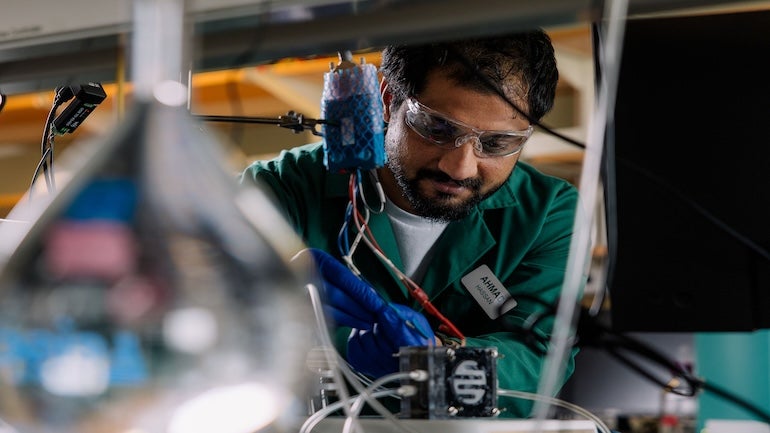
A team of researchers at the University of Houston has announced two major breakthroughs in carbon capture technology that could drastically reduce the cost of removing carbon emissions, potentially transforming the fight against climate change.
Led by Mim Rahimi, a professor at UH’s Cullen College of Engineering, the team’s work aims to make emissions reduction more accessible for industries worldwide.
Advancing carbon capture technology
The first breakthrough focuses on amine-based carbon removal, a widely used industrial method. Traditional systems rely on costly ion-exchange membranes, which limit efficiency and increase energy requirements. The UH team replaced these membranes with engineered gas diffusion electrodes, simplifying the process and cutting energy use.
This allowed the system to achieve a CO2 removal efficiency exceeding 90% – almost 50% higher than conventional electrochemically mediated amine regeneration (EMAR) methods. It also reduced the cost to roughly $70 per metric ton, making it competitive with the most advanced existing technologies.
Ph.D. student Ahmad Hassan, lead author of the study, described the advancement as a “game-changer,” noting that it could allow existing industrial exhaust systems to be retrofitted with compact, affordable carbon capture modules.
Merging with renewable energy storage
The team’s second project addressed the challenge of linking carbon capture to renewable energy storage. Ph.D. student Mohsen Afshari developed a vanadium redox flow battery capable of both storing energy and capturing CO2. During charging, the system absorbs carbon, and during discharging, it releases it – while maintaining stable cycles and high capture capacity.
This approach could enable power plants and industrial facilities to reduce emissions while supporting intermittent solar and wind energy.
Rahimi emphasised the broader impact of their work: “From membraneless capture systems to scalable energy storage integration, we are creating practical solutions to decarbonize industries and support the transition to a low-carbon economy.”
With costs declining and efficiency rising, the University of Houston team’s dual innovations could accelerate adoption of carbon capture technology in power plants, refineries, and heavy industries worldwide.


