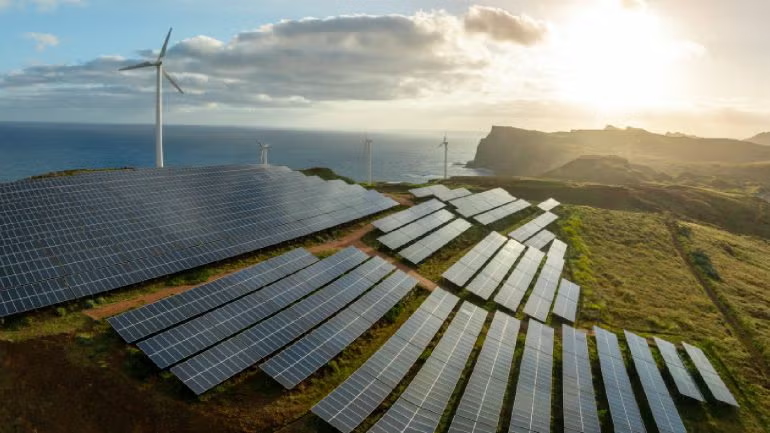
The European Commission has authorised a €23 bn ($26.5 bn) state aid scheme in Italy intended to increase electricity generation from renewable energy sources. The scheme was cleared under the Clean Industrial Deal State Aid Framework adopted by the EC on 25 June 2025. According to the Commission, the Italian programme will support the construction of new installations producing electricity from onshore wind, solar, hydropower and sewage gas.
These projects are forecast to provide a total of 37.15 GW of additional renewable electricity capacity, representing roughly 48% of Italy’s current renewable capacity. The initiative is part of Italy’s efforts to reach its target of 39.4% of gross final energy consumption coming from renewables by the end of this decade.
Financial support under the scheme will be provided via variable payments through two-way contracts for difference over 20 years. Under this system, the state pays the difference to producers if market prices fall below a fixed “strike price”, but companies must return the difference if market prices are higher.
The Italian authorities will allocate support through competitive bidding for projects in excess of 1 MW. Applicants for larger solar and wind projects will also be subject to additional Net Zero Industry Act requirements under relevant EU regulations. Projects under 1 MW are eligible for administratively set strike prices without a bidding process, decided by the Italian energy regulator.
The €23 bn budget is based on current market price projections. Actual expenditure could be lower if market prices exceed expectations, reducing the net support needed.
In making its decision the EC stated that the measure complies with CISAF requirements. It cited the use of a competitive process and direct price support, as well as safeguards to prevent compensation when prices are negative.
Furthermore, the regulator said the aid was considered necessary, appropriate and proportionate for accelerating Italy’s renewable transition in line with the Clean Industrial Deal.
The CISAF was developed to speed up support measures as part of the EU’s net-zero ambitions. The framework provides guidance for member states to grant aid through investment schemes, electricity price relief, support for industrial decarbonisation, and increased clean technology manufacturing. It also encourages private sector investment in clean energy projects.


