
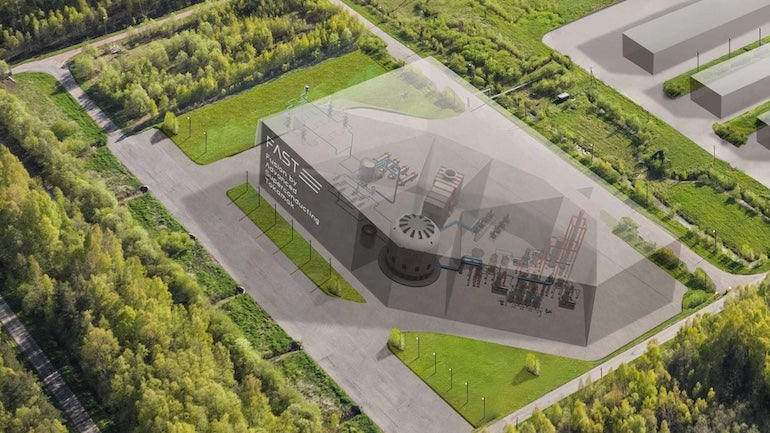
Starlight Engine Ltd. (SLE) and Kyoto Fusioneering Ltd. (KF) have completed the conceptual design for Japan’s privately-led FAST (Fusion by Advanced Superconducting Tokamak) power demonstration plant, reaching the project’s first major milestone one year after its launch in November 2024.
The partners have released a Conceptual Design Report (CDR) that sets out FAST’s objectives, required performance, system configuration, feasibility, costs and construction schedule. It is the first CDR in Japan prepared for a privately-led fusion power demonstration in line with the government’s “Fusion Energy Innovation Strategy.”
FAST is a low-aspect-ratio tokamak designed to generate and sustain deuterium–tritium burning plasma, targeting around 50 MW of fusion output using neutral beam injection heating in a device comparable to the JT‑60SA tokamak. The project aims to demonstrate an integrated fusion power system, combining energy conversion, tritium breeding and fuel cycle technologies, and remote maintenance at a scale relevant to commercial plants.
SLE leads the project with KF and leading researchers from the University of Tokyo, Nagoya University and Osaka University, supported by major Japanese companies including Sumitomo Mitsui Banking Corporation, J‑Power, JGC JAPAN, Hitachi, Fujikura, Furukawa Electric, Marubeni, Kajima, Kyocera, Mitsui & Co., Mitsui Fudosan and Mitsubishi Corporation.
The conceptual design draws on decades of Japanese experience in JT‑60SA, ITER and DEMO studies, and incorporates technologies such as high-temperature superconducting magnets and liquid breeding blankets. According to the project team, completing this phase in just one year is unusually fast.
FAST now moves into the engineering design phase, with an Engineering Design Report targeted for 2028 and construction planned after 2028. In parallel, the project is publishing site requirements, engaging potential host regions, advancing safety discussions with the Nuclear Regulation Authority, and preparing to secure funding for engineering design and R&D from 2026.

Read more: FFC launches UNITY-2 fusion project


