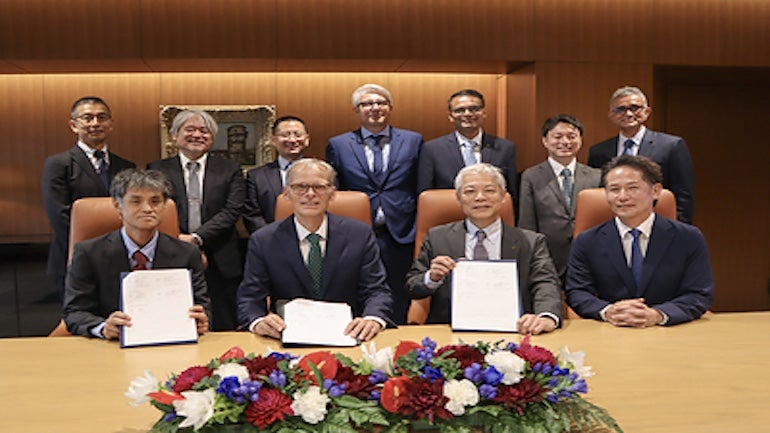
Hitachi Energy and Daikin Industries have announced an agreement to establish a long-term strategic supply relationship for Hitachi Energy’s proprietary EconiQportfolio of sulphur hexafluoride (SF6)-free high-voltage technologies. As part of the agreement, Daikin Chemical Europe, a subsidiary of Daikin Industries, will supply C4-FN, a specialty gas component used in insulating and quenching gas mixtures. The C4-FN will be produced by Daikin Refrigerants Frankfurt GmbH at its facility in Frankfurt, Germany, making use of its advanced manufacturing capabilities and environmental standards. The new production capacity will become available in 2027 and is to be part of ‘a resilient global supply strategy for critical materials’ that will be used in Hitachi’s EconiQ technology.
SF6 is a very powerful greenhouse gas used in high voltage high-voltage equipment. Utilising C4-FN gas reduces CO2-equivalent emissions by 99 % compared with conventional SF6-insulated equipment, while retaining the same technical performance, reliability, and compactness.
The announcement comes as demand for EconiQ continues to grow worldwide. To support this growth, Hitachi Energy is pursuing a multi-sourcing strategy for key materials. The addition of Daikin as a supplier strengthens the supply chain behind the EconiQ portfolio, complementing existing qualified sources in Asia with capacity in Europe.
Markus Heimbach, CEO, high voltage products Business Unit at Hitachi Energy, said: “Adding a world-class production site in Germany enhances supply resilience and supports the manufacturing of clean energy technologies in Europe. We want to be sure that we can continue meeting customer demand.”
“This agreement reflects a shared commitment to supporting the energy transition through innovation, quality, and long-term collaboration,” said Yasuhisa Hirao, general manager, Chemicals Division, Daikin Industries Ltd.


