
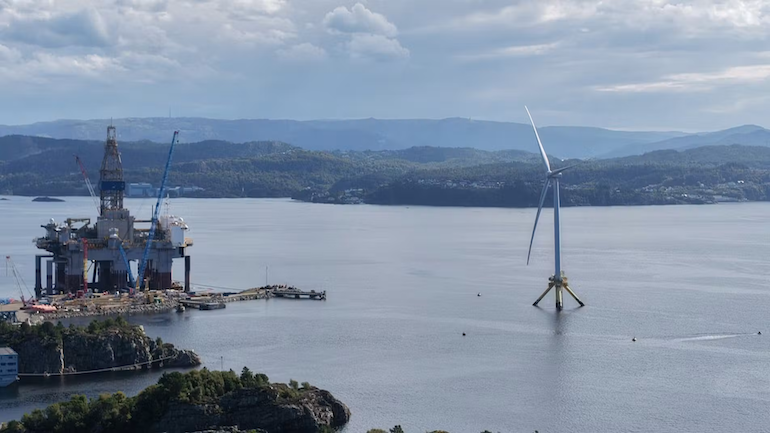
The 3.6 MW TetraSpar floating wind demonstrator has completed nearly five years of operation off Karmøy, Norway. It has now been disconnected from the Marine Energy Test Centre (METCentre) and towed to Hanøytangen near Bergen, where it will undergo inspection.
The project, developed by Stiesdal Offshore with RWE and TEPCO Renewable Power, was installed in 2021 in around 200 metres of water. Its Siemens Gamesa turbine operated through North Sea conditions on a modular steel floating foundation designed for assembly without welding.
During the deployment, the demonstrator recorded an average 98% availability and a lifetime capacity factor of 51.4%, generating approximately 70 million kWh for the Norwegian grid. The project accumulated more than 40,000 hours of operational data.
The latest phase has also provided experience beyond turbine operation. Global Maritime managed the decommissioning campaign, with subsea and marine contractors disconnecting the floater and recovering its mooring system. The dynamic export cable was lowered into wet storage at approximately 210 metres, freeing the METCentre berth for another demonstration project.
The floater is now secured at Hanøytangen, where engineers from Stiesdal Offshore, RWE and TEPCO Renewable Power will inspect components that have spent almost five years in the marine environment.
The physical inspection will allow the project partners to compare evidence of fatigue, corrosion and hydrodynamic wear with the assumptions used in the foundation’s design and the operational data collected offshore. Such information is important for establishing maintenance requirements and confidence in the lifetime performance of floating foundations as the technology moves towards commercial-scale projects.
The TetraSpar experience is also being carried into Stiesdal Offshore’s next-generation TetraSub foundation, designed for turbines above 15 MW. TetraSub has been selected for the 92.5 MW Pentland Floating Offshore Wind Farm in Scotland.
For floating wind, the significance of the demonstrator therefore extends beyond its electricity output. The project has provided operational, installation and decommissioning experience from a full-scale floating foundation, while the subsequent inspection should provide additional evidence on how the structure performs over time.
The data and physical findings are expected to inform the design and industrialisation of larger floating wind foundations as developers prepare for commercial deployment.


