
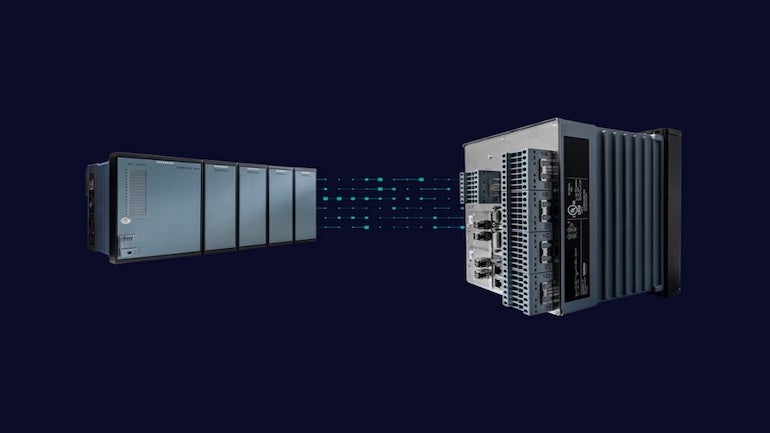
Siemens has unveiled what it regards as a breakthrough in innovation for energy infrastructure its ‘Siprotec 5 Precision Time Protocol (PTP) Grandmaster Clocks’. These are intended to ‘secure the backbone’ of modern power grids and boost overall grid reliability by ensuring resilient, fail-safe time synchronisation for digital substations, to safeguard critical protection functions from disruption, to shield against external disturbances, and to strengthen cybersecurity.
In a digital power grid, precise time synchronisation is essential for protection systems. While many applications require globally accurate time signals, sampled values within process bus systems primarily depend on consistent local precision rather than external global sources.
Siemens’ solution separates sample synchronisation from global time synchronisation using specialised internal time sources. Siprotec 5 devices, equipped with integrated PTP Grandmaster Clocks compliant with IEEE 1588v2/PTP standard, operate independently of external global navigation satellite system (GNSS) signals, but use use internal oscillators as time references. A feature of this approach is Siemens’ patent-pending ‘seamless PTP grandmasterchangeover technology’, built into Siprotec 5 devices. This ensures that when primary clocks return to the system they first align with active backup clocks before resuming their role. In doing so, disruptive time base jumps during switchovers are prevented.
The synchronisation enables process bus networks in digital switchgears to operate autonomously without external access points, significantly strengthening cybersecurity by isolating the process bus from the station bus network.
GNSS clocks
Conventional digital substation architecture often relies on GNSS-based grandmaster clocks. However, even with redundancy, they remain vulnerable: disturbances to GNSS signals, whether from natural phenomena like solar storms or intentional interference such as jamming and spoofing, can cause disruptive ‘jumps’ in the time base. Such disruptions force merging units to resynchronise, temporarily disabling critical protection functions and can lead to unnecessary removal of equipment from service or even cause false tripping events. This new solution is believed to mitigate these risks, ensuring uninterrupted secure operation.


