
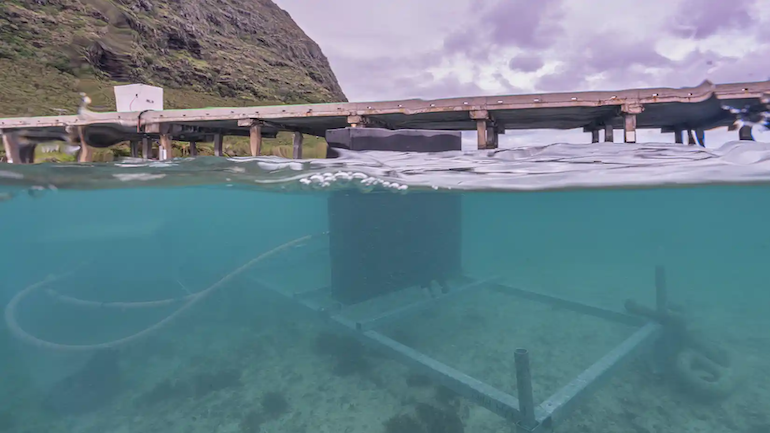
A small wave energy converter developed by researchers in the US has begun generating electricity in open-ocean conditions, providing new performance data for a marine energy technology that has so far been tested mainly through modelling and laboratory work.
The Small Underwater Research Flap Wave Energy Converter (SURF-WEC) was deployed off the Makai Research Pier on Oahu, Hawaii, following around two years of modelling, construction and laboratory testing by researchers at the National Laboratory of the Rockies (NLR) and the University of Hawaii at Manoa.
The project is intended to address one of the marine energy sector’s persistent challenges: limited access to data from real-world deployments. The researchers plan to make the device’s design, operational data and lessons learned available to the wider research community.
SURF-WEC uses a buoyant underwater flap that moves back and forth with passing waves. The motion drives a hydraulic power take-off system, which builds pressure in a sealed fluid circuit before driving a motor and electrical generator.
The system can be operated in either passive or active modes. Researchers can change its response to incoming waves remotely, allowing them to compare the theoretical efficiency advantages of active control with the additional energy losses associated with sensors, controls and mechanical adjustments.
Before deployment, the hydraulic system was tested at NLR’s Flatirons Campus using an electric actuator to reproduce the motion of the flap. Hydrodynamic and power take-off models were also used to assess expected performance under different wave conditions.
The deployment itself was delayed by a storm approaching Oahu, providing an additional test of the project’s modelling and deployment procedures. Researchers used real-time buoy data to update simulations before completing installation two days later.
SURF-WEC produced its first electrical output after deployment. The team intends to keep the device in the water for up to one year, collecting operational data across changing ocean conditions.
A monitoring and control platform, MODAQ 2.0, records system performance and allows researchers to operate key functions remotely. Data from the project is being made available through a live interface, with a final report planned for public release.
The project is funded by the US Department of Energy’s Hydropower and Hydrokinetic Office.


