
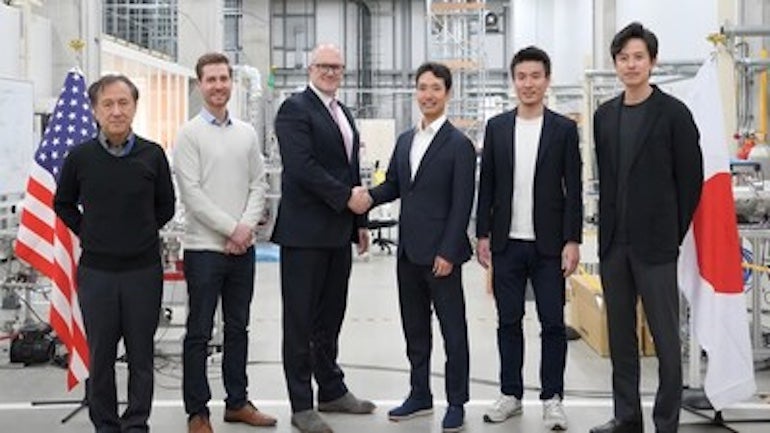
Realta Fusion and Kyoto Fusioneering on 16 March announced a bilateral strategic partnership designed to accelerate the global commercialisation of fusion energy. The agreement is expected to strengthen fusion industry ties between the USA and Japan and support joint development of a plasma heating system design for magnetic mirror fusion machines, mirror-based neutron sources, and blanket and fuel cycle technology. The agreement is said to ‘capitalise on the deep synergies between the advanced fusion ecosystems of the United States and Japan to drive unprecedented industrial momentum’.
It outlines several areas of joint technological development that build on the strengths of both companies. KF will bring its expertise to the design, engineering, and fabrication of plasma heating systems optimised for use in Realta’s magnetic mirror fusion machines. Realta and KF will also explore the design and deployment of mirror-based neutron sources that can be used to qualify materials and decisively de-risk the development of tritium blanket breeding and fuel cycle systems.
In the first phase of this partnership, Realta has purchased gyrotrons – the high-powered microwaves that help heat fusion plasmas to many times the temperature of the sun – from KF. These gyrotrons will be installed on Realta’s first commercial-grade fusion machine, which will be located in their planned research and development facility known as The Realta Forge.
“Most visibly, this partnership allows Realta to access some of the best fusion engineering expertise in the world at KF and tap directly into the depth of the Japanese supply chain” said Realta Fusion CEO and Co-Founder Kieran Furlong.
However, the collaboration is said to extend far beyond fusion hardware development. The companies will pursue joint engagement of their respective government stakeholders, industry associations, and standards bodies, while co-ordinating supply chain partnerships for components, materials, and subsystems.
Kiyoshi Seko, KF’s president and COO commented: “By linking our respective industrial bases, we are not just advancing magnetic mirror technology; we are forging the resilient, cross-border supply chains required to make commercial fusion a reality.”


