
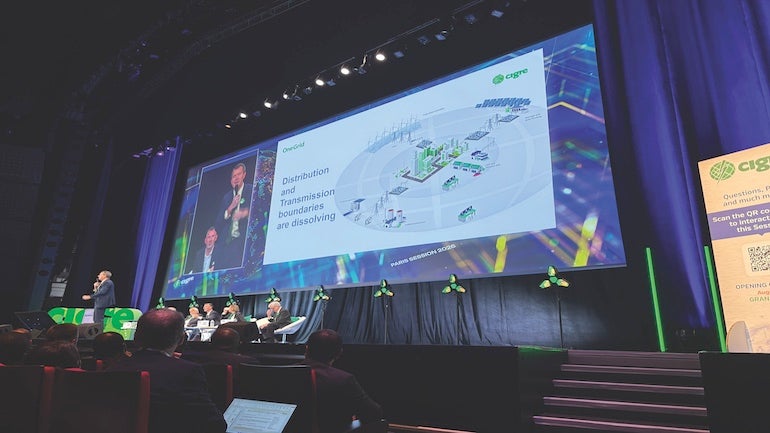
“Distribution and transmission boundaries are dissolving,” said Nenad Uzelac of G&W Electric Co, USA, at the opening of the CIGRE Paris Session. He was introducing CIGRE’s OneGrid initiative, with the basic message that distribution for too long has been seen as the poor relation of transmission and needs to be treated much more seriously. As CIGRE OneGrid Convener, he is well placed to promulgate this message, describing himself as a “distribution guy”, having spent his whole career in that part of the grid. “I’m excited to help bring more distribution into CIGRE, unite perspectives, and break traditional boundaries,” he says. “I’ve been in CIGRE for 20 years and a lot of the time I was the only distribution person in the room.”
CIGRE’s determination to change this was evident in the effort put into promoting its OneGrid initiative at the Paris Session, and for the 15000 or so attendees the messaging was very hard to avoid.
The Paris event included an “interactive pavilion” devoted to OneGrid and a dedicated “Distribution Day”, as well as promotion of a OneGrid symposium that CIGRE is planning for 27-30 April 2027 in Heidelberg, Germany, which will demonstrate the practicalities of “distribution and transmission, working together, as one grid.”
So, what is the OneGrid initiative? It is perhaps best summarised in the “collective perspective” below provided by the CIGRE OneGrid Core Team*:
“For decades, the power system has been understood and organised as a set of distinct layers. Transmission and distribution followed different logics, operated in different contexts, and developed their own communities of expertise. This structure proved highly effective and supported the reliability and performance modern societies depend on.
“That context is now changing. Electrification, distributed energy resources, and digitalisation are reshaping the grid in ways that make traditional boundaries less meaningful. Distribution networks are no longer passive systems delivering power to consumers; they are becoming active, dynamic parts of the grid where generation, demand, storage, and flexibility increasingly interact. At the same time, digital technologies are providing the visibility and control needed to manage this growing complexity in real time.
“What begins at the distribution level no longer stays there. It increasingly shapes how the entire system behaves.
“This shift is also redefining transmission. Transmission system operators now work in an environment where flows are less predictable, where stability depends on resources connected far beyond the traditional transmission boundary, and active information exchange with distribution is essential for planning and operation. The responsibilities on both sides are evolving, along with the need for a more integrated approach.
“It is impossible to talk about transmission without talking about distribution, and just as difficult to understand distribution without considering its impact on the complete system. The reality is one where everything is connected, and where decisions in one part of the grid is influencing the whole.
“This is not a future scenario – it is operational reality.
“Across the CIGRE community, this shift is increasingly recognised. Distribution is no longer a secondary topic, but a central part of how the system evolves. One of CIGRE’s greatest strengths lies in its ability to bring together diverse perspectives and create a coherent view of the system as a whole. The opportunity now is to make that strength more visible and more intentional.
“That is where the OneGrid initiative sits. Rather than introducing something entirely new, it builds on what already exists. CIGRE has always brought together expertise across the full value chain of the power system. What is changing is the need to connect this expertise more directly, reflecting how the system actually operates and engaging a broader range of participants shaping the grid in real time. At its core, OneGrid is about breaking traditional silos and enabling a more integrated system perspective.
“In that sense, OneGrid is less about defining something new and more about setting a clear direction. It reflects a shift toward thinking in terms of the integrated power system and toward working in a way that naturally aligns different parts of the community. As the system continues to evolve, so will the ways in which we organise technical work, engage stakeholders, and address emerging challenges.
“Looking ahead, the ambition is to continue building on this momentum. The goal is not to replace what CIGRE already does well, but to strengthen it by making the integrated system perspective more visible and more reflective of the challenges the industry is addressing. That includes ensuring that distribution is clearly represented, that technical work reflects real system interactions, and that engagement extends across the full range of stakeholders shaping the future grid.
“This will not be a sudden transformation. It is a gradual process that will develop through collaboration, shared experience, and continued dialogue across the community. What is clear, however, is that the system itself is no longer divided in the way it once was. It is interconnected, dynamic, and increasingly shaped by interactions across all voltage levels. Recognising that reality – and aligning with it is what OneGrid is about.”
* Nenad Uzelac (USA), Marcio Szechtman (Brazil), Pascal Mueller (Switzerland), Hiroshi Okamoto (Japan), Uwe Kaltenborn (Germany), Nikos Hatziargyriou (Greece), Kurt Dedekind (South Africa), Biljana Sovilj (Austria).


