
The modern power system is transforming faster than ever before. Electrification of heat and industry, accelerating data centre demand, and the rapid build-out of renewables are reshaping how, where, and when electricity is produced and consumed. This evolution brings immense opportunity, but also introduces a critical technical question: how do we manage oscillations in an increasingly dynamic grid so that stability keeps pace with change?
The answer to that question is complex.
It’s clear that we need to expand generation capacity and increase transmission capability. But the options for doing so aren’t always simple. New transmission corridors are scarce, costly, and, often, come with burdensome technical and regulatory requirements. While underground and subsea cables may help, they offer their own set of engineering challenges.
As the industry becomes more and more dependent on renewables, often inverter-based resources (IBR) like solar, wind, and battery storage, we find another issue in that the geographical pattern of generation is shifting as renewables replace centralised fossil fuel assets. These new renewable sources are often located far from legacy infrastructure and output profiles can change on an hourly basis. The pattern of power flow from generation to load keeps changing its shape and that means our transmission network needs to be flexible enough to deal with these variations on a seasonal, if not daily, basis.
Added to all of this is the complexity of controlling such a network when there are so many sources of power, each with its own powerful controls. And they must all work in harmony. If the controllers aren’t aligned, they can oscillate against each other, causing instability.
The variability of renewable generation further stresses this complexity. As wind and solar output rise and fall outside our direct control, the system’s balance must be maintained in real time. That raises the value of energy storage and fast controls that can respond to dips and surges. But it also increases the demands placed on co-ordination and damping. In short, we are not merely building more grid; we are evolving from a predictable, largely synchronous system into a dynamic, digital, multi-controller infrastructure.
If the industry doesn’t adapt quickly, the consequences could be rising instability and more frequent blackouts. Operators, utilities, and regulators all share a stake in addressing this challenge.
A simple device offers a solution
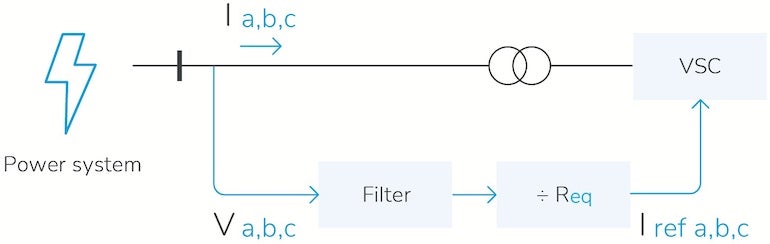
In thinking about that original question, how do we manage oscillations, an idea came to me that I wasn’t able to ignore – a device that continuously “listens” to the grid, detects the onset of oscillations across a broad frequency range, and responds instantly by absorbing energy from the oscillatory mode – just like a shock absorber on a car. Once that excess energy is captured, it does not go to waste; the device returns it to the system at the fundamental power frequency (50 or 60 Hz). The result is active damping that stabilises the network without expending energy or curtailing generation. It’s a simple idea with far-reaching implications.
The technology, called Universal Damping STATCOM (UD-STATCOM) can be delivered as a new, stand-alone device or implemented as a software-enabled extension of an existing STATCOM. In the latter case, the STATCOM retains its normal reactive power and voltage control function, but the damping capability kicks in the instant oscillations appear. That means asset owners could leverage installed infrastructure and add stability functionality largely through software, accelerating deployment and lowering cost.
Images below show PSCAD simulations, demonstrating UD-STATCOM in action (Credit: Ramboll)


However, there are real-world integration challenges. Current STATCOM fleets span multiple generations and manufacturers, each with distinct control architectures and firmware. Enabling damping functionality will require collaboration case by case, and in some instances the involvement of OEM engineers to update older systems. Still, the value of a relatively low-cost and easy-to-deploy tool that increases stability, reduces the risk of controller interactions spiraling into oscillations, and supports higher penetrations of inverter-based resources is undeniable.
Application to microgrids
Microgrids are often seen as a solution to the grid stability issues outlined above, and the UD-STATCOM is also highly applicable to those. One of the strongest incentives for microgrids is economic: collocating generation and load removes the need for long transmission lines, which are expensive to build and maintain. In remote regions — such as parts of Canada where I’m from — connecting communities via thousands of kilometers of line can be quite costly for relatively low utilisation. Microgrids can deliver reliable supply at far lower lifecycle cost in these settings. Even in dense urban areas, where building new transmission is increasingly difficult, the logic remains: bringing generation closer to consumption reduces the infrastructure burden and can unlock faster deployment of clean energy.
But, at the end of the day, a microgrid is still a grid. As it incorporates solar, wind, storage, and demand-side resources, it must be designed for stability, particularly as resource outputs and load profiles vary throughout the day. The same oscillation dynamics that challenge the transmission system can arise within microgrids as controllers interact. Here, the UD-STATCOM can serve as the microgrid’s stability backbone, suppressing oscillations and safeguarding power quality. There’s also a pathway for microgrids to provide ancillary services to the wider system, with damping as a defined and compensated service. While the market constructs for this are still emerging, the concept points toward a future in which stability assurance is an explicit product that distributed assets can offer.
What’s next?
We are working with manufacturers on implementation of the UD-STATCOM with the goal of making the upgrade as straightforward as possible, so that once released, adoption is quick and seamless. For asset owners and grid operators, the practical next steps are clear:
- Assess where oscillatory risks are most acute: high concentrations of IBR generation, known resonance points, or interties that have exhibited low damping ratios.
- Engage with vendors and technology partners to define pilot deployments where the stability benefits can be measured under realistic operating scenarios. Early pilots can validate performance across frequency ranges, response latencies, and interaction with other control loops.
As the grid grows more distributed, more digital, and more dynamic, stability will be increasingly challenged. Thus, stability, reliability, and agility must be threaded into the fabric of our infrastructure. Oscillation damping will be a critical part of keeping our grids healthy.


