
Ageing power plants don’t have to be headed for retirement – many are standing on the threshold of a second, far more efficient life.
Across the globe, gas-turbine-based power plants built around the year 2000 are reaching the limits of their initial design life. Rising O&M costs, poor efficiency due to outdated design combined with degradation, sourcing challenges for spare parts, and tightening emissions regulations paint a familiar picture. At first glance, shutting down or replacing an ageing plant may seem inevitable. But in reality the story doesn’t need to end here.
With modern technology, thoughtful refurbishment, and strategic upgrades, an existing plant can be transformed into a high-performing, flexible, and future-ready asset – at only a fraction of the cost and time needed for a new build project. Much of the plant’s infrastructure remains robust for decades, and by focusing on the true heart of performance – the gas turbine – operators can unlock dramatic improvements in efficiency, flexibility, emissions, and operating costs. As global power demand rises and grids are increasingly shaped by renewable generation, extending the life of existing gas-turbine-based plants is becoming not only attractive but essential. This article explains how plant operators can breathe new life into ageing assets and position them for the next generation of energy systems.
Gas turbine: main life limitation and the core of plant performance
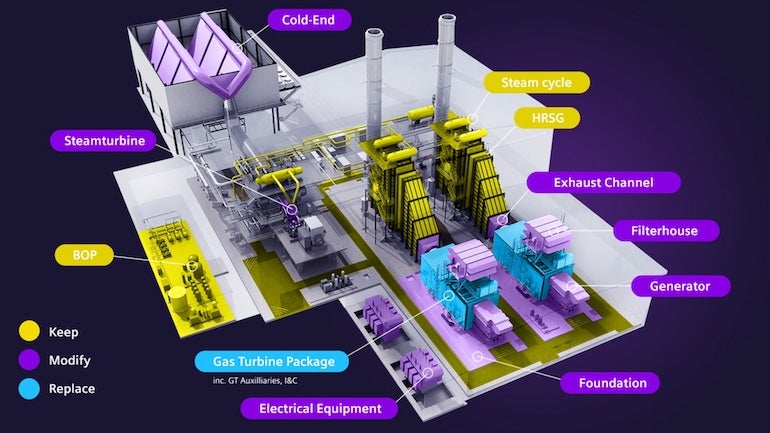
The gas turbine can be replaced with a new, modern one, often installed on the existing foundation. A gas turbine, in addition to general ageing, suffers from degradation of performance compared with its original new status. To make it worse, it has also become outdated, as GT technology has developed significantly over the years. A new gas turbine with higher efficiency and similar capacity to the replaced machine leaves somewhat less waste heat in the exhaust. Therefore, often the bottoming cycle fits well in terms of capacity even if gas turbine capacity increases.
Since the gas turbine is at the core of plant performance, replacing it with a new and modern machine brings plant performance close to what is achievable with a new plant at the same location. The concept of bottoming cycles has not changed much over the years, even though some modern combined cycle plants utilise higher steam conditions than were common 25 years ago. That said, start/stop operation favours lower steam conditions, so an old plant with some adaptations may still be suitable for future operating scenarios.

Some gas turbine models designed in the 1980s and 1990s and supplied around 2000 were taken out of production long ago. As a result, access to spare parts and qualified service personnel is becoming increasingly difficult, costly, and subject to longer lead times – especially when components must be fabricated as single-order items rather than taken from stock.
Gas turbines that have been taken out of production will also no longer receive service upgrades, since development of technology for a machine is generally halted some years prior to the end of sales. Replacement with a new gas turbine model reduces service costs and shortens downtime during each service interval. Typically, any machine approaching the end of its design life also shows an increasing rate of ageing-related faults and outages, and the risk of a serious fault rises. Even if the design lifetime of a gas turbine can be 30 years, it may be economic to replace the gas turbine earlier unless upgrades have been implemented.
In some cases, simply evaluating the performance gain by replacing an existing turbine with a new machine reveals a payback time of as little as two years, since running costs have a decisive impact.
When considering replacement of an old GT with a new one, you first search for a machine with similar capacity, but layout considerations are also vital. For example, if the old machine has the exhaust directed sideways, then a new machine with axial exhaust would require positioning far from the old foundations to leave room for a duct elbow. You would be better off finding an alternative machine with a side exhaust. The position of the generator – at the hot or cold end of the gas turbine – is another important factor.
If the old machine is an aeroderivative, then a new industrial machine may be used instead. A modification of the exhaust duct is usually required, even S shaped ducts have been used to enable the fit.

Improvement of gas turbine inlet air filtration may be wise. The existing GT inlet air structure can be kept, but the GT interface typically needs to be modified. However, it is often found that the filtration quality of old installations is rather poor, and modern HEPA filtration should replace the old system, even if the old housing structure is kept. Better air filtration improves gas turbine operating performance due to less fouling, reduces need for compressor washing and reduces gas turbine degradation thanks to less wear caused by particles in the air.
If a gas turbine of a more modern vintage replaces an older machine of the same type, performance upgrades often go hand in hand with increased generating capacity. Thus, the replacement machine typically has higher capacity as well as better efficiency. Since the more modern machine achieves improved efficiency, a larger part of the fuel input heat is converted to power – meaning the remaining exhaust heat does not necessarily increase as much as the installed capacity increases.
To verify the thermodynamic fit, a “digital twin” of the original design is created. In this performance simulator, the gas turbine model is replaced with one representing the candidate new machine. It is therefore important to find the original heat balances that once formed the design basis for the HRSG and the rest of the balance of plant in the plant archive. From the simulations, you may, for example, find that the new gas turbine needs to be limited somewhat at low ambient temperatures to avoid overloading the steam system. In such cases, air preheating is a useful method to reduce power without loss of efficiency.
With increased electricity generating capacity, the step-up transformer and possibly the switchgear and cabling may need to be upgraded. However, in some cases, a redistribution of the reactive power factor between the gas turbine and the steam turbine may provide the necessary adjustment to avoid replacing of equipment.
A slight increase in exhaust heat from the gas turbine can often be handled. The HRSG may have a certain margin so that the maximum continuous rating (MCR) can be upgraded slightly if the safety valve(s) are modified accordingly. Increased steam production can in many cases be accepted by the steam turbine, provided technical margins allow it. If the steam turbine cannot accept more steam flow without causing an increase in steam system backpressure, then an HRSG safety valve with higher reseating pressure can be used. Alternatively, additional safety valve options exist that force the valve closed until release pressure is reached.
One example of a good fit is replacing an old Westinghouse W251 gas turbine with a Siemens Energy SGT-800. Another example is the replacement of an RB211 with an SGT 700.
Both the SGT-800 and SGT-700 are mounted on a base frame that also carries several auxiliary systems, described as a package. This facilitates site installation. Larger gas turbines are assembled on site instead, as the transport size of a frame-mounted machine cannot be much larger than that of the SGT-800. For frame-mounted gas turbines, it is best to replace the gearbox and generator as well, since they come with the standard GT package. For larger gas turbines, the gearbox (if applicable) and generator may be retained, depending on their condition and fit.
The gas turbine foundation can often be reused, but suitability of its condition — free from cracks requiring repair or other issues — can only be confirmed once the original gas turbine has been removed. Confirming that the foundation and below-ground piling are sufficient for the new machine can be challenging if original documentation is lacking. However, in most cases, the structure is more than sufficient — the only issue is proving it. If the rotor string of the new machine is lighter than the old one, then one may assume that forces resulting from events such as short circuits or blade-loss incidents are lower. The conclusion is that if the foundation was good enough for the old gas turbine, it is likely even better for the new one.
So far, all is fine — but this does not resolve the risk of eigenfrequencies. Even if this risk is low, it must be addressed, and mitigation plans must be in place. After the old gas turbine is removed, the embedded steel is carved out and cavities in the concrete are created to allow new embedment to be cast.
By replacing the gas turbine with a modern one, emissions are brought down to modern standards, complying with permitting requirements equivalent to those for new builds. The risk of a ban on operation in the near or far future is thus mitigated.
A new machine may also be supplied as future-ready in terms of fuel flexibility. It may be delivered ready for up to 100% hydrogen for the gas turbine package and auxiliaries, and when the time comes for a fuel change, only the burners need to be replaced – preferably during a routine inspection, when burners are replaced anyway. Converting an existing machine to hydrogen-ready is sometimes possible but is certainly more expensive than the additional cost of including that option in a new-machine delivery.
The plant can also gain improved flexibility features, such as fast starting of the gas turbine and the ability to preserve heat during standstills and to withstand cycling operation better than originally designed. The startup time for the bottoming cycle may be significantly improved by combining better heat retention with warm-keeping measures.
HRSG can be suitable after minimal modifications
The HRSG can reach a lifespan of up to 50 years if water chemistry has been managed well and some restoration is carried out. In some cases, partial tube replacement is required, especially in the low temperature section if sulphur-containing fuels have been used.
One issue with changing from an older GT to a more modern one is that the exhaust temperature is typically higher than that of the original gas turbine. In many cases, this is wrongly seen as a project–stopping issue. Unfortunately, some plant owners specify requirements that a new GT must not exceed the old “rated” GT exhaust temperature. This misunderstanding often stems from the HRSG nameplate rating, which states a GT type and maximum temperature. However, such a rating merely defines the heat input used to determine the maximum continuous rating – a steam flow figure. It has little to do with the material limits regarding temperature.
When replacing the gas turbine, the HRSG certificate must be revised anyway. In practice, much higher exhaust temperatures can be used if the superheater is adapted, which often requires only cutting out part of it and reconnecting piping. In the worst case, a superheater module must be replaced. In other cases, an upgrade of the water-spray capacity between superheater modules is sufficient. Some adjustments to the start sequence and to forced steam venting at steam turbine trips may be needed if the maximum allowable temperature of the superheater material is lower than the new gas turbine’s maximum exhaust temperature. These steps prevent excessive exhaust temperatures when low steam flow passes through the superheater.
If the HRSG is equipped with duct-firing burners, normally no modification of the superheater is required. However, changes in exhaust flow and temperature may justify an adjustment of permissible firing rate.
The material temperatures of the evaporator and economiser sections of the HRSG mainly follow the temperature of the water and steam on the inside, and not the exhaust temperature. This is due to the very efficient heat transfer via water compared to the transfer from dry exhaust. Thus, material temperatures are not significantly affected by a change in exhaust gas temperature from the gas turbine. This holds even considering the large external surface area created by added fins or serrations. If the steam pressure is reduced slightly (as a result of lower steam production, assuming a sliding-pressure concept), the reduction in steam saturation temperature may lower the material temperature more than any influence from a higher exhaust gas temperature.
If the casing is internally insulated, it is only marginally affected, and no issues arise with a GT replacement. Internal liner plates and insulation systems are normally suited for higher temperatures than originally specified. Duct expansion joints located in areas exposed to high temperature exhaust may need upgraded temperature resistance. However, their replacement is advisable anyway as part of maintenance and life extension measures.
For an externally insulated vertical exhaust-gas-flow HRSG, the effects of creep deformation in the casing must be assessed. In such cases, an increase in GT exhaust temperature may require replacement of parts of the duct or reinforcement using internal stays. An alternative method is to modify GT control to allow more air to pass through the machine – diluting the exhaust. Alternatively, dilution air can be introduced using an additional fan.
If a bypass stack and diverter are installed, they are typically of a standard design that tolerates higher temperatures than specified for a particular plant. In other words, there is often hidden margin. This can sometimes be confirmed through scrutiny of drawings or by checking the materials used in the design.
Steam turbine life extension
Many steam turbines have been operating for more than 50 years; there are even examples of machines that have survived 100 years of operation. So why should a turbine be at the end of its life after 25 years?
If the turbine has been exposed to poor quality steam, blades may be damaged even after very few years of operation. Likewise, erosion damage may occur quickly if the exhaust is operated too wet due to low condenser pressure. Naturally, the number of start–stop cycles and the extent of load cycling have significant influence, as does continued operation under vibration issues. Even if an old turbine is still functional, it may have severely degraded performance due to worn blades, increased internal leakages, etc. Turbine degradation results in increased temperature at extractions and at the outlet, at worst resulting in risk of trips disturbing operations.
But even if the turbine requires a complete re-blading or even shaft replacement, the cost is often lower than replacing the turbine entirely. When replacing a turbine, the foundation is not always reusable, and interfaces to the condenser and piping differ, resulting in many additional costs that can be avoided by revamping the existing machine. Naturally, some auxiliary systems and instrumentation – such as hydraulics, oil pumps, steam valves, and the evacuation system – should be replaced or refurbished to ensure they last through the extended life cycle.
If the steam cycle concept is dual- or triple-pressure, the GT change may affect both HP steam production capacity and the balance between HP, IP, and LP steam flow. If the steam turbine is re-bladed anyway, this presents an opportunity to rematch the new blading to the new operating conditions to optimise plant performance. A rematch mainly affects the last-stage blading, which is also the most exposed to erosion and fatigue – meaning a rematch typically aligns well with refurbishment needs.
In many cases, the steam turbine power is reduced somewhat when replacing the GT, even when GT capacity is increased. This means the gearbox (if any), generator, and electric gear can be kept. However, the gearbox and generator should be inspected and serviced to ensure a lifespan consistent with the extended plant life. This may require pulling the rotor and possibly rewinding. If suitable, the old generator from the replaced gas turbine can be kept as a strategic spare for the steam turbine.
Balance of plant equipment
Naturally, other plant components need to be replaced or renovated to extend plant life, but most costly infrastructure can remain. Whether pumps and valves should be replaced regardless of condition – to achieve a full refurbishment – or maintained on demand depends on financial considerations. Adding variable frequency drives (VFDs) is a way to improve plant efficiency and achieve capacity upgrades if needed. However, typically many pumps are severely oversized in the original design, which actually argues for efficiency gains from VFDs through speed reduction rather than for capacity increases.
A wet surface condenser may require replacement of protective plates, the most erosion-exposed tubes, and possibly re-lining of the water chamber. However, condensers generally have a long lifespan unless exposed to severe corrosion or erosion.
If the plant uses open cooling water, piping should be properly cleaned, as fouling significantly reduces flow. Pipes should also be inspected and, if required, repaired or lined.
It is often desirable to replace the plant control system in conjunction with a life extension project.
When replacing a control system, a large number of logics and signal interfaces must be translated to the new system architecture. It is not always possible to find identical logic building blocks in the new system, so similar logic functions may need to be constructed differently. Since a new system may integrate and automate the plant more than before, additional commissioning tasks arise – not just re tuning of controls. To allow comparison and minimise risk, it is recommended that plant DCS is switched only when all plant systems are in a steady state. In short: do not combine DCS replacement with other plant structural changes, run it as separate projects, separated in time to minimise risk of disturbances and delays.
Small PLC controllers may be used as patching temporarily if the DCS exchange is to be made after the plant re-commissioning. For a lifetime extension project where the gas turbine is replaced and DCS replaced later, the integration between the old DCS and the new GT should be kept to a minimum.
In conjunction with a control system update it is recommended that instrument redundancies and alarm philosophies are reviewed. Plant reliability and safety can be improved by modern 2oo3 voting and addition of new automated shift to emergency back-up control mode for critical controls can be programmed (initiated, eg, when valve positioning failure is detected). Suppression of consequential alarms or “first-out indication” helps operators to understand and swiftly act. Categorisation of alarms and change where possible from alarm to event-indication reduces the risk of alarm-flooding. An opportunity to clean up!
Flex operation adaptations
Re purposing and adapting an old plant for more flexible operation is both possible and advisable. Adding a stack damper plus a small barring vent (see diagram) to reduce HRSG stress during gas turbine stops – stress caused by flushing with cold air – is relatively simple, and there are other measures that reduce cycle stress and improve startup time.

Most such measures are relatively easy to implement, for example warm-keeping using steam from a nearby unit or a small auxiliary boiler. Replacement of drain systems for the HRSG and steam lines with designs that prevent loss of pressure during standstill is advisable. Keeping an HRSG warm, slightly above 100°C, significantly reduces startup stress, allowing the heat-soak period during startup to be skipped. Steam production begins rapidly and helps limit the superheater material-temperature peak.
The addition of a purge-credit system saves time in the gas turbine start sequence and enables fast start. Purge credit stores a validated purge sequence in a safety-classified memory and tracks valve positions, ensuring no fuel ingress occurs during the waiting period.
Traditional thermodynamic drain traps automatically open when steam temperature has dropped only slightly; these traps should be replaced with other types to avoid energy loss during standstill.
To conclude
Your old plant can be reborn to a new, high performing life through a renovation in which gas turbine replacement is the key to achieving a new lifecycle and, at the same time, bringing the plant up to modern performance, modern emission standards, flexible operation capability suitable for the future energy system, and – if desired – readiness for zero-emission fuels.


